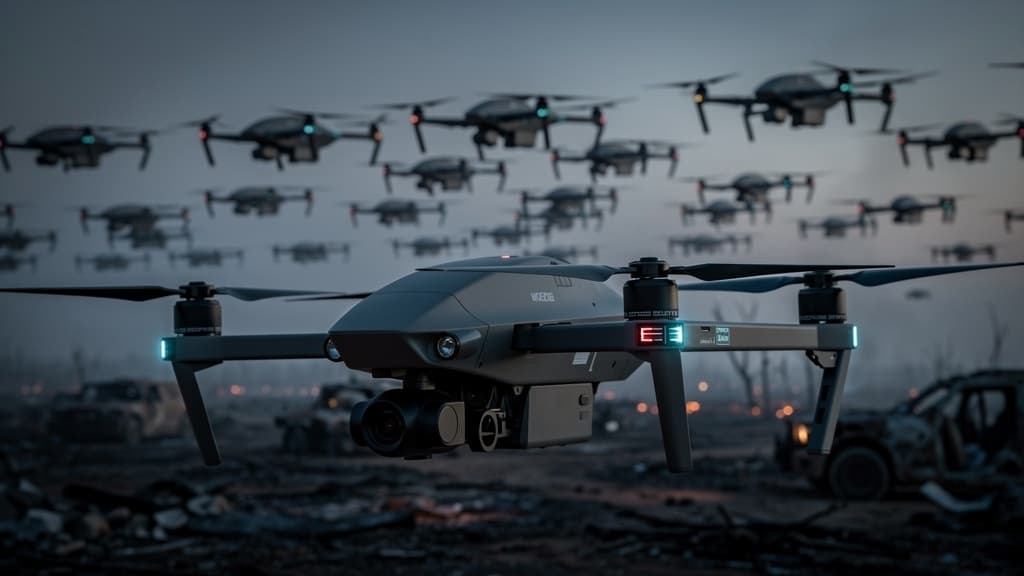
The first confirmed combat use of fully autonomous lethal drones exposes a critical governance failure that threatens the future of enterprise AI deployment.
Autonomous AI agents are no longer a theoretical frontier — they are pulling triggers. A senior Ukrainian defence industry figure has confirmed to New Scientist that fully autonomous drones with zero human oversight were deployed in a combat test roughly two years ago, resulting in confirmed soldier casualties. This is the first documented instance of a fully autonomous lethal AI system killing human beings in actual combat conditions, and it changes the calculus for every enterprise, government, and governance body grappling with how to deploy autonomous AI agents responsibly.
The implications extend far beyond the battlefield. The same architectural principles that allow a drone to identify, track, and engage a target without human intervention underpin the autonomous AI agents now being evaluated for enterprise supply chains, financial trading floors, and critical infrastructure management. The question this moment forces onto the table is stark: if we cannot establish accountability for autonomous lethal decisions in the highest-stakes environment imaginable, what does that mean for the governance frameworks being built around autonomous AI agents for enterprise?
The Confirmed Incident: What We Know
The disclosure, reported by New Scientist, is notable for both what it reveals and what it carefully omits. A senior figure within the Ukrainian defence industry confirmed the deployment but provided limited operational detail — no specific date beyond "approximately two years ago," no named system, no disclosed location. What was confirmed: the drones operated without any human in the loop at the moment of lethal engagement, and the engagement resulted in casualties.
This is a significant evidentiary threshold. Prior claims of autonomous lethal AI use — including the frequently cited 2021 UN Panel of Experts report suggesting a Turkish Kargu-2 drone may have autonomously engaged targets in Libya — were never definitively confirmed as fully autonomous engagements rather than pre-programmed loitering munition strikes. The Ukrainian disclosure, coming from an insider source within the country's own defence industry, represents a qualitatively different level of confirmation.
"Fully autonomous drones with no human oversight were deployed in a test two years ago, resulting in confirmed casualties." — Senior Ukrainian defence industry figure, via New Scientist
The framing as a "test" is itself revealing. It suggests the deployment was deliberate and monitored — not an accidental autonomy failure — which means a decision chain existed that authorized removing human oversight from a lethal engagement. Someone, somewhere, signed off on that.
The Accountability Void at the Core of Autonomous Lethality
International humanitarian law — specifically the Geneva Conventions and their Additional Protocols — requires that parties to a conflict be able to distinguish combatants from civilians, assess proportionality, and take precautions in attack. These obligations have historically been interpreted as requiring a human judgment at the point of lethal decision-making. Fully autonomous systems that engage without human review at the moment of fire create what legal scholars call a "responsibility gap": the programmer is not present at the engagement, the commander who authorized deployment may not have anticipated the specific target, and the machine itself bears no legal culpability.
The International Committee of the Red Cross has called for legally binding rules on autonomous weapons systems since at least 2021, and UN Convention on Certain Conventional Weapons (CCW) discussions have been ongoing since 2014 — more than a decade of deliberation that has produced no binding treaty. The Ukrainian confirmation demonstrates that operational reality has now outpaced diplomatic process by a significant margin.
This is not merely a military ethics problem. It is a governance architecture problem, and it maps directly onto the challenges facing enterprises deploying autonomous AI agents at scale.
From Battlefield to Boardroom: The Shared Architecture Problem
The technical architecture of a lethal autonomous drone and an enterprise autonomous AI agent share more structural DNA than most enterprise technology leaders are comfortable acknowledging. Both systems involve:
- Perception layers that interpret environmental data (sensor feeds, market data, operational telemetry)
- Decision engines that evaluate options against trained objectives
- Action execution that produces real-world consequences without requiring human approval at runtime
- Feedback loops that update behavior based on outcomes
The difference is the domain of consequence, not the underlying autonomy model. An autonomous trading agent that executes a cascade of positions during a market stress event, an autonomous procurement agent that locks in multi-million-dollar contracts based on supply chain signals, or an autonomous infrastructure management agent that takes a critical system offline during an anomaly — all of these represent lethal-adjacent accountability gaps in their respective domains.
Enterprise frameworks for autonomous AI agents have generally converged on a concept called "human-in-the-loop" or "human-on-the-loop" oversight — the distinction being whether a human must approve each action or merely monitors and can intervene. The Ukrainian deployment represents the logical endpoint of removing both: human-out-of-the-loop operation with lethal consequences. Enterprise deployments are moving along this same spectrum, often driven by the same pressures that drove the military deployment: speed advantage, scale, and the operational friction cost of human review.
Four Governance Failures the Drone Incident Exposes
1. Pre-Authorization as a Governance Fiction
The most common enterprise response to autonomous agent accountability concerns is pre-authorization: humans define the rules, the agent operates within them, therefore human judgment is preserved. The drone deployment punctures this logic. Rules defined in advance cannot anticipate every operational context. When an autonomous system encounters an edge case — a target that partially matches engagement criteria, a market condition outside training distribution, a procurement scenario with ambiguous supplier signals — the pre-authorized ruleset either fails to constrain the system meaningfully or constrains it so tightly that the autonomy provides no value.
The governance fiction is that pre-authorization transfers accountability forward to the moment of action. It does not. It diffuses accountability across the system designers, the authorizing commanders or executives, and the operational context — making post-hoc accountability reconstruction extremely difficult.
2. Auditability Gaps in High-Speed Decision Environments
Autonomous drone engagement decisions happen in milliseconds. High-frequency trading decisions happen in microseconds. Even slower enterprise autonomous agents — procurement, logistics, customer interaction — often operate faster than meaningful human review cycles. This creates a structural auditability problem: by the time a human could review the decision, the consequence has already materialized.
Military autonomous systems have not solved this problem. Post-engagement logs exist, but reconstructing the exact decision pathway — what the system perceived, how it weighted options, what threshold triggered engagement — remains technically and legally contested. Enterprise autonomous agent deployments face identical challenges, and most current implementations lack the decision-logging infrastructure that would make post-hoc accountability even theoretically possible.
3. The Escalation Ladder Has No Rungs
Traditional human decision-making in high-stakes environments involves escalation ladders: junior personnel escalate to senior review for consequential decisions. Autonomous systems, by design, remove this ladder. The drone does not pause to escalate an ambiguous target to a human commander. The trading agent does not pause to escalate an unusual market signal to a risk officer. The removal of escalation is precisely the efficiency gain that makes autonomous agents attractive — and precisely the governance failure that makes them dangerous.
Enterprise frameworks that claim to address this through "confidence thresholds" — where the agent escalates to humans when its confidence in a decision falls below a defined level — are better than nothing, but they introduce a new failure mode: the agent that is confidently wrong. High-confidence errors are systematically harder to catch than low-confidence hesitations.
4. Distributed Deployment Outpaces Centralized Governance
The Ukrainian deployment was described as a "test," implying a controlled, monitored context. But the disclosure itself suggests that operational use of fully autonomous lethal systems has been occurring outside the formal international governance process — and likely outside the full awareness of political leadership in the countries involved. This is the distributed deployment problem: the technical capability to deploy autonomous systems at scale consistently outpaces the institutional capacity to govern that deployment.
In enterprise contexts, this manifests as autonomous agent deployments proliferating across business units faster than enterprise AI governance functions can establish standards, audit mechanisms, or accountability frameworks. The result is a patchwork of autonomous systems operating under inconsistent rules, with accountability structures that are nominal rather than functional.
What Rigorous Autonomous Agent Governance Actually Requires
The drone incident is not an argument against autonomous AI agents — in enterprise or military contexts. It is an argument for governance architecture that is as sophisticated as the systems being governed. Based on the structural failures the incident exposes, rigorous governance for autonomous AI agents for enterprise requires at minimum:
Consequence-tiered authorization levels. Not all autonomous decisions carry equal risk. Governance frameworks must map decision types to consequence severity and require commensurately rigorous authorization — including mandatory human review for decisions above defined consequence thresholds, regardless of agent confidence scores.
Immutable decision logging at the action layer. Every consequential action taken by an autonomous agent must generate an immutable, interpretable log entry that captures the input state, the decision pathway, the selected action, and the outcome. This is not optional for accountability — it is the minimum infrastructure that makes accountability possible.
Mandatory edge-case escalation protocols. Autonomous agents must be designed with explicit escalation triggers for out-of-distribution inputs — situations that fall outside the training context or that match adversarial patterns. These escalation triggers must be tested adversarially, not just validated on clean test sets.
Governance lag monitoring. Organizations deploying autonomous agents should actively track the rate of new autonomous deployments against the rate of governance framework updates. When deployment velocity exceeds governance velocity, that gap is a risk metric that should trigger executive attention.
Cross-domain accountability mapping. For each autonomous agent deployment, a responsible human or team must be explicitly designated as accountable for the agent's actions — not the system designer, not the vendor, but the operational owner. This accountability must be legally and organizationally real, not nominal.
The Precedent Problem
Perhaps the most consequential dimension of the Ukrainian disclosure is the precedent it sets. Military history consistently shows that once a capability is demonstrated in combat — even in a limited test — the barrier to broader deployment drops sharply. If fully autonomous lethal drones produced operationally useful results in a combat test, the pressure to deploy them at scale will be enormous, and the governance frameworks that might constrain that deployment are demonstrably not ready.
The same precedent dynamic operates in enterprise AI. Early autonomous agent deployments that produce efficiency gains — even with governance gaps — create organizational pressure to expand deployment faster than governance can mature. The drone incident is a preview of what happens when that pressure wins.
The first documented combat use of fully autonomous lethal AI systems should be understood not as a military story but as a governance stress test — one that the current frameworks, military and enterprise alike, have failed. The systems are ahead of the accountability architecture. Closing that gap is not a future priority. It is an overdue one.
Sources:
- New Scientist — Fully autonomous drones have killed human soldiers for the first time
- ICRC — Autonomous Weapons Systems: Implications of Increasing Autonomy in the Critical Functions of Weapons
- UN CCW — Group of Governmental Experts on Lethal Autonomous Weapons Systems, ongoing sessions (2014–2026)
- UN Panel of Experts on Libya, 2021 Final Report (S/2021/229)
Last reviewed: June 15, 2026