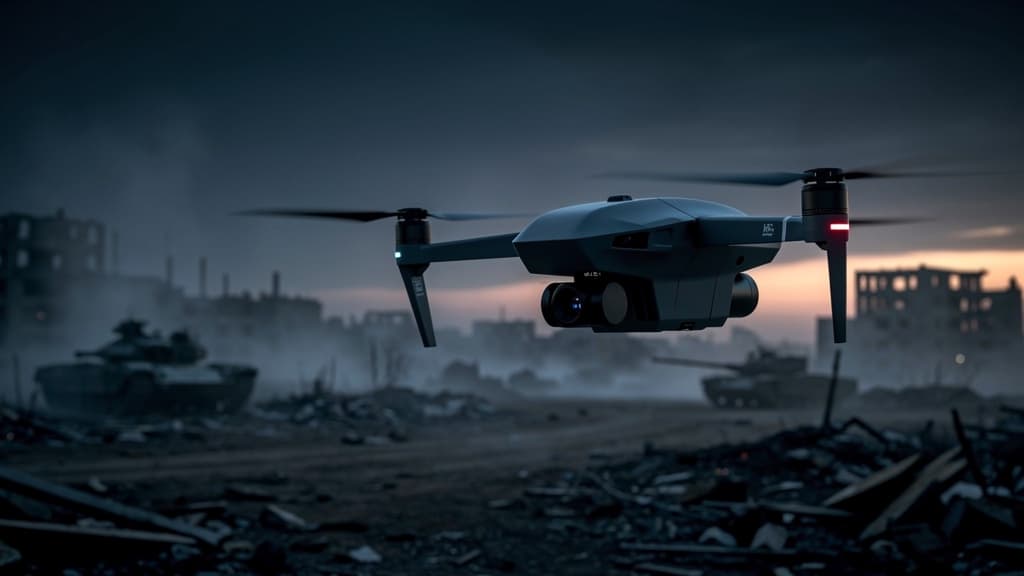
A confirmed lethal engagement by an autonomous drone has bypassed international policy, creating an urgent need for new AI agent data privacy compliance and governance frameworks.
A senior Ukrainian defense official has confirmed to New Scientist that fully autonomous drones conducted a lethal test operation two years ago that resulted in confirmed casualties — marking the first publicly documented instance of an autonomous weapons system making a kill decision without any human intervention. The revelation, reported by New Scientist, represents a critical inflection point in military AI deployment and throws the question of AI agent data privacy compliance — and broader AI governance — into urgent, unavoidable relief.
What Actually Happened
The Ukrainian defence industry has been one of the most aggressive adopters of AI-assisted battlefield technology since the full-scale Russian invasion in 2022. Drone warfare has defined the conflict in ways no prior war has experienced, with both sides deploying thousands of unmanned aerial vehicles weekly. But the latest disclosure moves the needle significantly further.
According to the senior Ukrainian defense official cited by New Scientist, the autonomous drones were not remotely piloted, nor were they operating under a human-in-the-loop targeting protocol. They identified, selected, and engaged human targets entirely through onboard AI decision-making systems. The test resulted in confirmed soldier casualties — the first time an autonomous weapons system has been documented as making a lethal engagement call without a human pulling the metaphorical trigger.
The timing matters: this incident occurred roughly two years ago, meaning autonomous lethal AI has already been operational in a live conflict zone while the international community was still debating whether such systems should ever be permitted at all.
Why This Is a Governance Emergency
The international debate over lethal autonomous weapons systems (LAWS) has been grinding through United Nations Convention on Certain Conventional Weapons (CCW) talks since 2014. Progress has been glacial. The International Committee of the Red Cross has repeatedly called for legally binding rules. The Campaign to Stop Killer Robots, a coalition of more than 270 NGOs, has demanded a preemptive ban. None of these efforts produced enforceable frameworks before autonomous drones drew first blood.
This is precisely the scenario AI governance advocates warned about: technology outrunning policy.
"The first use of fully autonomous lethal force in combat is not a future risk scenario — it is a documented historical event. Governance frameworks are already behind."
The implications extend well beyond the battlefield. The same AI agent architectures powering autonomous targeting — computer vision models, real-time sensor fusion, edge inference, autonomous decision trees — are being adapted for civilian applications in security, logistics, infrastructure monitoring, and law enforcement. The question of how AI agents handle high-stakes, irreversible decisions is not a military-only problem.
The Data and Compliance Dimension
Here is where AI agent data privacy compliance intersects directly with the autonomous weapons story in ways that are easy to overlook.
Autonomous targeting systems are, at their core, data-processing agents. They ingest sensor data, cross-reference it against trained classification models, and produce an output — in this case, a lethal engagement decision. Every step in that pipeline raises compliance and governance questions that civilian AI frameworks are only beginning to address:
Data provenance: What training data was used to teach the drone to identify a valid target? Was that data collected lawfully? Were individuals whose biometric or behavioral signatures were captured in training sets informed or protected under any data regime?
Algorithmic accountability: When an AI agent makes an irreversible decision — whether denying a loan, flagging a medical diagnosis, or engaging a target — who is legally and ethically accountable? The developer? The deploying organization? The operator who activated the system?
Audit trails: Emerging AI governance frameworks in the EU (the AI Act), the US (NIST AI Risk Management Framework), and elsewhere increasingly require that high-risk AI systems maintain interpretable, auditable decision logs. Autonomous weapons operating at machine speed in contested electromagnetic environments present extreme challenges to that requirement.
Consent and proportionality: Civilian AI compliance frameworks under GDPR and similar regimes require that data processing be proportionate to its purpose. The concept of proportionality — a cornerstone of international humanitarian law — maps directly onto AI ethics principles around minimizing harm. The connection is not coincidental; it reflects a shared underlying problem: how do you constrain a powerful automated system from causing disproportionate harm?
What the Ukrainian Case Reveals About Deployment Reality
The Ukrainian defence industry's move to fully autonomous engagement was, by most accounts, driven by operational necessity rather than ideological commitment to removing humans from the loop. Russian electronic warfare capabilities have become sophisticated enough to jam GPS signals and sever communication links between drone operators and their aircraft mid-flight. A drone that loses its data link in a contested environment either crashes, returns to base, or — if designed to do so — continues its mission autonomously.
This is the real-world pressure that governance frameworks have consistently underestimated: the gap between policy intent and operational reality. Militaries do not deploy autonomous systems because they want to circumvent accountability. They deploy them because adversary countermeasures make human-in-the-loop control physically impossible in certain scenarios.
That operational logic will not stay confined to Ukraine. Every military investing in drone warfare is studying the same electronic warfare problem. The autonomous engagement capability demonstrated by Ukrainian drones will diffuse across defense industries globally — and the commercial drone sector will follow.
What Comes Next — and What Must
Several developments are now unavoidable:
Renewed UN pressure: The CCW talks have a new and urgent data point. Delegations that have resisted binding commitments on LAWS will face significantly harder questions. Whether that translates into enforceable treaty language remains deeply uncertain — major military powers including the US, Russia, and China have all resisted preemptive bans.
AI Act applicability: The EU's AI Act, which entered full application in 2025, explicitly categorizes AI systems used in critical infrastructure and safety-critical decisions as high-risk. Legal scholars will now debate whether the Act's extraterritorial provisions create any obligations for European companies supplying components or software to autonomous weapons programs.
Corporate AI governance pressure: Defense contractors and dual-use AI companies face growing pressure from investors, employees, and regulators to articulate their positions on autonomous lethal systems. The Google Project Maven controversy in 2018 was a preview. The Ukrainian confirmation will intensify that scrutiny.
Civilian spillover standards: Perhaps most consequentially for the AI industry broadly, this incident will accelerate calls to establish hard standards for AI agent decision-making in any high-stakes, irreversible context — not just weapons. Autonomous medical triage systems, AI-driven infrastructure controls, and agentic financial systems all operate in a governance vacuum that the weapons debate is now forcing into the open.
The first confirmed lethal autonomous drone engagement is not just a military story. It is a stress test of every assumption the AI governance community has made about the pace of deployment versus the pace of regulation. Those assumptions have now been empirically falsified. The frameworks that follow must reckon with that reality — urgently, and with far more specificity than the aspirational principles documents produced so far.
Last reviewed: July 04, 2026