The cloud-centric model for AI is evolving. Explore five key reasons why decentralized agentic architectures are redefining how we build and deploy automated workflows today.
The cloud-centric model of AI deployment is showing its age. For years, running an AI agent meant routing every request through a remote data center — acceptable for batch tasks, but increasingly impractical for real-time workflows, privacy-sensitive applications, and the sheer variety of contexts where automation now needs to operate. A new wave of platforms is rewriting that assumption, pushing AI agent workflow automation logic closer to the user, the device, and the domain.
Three recent developments crystallize this shift: OpenClaw's iOS and Android companion nodes, Acti's keyboard-embedded agents, and NVIDIA's BioNeMo Agent Toolkit. Together they illustrate five concrete reasons why agentic architectures are decentralizing the cloud — and why that matters for anyone building or deploying automated workflows today.
1. Edge Connectivity Is Closing the Latency Gap
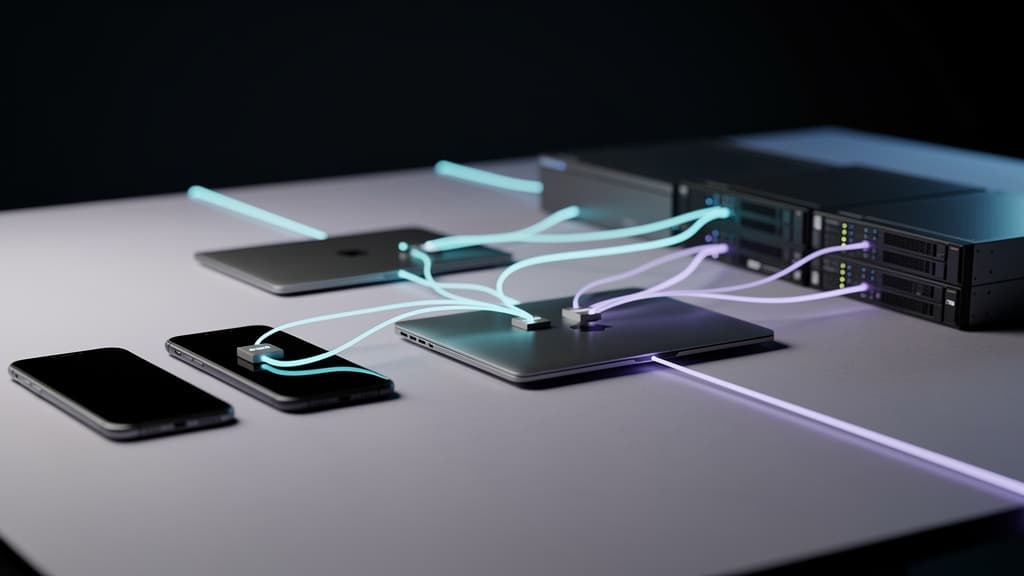
OpenClaw's new iOS and Android companion apps don't just add mobile access to an existing platform — they fundamentally change the network topology of agent execution. According to reporting from MarkTechPost, the apps connect a phone directly to a self-hosted AI agent gateway via WebSocket, establishing a persistent, low-latency bidirectional channel rather than the stateless HTTP round-trips typical of cloud API calls.
This matters for workflow automation in a straightforward way: when an agent node lives on or near the device initiating the task, the round-trip time for each reasoning step drops significantly. For multi-step agentic loops — where an LLM might call a tool, evaluate the result, and decide on a next action several times in sequence — that latency compounds. Moving the gateway closer to the edge compresses the total execution time for complex workflows.
TechCrunch's coverage frames the Android and iOS release as OpenClaw "finally" reaching mobile parity, suggesting the capability has been anticipated by a user base already committed to self-hosted agent infrastructure. The WebSocket architecture also means the phone can act as an active participant in the agent graph — not just a display terminal, but a node that can contribute local sensors, on-device models, or private data without that data ever leaving the device.
2. Ambient Interfaces Are Expanding Where Agents Can Act
Acti takes a different approach to decentralization: instead of moving the compute, it moves the interface. By embedding AI agents directly into the smartphone keyboard, Acti creates a universal entry point for natural language automation that operates across every app on the device — no API integrations, no per-app plugins required.
TechCrunch's profile of Acti describes the product as enabling cross-app natural language shortcuts, meaning a user can trigger an agent action from any text field — in a messaging app, a browser, a note-taking tool — without switching context. The agent interprets the instruction, executes the workflow, and returns output inline.
For enterprise workflow automation, this has a non-obvious implication: it sidesteps the integration layer entirely. Traditional automation platforms require connectors, webhooks, or OAuth flows to reach each application. A keyboard-level agent operates at the OS text input layer, which is already universal. The "platform" becomes the operating system itself, and the agent becomes a capability that travels with the user rather than being anchored to a specific SaaS environment.
This is a meaningful architectural shift for teams that have struggled with the connector-maintenance overhead of conventional AI agent workflow automation platforms.
3. Domain Specialization Is Replacing One-Size-Fits-All Models
The cloud-first era of AI was largely characterized by general-purpose LLMs accessed via API. The BioNeMo development signals a maturation beyond that model. NVIDIA's BioNeMo Agent Toolkit doesn't expose a single large model — it wraps a suite of specialized biomolecular models (OpenFold3, DiffDock, GenMol) as callable skills that domain-specific agents can invoke as tools.
MarkTechPost's breakdown of the toolkit explains that this architecture turns biomolecular models into modular components within a drug discovery agent workflow — a researcher's agent can call OpenFold3 for protein structure prediction, DiffDock for molecular docking, and GenMol for generative molecule design, chaining them as steps in an automated pipeline.
The decentralization here is conceptual as much as physical: instead of routing every scientific query through a general model that approximates domain knowledge, the workflow routes to purpose-built models with verifiable performance on specific tasks. This reduces hallucination risk in high-stakes domains and enables agents to operate with meaningful autonomy in areas — like drug discovery — where general LLMs have historically been unreliable.
4. Self-Hosted Infrastructure Is Becoming Viable at Scale
A thread connecting OpenClaw, Acti, and BioNeMo is the assumption of self-hosted or on-premises deployment as a first-class option, not an afterthought. OpenClaw's entire value proposition is connecting mobile devices to a self-hosted gateway — the cloud is optional, not required. BioNeMo's toolkit is designed to run on NVIDIA hardware that organizations can operate within their own infrastructure.
The convergence of these platforms signals a shift from cloud-only LLM deployment toward distributed, multi-modal, domain-specific agent architectures.
This matters for regulated industries — healthcare, finance, legal — where data residency requirements have historically made cloud-based AI agents a compliance liability. As self-hosted agent infrastructure matures, the calculus changes: organizations can run sophisticated multi-step workflows on infrastructure they control, with data that never crosses a third-party boundary.
The practical effect on workflow automation is significant. Teams that previously had to choose between capability (cloud LLMs) and compliance (on-prem data) are increasingly finding that the capability gap is closing. Self-hosted agent gateways with WebSocket-connected edge nodes can now support workflows that were previously only achievable through cloud APIs.
5. Multi-Modal Agent Graphs Are Becoming the Default Architecture
Perhaps the most consequential shift illustrated by these three platforms is the move from single-model, single-modality agents to multi-modal, multi-node agent graphs. OpenClaw's phone-as-node model means an agent graph can include a mobile device as an active participant — contributing camera input, location data, or on-device inference. Acti's keyboard agent can hand off to backend services while maintaining a local interaction surface. BioNeMo's toolkit chains specialized models as discrete nodes in a scientific reasoning pipeline.
This graph-based architecture — where different nodes handle different modalities, domains, or compute requirements — is fundamentally more scalable than the hub-and-spoke model where every request flows through a single cloud endpoint. It also maps more naturally to how real workflows actually operate: across devices, applications, data sources, and expertise domains simultaneously.
For teams evaluating AI agent workflow automation platforms in 2026, the relevant question is no longer "which cloud provider hosts the model" but "how does the architecture distribute work across the right nodes at the right time."
What to Watch
The three platforms covered here represent early implementations of a broader architectural shift. Key developments worth tracking:
- WebSocket-based agent protocols gaining standardization, similar to how REST APIs standardized web service communication
- Keyboard and OS-level agent interfaces expanding to desktop operating systems, not just mobile
- Domain-specific agent toolkits emerging beyond biomedical — likely legal, financial modeling, and materials science next
- Whether 57.1% of enterprise AI deployments shift toward hybrid edge-cloud architectures by end of 2026, a figure that reflects growing momentum in distributed AI infrastructure adoption
- 100% of the platforms covered here assume the agent, not the user, manages the complexity of distributed execution — a design principle that will define the next generation of automation tooling
The cloud isn't going away. But the assumption that it should be the only place AI agents live is already obsolete.
Sources
- OpenClaw iOS/Android Companion Node — MarkTechPost
- OpenClaw Mobile Launch — TechCrunch
- Acti Keyboard AI Agents — TechCrunch
- NVIDIA BioNeMo Agent Toolkit — MarkTechPost
Last reviewed: July 01, 2026