DeepSeek's permanent 75% discount on V4-Pro is forcing a massive shift in enterprise AI strategy. Learn how this pricing move is changing the economics of agentic workflows and reducing operational costs with AI.
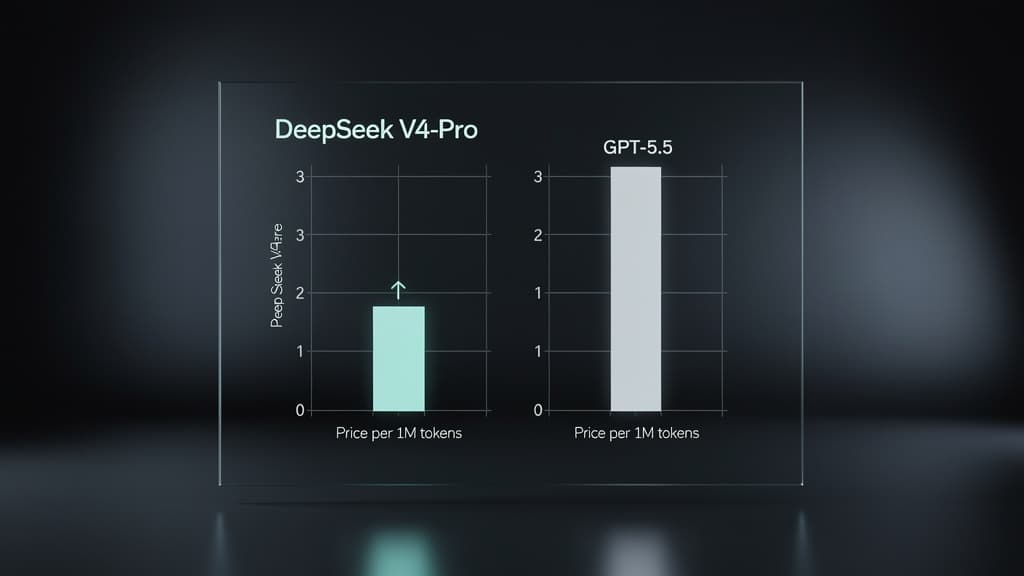
DeepSeek has permanently locked in a 75% discount on its flagship V4-Pro model, pricing input tokens at $0.435 per million and output tokens at a rate that is at least 11.5 times cheaper than GPT-5.5—and more than 34 times cheaper on output tokens. The move, reported by Bloomberg and The Decoder, is no longer a promotional tactic. It is a structural pricing signal—and for Western AI providers, it may be the most consequential competitive development of 2026.
The Numbers That Don't Lie
To understand why this matters, consider the arithmetic at enterprise scale. A production-grade agentic system processing 10 billion output tokens per month—not unusual for a mid-sized enterprise deploying AI across customer service, code generation, and internal search—faces a cost delta of roughly 34x between DeepSeek V4-Pro and GPT-5.5 on that single line item.
At 34x cheaper on output tokens, the annual inference bill for a token-hungry agentic deployment could shift from $8 million to under $250,000.
That is not a rounding error. That is a budget category that disappears. For CFOs and engineering leaders building business cases around reducing operational costs with AI, DeepSeek V4-Pro has fundamentally rewritten the denominator.
The permanence of the discount is the critical detail here. A promotional rate invites patience—wait it out, negotiate your enterprise contract, bank on the Chinese provider blinking. A permanent rate forces a strategic response.
Why Agentic Workloads Amplify the Pressure
The timing of this pricing move is not accidental. The AI industry's center of gravity has shifted from single-turn inference to agentic systems: multi-step pipelines where models plan, use tools, generate sub-tasks, and iterate across dozens or hundreds of LLM calls to complete a single user goal.
In that architecture, token costs compound. A single agentic workflow that would have consumed 50,000 tokens in a 2023 chat application may now consume 2 to 5 million tokens across its reasoning chain, tool calls, and synthesis steps. Western providers built their pricing models in an era when inference was a discrete, bounded transaction. DeepSeek is pricing for the agentic era—where volume is the baseline, not the exception.
For enterprise architects evaluating AI infrastructure ROI, the calculus is shifting. The question is no longer "which model produces the best output?" but "which model produces acceptable output at a cost that doesn't make the use case economically inviable?"
The Margin Problem for Western Providers
OpenAI, Anthropic, Google DeepMind, and their cloud distribution partners—Microsoft Azure, AWS Bedrock, Google Cloud Vertex—are caught between two structural pressures.
First, their compute costs are real and substantial. Training frontier models at the scale of GPT-5.5 or Gemini Ultra requires capital expenditure measured in the hundreds of millions to low billions of dollars. Inference at scale requires dedicated GPU clusters with ongoing energy and maintenance costs. These are not costs that can be wished away through pricing strategy.
Second, their enterprise customers are now holding a credible, permanent alternative that is priced at a fraction of the cost. The typical response—bundling, lock-in through ecosystem integrations, safety and compliance differentiation—buys time but does not resolve the underlying unit economics problem.
The margin pressure is particularly acute for providers whose business models depend on high per-token pricing to subsidize model R&D. If enterprise customers shift even 30% of their inference volume to DeepSeek V4-Pro for cost-appropriate workloads, the revenue impact on Western providers is material.
What Enterprises Are Actually Weighing
Sophisticated enterprise AI teams are unlikely to make a wholesale switch. The more probable outcome is workload segmentation: routing token-intensive, lower-stakes tasks—document summarization, data extraction, classification, internal knowledge retrieval—to the cheapest capable model, while reserving premium Western models for tasks where frontier reasoning, safety guarantees, or regulatory compliance justify the cost premium.
This tiered approach is already standard practice in cloud infrastructure (spot instances vs. reserved capacity, tiered storage classes). Applied to AI inference, it represents a maturation of how enterprises think about AI infrastructure ROI—moving from "which model is best" to "which model is best for this specific cost-performance point."
DeepSeek V4-Pro's permanent pricing makes it a viable anchor for the cost-optimized tier in a way that no Western provider currently matches.
The Geopolitical Overhang
No analysis of DeepSeek's pricing strategy is complete without acknowledging the risk layer that enterprise procurement teams cannot ignore. Data residency, export controls, potential regulatory restrictions on Chinese AI providers, and the opacity of DeepSeek's ownership and training data provenance all represent non-trivial enterprise risk factors.
For some regulated industries—financial services, healthcare, defense contractors—these risks may be disqualifying regardless of price. For others, the 34x cost differential will prompt serious legal and compliance review that would not have happened at a 2x differential.
The geopolitical overhang does not neutralize DeepSeek's pricing pressure. It redirects it. Western providers cannot simply point to sovereignty concerns and expect enterprise customers to absorb a 34x cost premium indefinitely. The pressure is on Western providers to close the price gap, not on enterprises to accept it.
What to Watch Next
Three developments will determine how this plays out over the next 12 to 18 months.
Competitive repricing: Whether OpenAI, Anthropic, or Google respond with structural price reductions—not promotional discounts—on their mid-tier models. Early signals suggest Azure and Google Cloud are absorbing some margin at the infrastructure layer to keep enterprise customers in their ecosystems, but this is not sustainable indefinitely.
Open-weight proliferation: DeepSeek's pricing may be less significant than its open-weight releases, which allow enterprises to self-host at marginal compute cost. If V4-Pro capabilities become available as an open-weight model, the pricing conversation becomes moot—the inference cost approaches zero at scale.
Regulatory action: The U.S. and EU are both examining AI supply chain dependencies. Any restrictions on DeepSeek access for enterprise use would reset the competitive dynamics, though they would not eliminate the underlying pressure to reduce inference costs.
For now, DeepSeek V4-Pro's permanent 75% discount has done something that months of industry debate could not: it has forced a concrete, numerical reckoning with what AI inference should actually cost—and who can afford to keep charging what they have been.
Last reviewed: May 24, 2026