With a $71 billion valuation and a 2027 IPO, DeepSeek is moving beyond scrappy optimization to build a vertically integrated AI stack. Explore how this changes the global AI arms race and the deepseek ai capabilities vs chatgpt narrative.
The moment DeepSeek announced it was raising another $1.5 billion — just weeks after closing a $7 billion round — the global AI industry had to reckon with something it had been quietly avoiding: the possibility that the most disruptive force in frontier AI development isn't based in San Francisco.
With a reported $71 billion valuation and a 2027 IPO on the horizon, DeepSeek is no longer a scrappy Chinese underdog punching above its weight. It is a capitalized, strategically aggressive competitor that is fundamentally reshaping how we should think about the deepseek ai capabilities vs chatgpt debate — and more broadly, who wins the global AI arms race.
Here are three ways that valuation changes everything.
1. Capital Efficiency Was Always the Story — Now It's the Strategy
DeepSeek built its early reputation on doing more with less. When DeepSeek-R1 emerged in early 2025 and matched or exceeded GPT-4-class performance on several reasoning benchmarks at a fraction of the training cost, the narrative was one of scrappy ingenuity. Western observers interpreted it as a clever workaround — a response to US export controls on high-end chips like the NVIDIA H100 that forced DeepSeek to optimize aggressively.
That framing was always incomplete. And the current funding trajectory makes it obsolete.
Raising $1.5 billion on top of a freshly closed $7 billion round isn't a company stretching its budget. It's a company that has proven its capital efficiency story to investors and is now using that credibility to scale aggressively. According to reporting from TechCrunch and The Decoder, the capital is earmarked specifically for proprietary data centers and custom silicon — the two infrastructure layers that define long-term frontier model competitiveness.
This is the strategic pivot that matters. DeepSeek isn't just optimizing within constraints anymore. It's building the infrastructure to remove those constraints entirely.
For OpenAI, Anthropic, and Google DeepMind, this is a different kind of threat than the one they faced in 2024. Then, the concern was that DeepSeek could replicate capabilities cheaply. Now, the concern is that DeepSeek is building a vertically integrated AI stack — models, chips, and compute — that could rival the US frontier labs on their own terms.
2. The IPO Timeline Forces a Valuation Reckoning Across the Entire Sector
A $71 billion IPO valuation in 2027 isn't just a number. It's a benchmark that will pressure every major AI lab to justify its own valuation story.
Consider the context: OpenAI raised at a $157 billion valuation in late 2024. Anthropic has been valued at over $60 billion. xAI reached a reported $50 billion valuation. These numbers have been sustained largely on the promise of future dominance — the assumption that US-based frontier labs have a durable moat through talent, compute access, and regulatory alignment with enterprise customers.
DeepSeek going public at $71 billion — if it achieves that target — introduces a direct public-market comparator that didn't exist before. Institutional investors will ask hard questions: If DeepSeek can deliver comparable or superior reasoning capabilities at lower cost, and is now building its own compute infrastructure, what exactly is the moat that justifies a 2x premium for OpenAI?
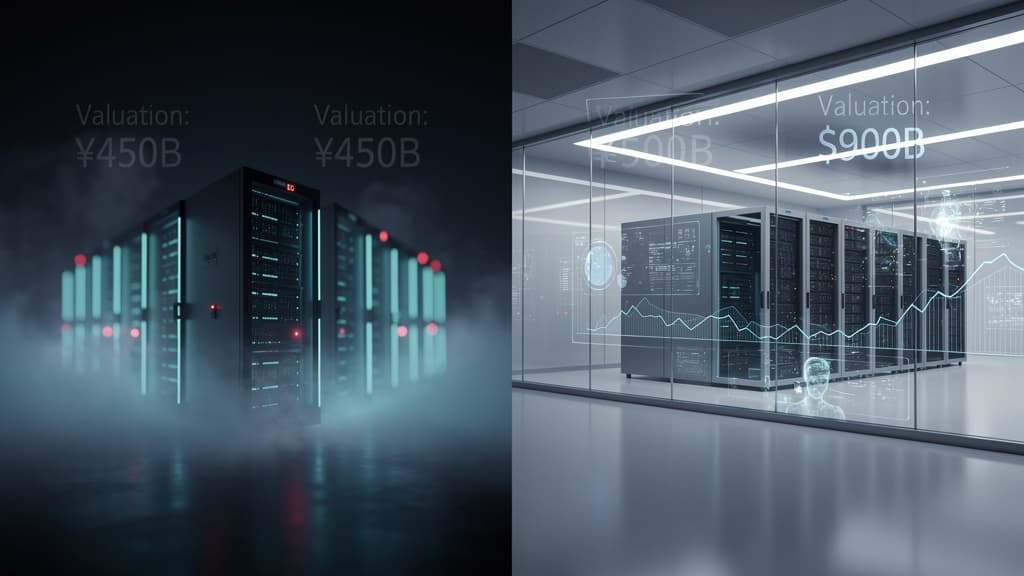
DeepSeek is raising approximately $1.5 billion after just closing its first $7 billion round, preparing for a 2027 IPO at a reported $71 billion valuation — a trajectory that signals aggressive capital deployment into proprietary data centers and chips.
This dynamic is particularly sharp because DeepSeek's IPO will likely occur on a Chinese exchange, creating a bifurcated public market for frontier AI. Western institutional investors who cannot or will not hold Chinese-listed equities will be watching from the sidelines — but the valuation signal will still reverberate globally. It will shape how sovereign wealth funds, Asian institutional investors, and emerging-market allocators think about AI exposure.
The 2027 IPO also creates a hard deadline. DeepSeek will need to show revenue scale, enterprise adoption, and model performance improvements that justify the valuation. That pressure accelerates their product roadmap in ways that pure private-company timelines do not. Expect a significant model release cadence between now and the IPO — each one designed as much for investor narrative as for technical leadership.
3. The Competitive Frame Is Wrong — and DeepSeek Is Exploiting That
The persistent framing of "DeepSeek vs. ChatGPT" is a category error that benefits DeepSeek more than it does OpenAI.
ChatGPT is a consumer product. OpenAI is a frontier lab with an API business, an enterprise sales motion, and a complex governance structure that has repeatedly created internal turbulence. Comparing DeepSeek's models to ChatGPT on benchmark performance is like comparing a Formula 1 engine to a road car — technically interesting, but strategically misleading.
What DeepSeek is actually competing for is the infrastructure layer of global AI — the foundational models that power applications across industries, the APIs that developers build on, and increasingly, the custom silicon that determines who controls the cost curve of inference at scale.
By raising at a $71 billion valuation and investing in proprietary chips, DeepSeek is positioning itself not as a chatbot competitor but as an alternative AI infrastructure provider for the roughly 140 countries that are not the United States and are not subject to US export control alignment. That is an enormous addressable market that US labs have largely ignored in their enterprise-focused go-to-market strategies.
This is where the geopolitical dimension becomes impossible to ignore. The US government has used chip export controls as the primary lever to slow Chinese AI development. DeepSeek's response — first through algorithmic efficiency, now through vertical integration into custom silicon — is a direct counter-strategy. If DeepSeek successfully develops competitive inference chips (even if not training chips at H100-class scale), the export control lever loses significant force.
The Uncomfortable Conclusion
None of this means DeepSeek wins. Frontier model development at the highest capability levels still requires compute scale that even $8.5 billion in fresh capital may not fully address. OpenAI's relationship with Microsoft's Azure infrastructure, Google's TPU advantage, and Anthropic's Constitutional AI differentiation in regulated industries are real competitive assets.
But the $71 billion valuation and the aggressive capital deployment that precedes it force a reframing of the competition. This is no longer a story about a Chinese lab that got lucky with clever optimization. It is a story about a well-capitalized, vertically integrating AI company that has chosen to compete on infrastructure, not just models — and has chosen a global market, not just a domestic one.
The AI arms race has always been framed as a US-China technology competition. DeepSeek's IPO trajectory suggests it may increasingly be framed as a public-market competition, where quarterly results, enterprise revenue, and infrastructure margins matter as much as benchmark leaderboards.
For US frontier labs still operating as private companies with complex cap tables and governance structures, that is a different kind of race — and one they may not be as prepared to run.
Last reviewed: July 15, 2026