Dell’s $60 billion AI server forecast signals a permanent shift in hardware economics. Explore how the nvidia ai infrastructure investment impact is cannibalizing traditional IT budgets and reshaping supply chains.
Dell Technologies just handed Wall Street a number that should stop every CIO in their tracks: $60 billion in AI server sales forecast for a single fiscal year, against a total revenue outlook of $167 billion. That means roughly 36 cents of every dollar Dell expects to generate this year will come from hardware built to run artificial intelligence workloads. The market responded accordingly — Dell shares surged 40% in a single session, one of the most dramatic single-day moves for a company of its size in recent memory.
This isn't a story about Dell. It's a story about what Dell's numbers reveal: a fundamental rewriting of hardware economics driven by Nvidia AI infrastructure investment impact, and a capital expenditure shift so large it's restructuring how the entire technology supply chain operates — from memory fabs in South Korea to data center procurement desks in Silicon Valley.
The $60 Billion Signal Is Bigger Than It Looks
To appreciate the magnitude of Dell's forecast revision, consider the baseline. Traditional enterprise server markets — the bread-and-butter PowerEdge boxes that ran corporate databases and virtualization workloads for two decades — were never $60 billion businesses for a single vendor in a single year. The entire global server market hovered around $100–120 billion annually as recently as 2022.
Dell's CFO cited AI server demand as the primary growth driver, not a supplementary one. That framing matters. It means the company isn't riding a wave that happens to include AI — it has repositioned its core business around fulfilling the infrastructure appetite of hyperscalers, sovereign AI programs, and enterprise customers building private inference clusters.
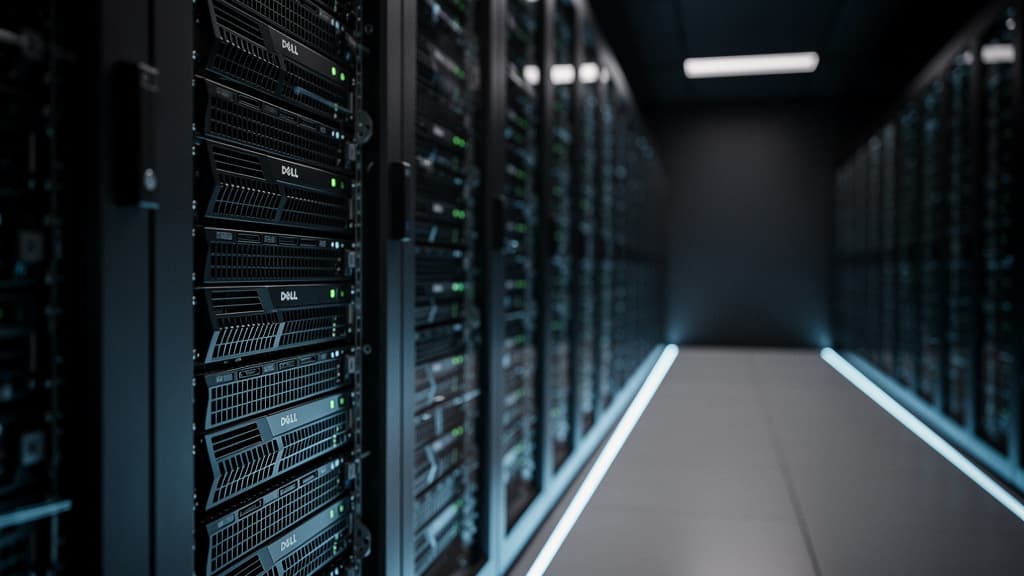
The mechanism is straightforward but the scale is staggering: every major LLM deployment — whether for training frontier models or running inference at scale — requires racks of GPU-dense servers, high-speed interconnects, and the thermal and power infrastructure to support them. Dell, as one of the largest system integrators of Nvidia hardware, sits at the exact intersection of that demand.
"AI server demand [is] the primary growth driver" — Dell Technologies CFO, as reported by Bloomberg
When a company that sells everything from laptops to storage arrays says that AI servers are the primary engine of a $167 billion revenue year, you're looking at a structural transformation, not a product cycle.
Three Ways This Rewrites Hardware Economics
1. Average Selling Prices Have Broken From Historical Norms
Traditional servers sold for tens of thousands of dollars. An AI server rack dense with Nvidia H100s or Blackwell GPUs sells for hundreds of thousands — sometimes over a million dollars for a fully configured system. This ASP explosion is the quiet engine behind Dell's forecast.
The implication for hardware economics is profound: revenue per unit shipped is no longer constrained by the cost of compute silicon alone. It's constrained by the buyer's ability to absorb capital expenditure. And right now, hyperscalers and well-funded AI labs have demonstrated a near-unlimited appetite. Microsoft, Google, Meta, and Amazon have collectively committed hundreds of billions in AI infrastructure capex over the next several years. Dell is one of the primary beneficiaries of that commitment on the systems integration side.
This creates a new pricing dynamic where the bottleneck isn't manufacturing capacity or demand — it's the supply of the GPU accelerators themselves. Which leads directly to the second shift.
2. The Memory Supply Chain Is Now a Strategic Battleground
No GPU server ships without high-bandwidth memory, and the race to supply that memory has become as strategically significant as the GPU competition itself. Samsung Electronics has begun shipping samples of what it describes as the industry's most advanced memory chips to customers, taking an early lead in supplying essential components for AI accelerators made by Nvidia and others, according to Bloomberg.
Samsung's move signals that the memory supply chain — long treated as a commodity layer beneath the glamorous GPU narrative — is now a locus of genuine competitive differentiation. HBM (High Bandwidth Memory) capacity is finite, technically demanding to manufacture, and increasingly the rate-limiting factor in how fast Nvidia can ship accelerators and how fast system integrators like Dell can fulfill orders.
The hardware economics implication: component scarcity is migrating up the value chain. It's no longer just about who can build the fastest chip. It's about who controls the memory stacks that make those chips useful at scale. Samsung's early lead in advanced memory samples is a direct attempt to capture supplier leverage in an ecosystem where Nvidia sets the architecture and everyone else competes to be indispensable to it.
For Dell, this means that its $60 billion forecast carries execution risk that has nothing to do with sales demand — it has everything to do with whether Nvidia can source enough HBM to keep GPU shipments flowing.
3. Traditional IT Capex Is Being Cannibalized — Not Supplemented
Here's the uncomfortable implication that most enterprise technology coverage glosses over: the capital flooding into AI infrastructure isn't purely additive. A significant portion of it is being redirected from traditional IT budgets — storage refreshes, network upgrades, conventional server procurement, software licensing.
CFOs at major enterprises are making explicit trade-offs: delay the SAN refresh, pause the on-premises virtualization expansion, and redirect that capital toward GPU clusters for internal AI initiatives. At the hyperscaler level, the same dynamic plays out at orders of magnitude larger scale. The result is a bifurcated server market where AI-optimized hardware commands premium pricing and rapid growth, while general-purpose compute faces pricing pressure and slower refresh cycles.
Dell's 40% stock surge reflects investor recognition that the company has successfully positioned itself on the right side of this bifurcation. But it also raises a harder question: what happens to the $107 billion of non-AI revenue in Dell's forecast? If AI server growth is pulling oxygen from traditional IT spending, even the winner of the AI hardware race faces a structural headwind in its legacy business.
The Nvidia Dependency Is Both the Moat and the Risk
Dell's AI server business is, at its core, an Nvidia distribution and integration business. The company's ability to forecast $60 billion in AI server revenue rests on Nvidia's continued dominance in AI accelerators — and on Nvidia's ability to manufacture and allocate enough product to meet demand.
This creates a peculiar competitive dynamic. Dell's moat isn't proprietary silicon or unique architecture. It's relationships, logistics, thermal engineering expertise, and the ability to deploy complex GPU clusters at enterprise scale. These are real advantages, but they're advantages that exist within an ecosystem Nvidia controls.
The Nvidia AI infrastructure investment impact, in this framing, flows through Dell as an amplifier — not an originator. Every dollar Nvidia captures in GPU pricing eventually flows downstream into system integrator revenue, memory supplier revenue, and power infrastructure revenue. Dell's $60 billion is a downstream measure of how much capital the AI build-out is mobilizing across the entire stack.
What This Means for Technology Decision-Makers
If you're a CIO, infrastructure architect, or technology investor, Dell's forecast revision carries several actionable implications.
First, lead times are real and getting longer. If AI server demand is driving 36% of Dell's total revenue, allocation queues are not a temporary inconvenience — they're a structural feature of the market for the foreseeable future. Plan procurement cycles accordingly.
Second, the total cost of ownership calculus has changed. AI servers are not just more expensive to buy — they consume dramatically more power, require more sophisticated cooling, and demand higher-density networking. The per-rack cost of AI infrastructure, when fully loaded with power and cooling, is 3–5x that of conventional compute. Organizations that haven't modeled this are in for a reckoning when their first GPU cluster goes live.
Third, the memory supply chain deserves board-level attention. Samsung's push to lead in advanced AI memory chip samples is a signal that HBM supply constraints will shape AI infrastructure availability for years. Enterprises and hyperscalers that can secure long-term memory supply agreements — or that back vendors with strong HBM relationships — will have a meaningful advantage in deployment velocity.
The Verdict
Dell's $60 billion AI server forecast isn't a company story. It's a macroeconomic signal: capital expenditure in technology has undergone a structural reorientation, and the hardware economics of the AI era bear almost no resemblance to the economics of the enterprise IT era that preceded it.
The 40% stock surge is the market pricing in what the numbers already show — that the companies positioned at the intersection of Nvidia's GPU ecosystem and enterprise deployment capability are capturing value at a scale the traditional server business never approached. Whether that value persists depends on supply chain execution, Nvidia's continued architectural dominance, and whether enterprise AI workloads deliver the ROI that justifies the capital being deployed.
But the direction of travel is unambiguous. The age of $500 commodity servers as the unit of enterprise compute is over. The age of $500,000 AI server racks has arrived — and Dell just told you exactly how big it's already become.
Sources:
- Dell Boosts Outlook to $60 Billion in AI Server Sales This Year — Bloomberg
- Dell Shares Soar 40% After Outlook Tops Estimates on AI Boom — Bloomberg
- Samsung Claims Lead in Shipping Top-End AI Memory Chip Samples — Bloomberg
Last reviewed: May 29, 2026