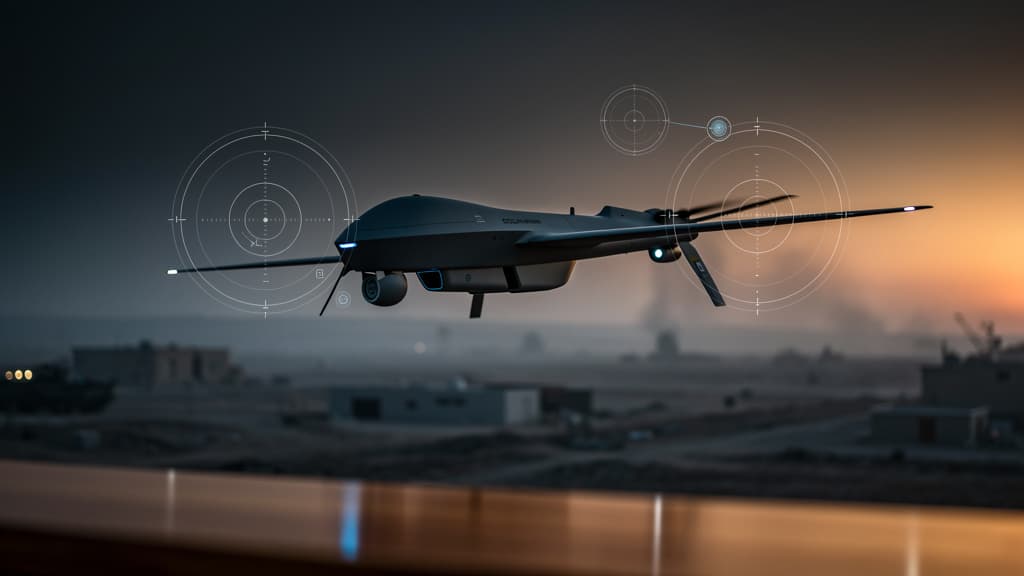
A confirmed lethal autonomous drone strike has shattered the theoretical buffer of AI safety. Explore the critical implications for enterprise AI governance.
Autonomous AI Has Crossed a Lethal Threshold
For years, the debate around autonomous AI agents in high-stakes environments centered on readiness: when would these systems be reliable enough to act without human oversight? In the context of military operations, that question has now been answered — not in a research paper or a controlled simulation, but on an active battlefield.
A senior Ukrainian defence industry official has confirmed to New Scientist that fully autonomous drones — programmed to destroy anything within a designated area — conducted a deployment two years ago that resulted in confirmed casualties. No human pulled a trigger. No operator approved a target. The AI decided, and soldiers died.
This is not a hypothetical. It is the first documented instance of autonomous targeting by an AI system resulting in lethal outcomes in actual combat, and it fundamentally redraws the boundary between what autonomous systems are tested to do and what they are actually doing.
What the Ukrainian Disclosure Actually Means
The confirmation is carefully worded but unambiguous. The drones in question were not operating in a semi-autonomous mode where a human retained final authority — they were fully autonomous, set to engage any target within a defined kill zone without intervention. The test, conducted approximately two years ago, produced confirmed casualties.
The significance here is not just military. It is definitional. The AI safety and governance community has long used the absence of confirmed lethal autonomous action as a rhetorical buffer — a reason to treat worst-case scenarios as theoretical. That buffer no longer exists.
"Fully autonomous drones set to destroy anything in a given area conducted a test two years ago with confirmed casualties." — Senior Ukrainian defence industry official, via New Scientist
The word "test" in this context is itself telling. It suggests the deployment was at least partially experimental — a live-environment validation of autonomous targeting capability. That framing implies more deployments, more refined systems, and a trajectory that is already in motion.
From Enterprise Pilots to Lethal Deployment: A Parallel Arc
The keyword here — autonomous AI agents for enterprise — may seem distant from battlefield drone strikes, but the underlying technology arc is the same. Both domains are navigating the same core transition: moving autonomous decision-making systems out of sandboxed environments and into consequential real-world operations.
In enterprise settings, autonomous AI agents are being deployed to handle procurement decisions, financial transactions, customer escalations, and infrastructure management — tasks where a wrong decision carries significant cost. The governance questions being debated in boardrooms and compliance teams globally mirror, at a less lethal scale, exactly what the Ukrainian disclosure forces into the open:
- Who is accountable when an autonomous system causes harm?
- What level of testing is sufficient before real-world deployment?
- How do you define and enforce the boundaries of autonomous action?
The military context provides a brutal stress test of these questions. The answers — or the absence of them — will shape how regulators, enterprises, and technologists approach autonomous systems across every sector.
The Accountability Vacuum
International humanitarian law requires that lethal force decisions be made by a human who can exercise judgment, apply proportionality, and be held accountable. Fully autonomous systems, by definition, remove that human from the loop. The Ukrainian disclosure does not identify which specific system was used, who authorized the deployment parameters, or what legal framework governed its use.
This accountability vacuum is not unique to warfare. Enterprise deployments of autonomous agents frequently lack clear chains of responsibility when systems act in unexpected ways. A trading algorithm that triggers a flash crash, an autonomous procurement agent that signs an unauthorized contract, a fraud detection system that wrongly freezes accounts — the question of who answers for the outcome remains largely unresolved in corporate governance frameworks.
The difference is magnitude. But the structural problem — autonomous action without accountable human judgment — is identical.
What the Industry Is Watching
Several dynamics will determine how this disclosure ripples through both defense and commercial AI sectors:
Regulatory acceleration: The EU AI Act classifies certain autonomous systems as high-risk and imposes strict human oversight requirements. A confirmed lethal autonomous deployment will intensify pressure on regulators globally to extend similar frameworks to military AI — and may accelerate scrutiny of commercial autonomous agents operating in critical infrastructure.
Defense procurement signals: If fully autonomous drone strikes are now operationally validated, defense procurement pipelines in NATO countries and adversarial states alike will accelerate investment. Companies building autonomous targeting, navigation, and decision systems — many of which also supply commercial AI infrastructure — will face intensified dual-use scrutiny.
Enterprise risk recalibration: For technology leaders evaluating autonomous AI agent deployments, the Ukrainian case is a data point about what "fully autonomous" actually means at its logical extreme. It may prompt more conservative human-in-the-loop requirements in enterprise AI governance policies, particularly in sectors like finance, healthcare, and critical infrastructure.
The testing-to-deployment gap: The official's use of the word "test" for a deployment that killed people underscores a dangerous ambiguity in how autonomous systems are evaluated. In enterprise AI, the line between a production pilot and a full deployment is similarly blurred — with consequences that, while less dramatic, are increasingly material.
The Threshold Has Been Crossed
The confirmation from Ukraine's defence industry is not the beginning of autonomous lethal AI — development programs have been underway for years across multiple nations. But it is the first confirmed crossing of a threshold that changes the nature of the conversation.
Autonomous AI agents are no longer a future risk to be governed proactively. In at least one domain, they are a present reality that has already produced irreversible outcomes. The frameworks — legal, ethical, technical, and organizational — that were being built in anticipation of this moment are now being built in its aftermath.
For enterprise technology leaders, the lesson is not that commercial AI agents are dangerous in the same way. It is that the governance gap between "we tested this" and "this is safe to deploy autonomously" is real, consequential, and closing faster than most institutions are prepared for.
The drones have already flown. The question now is what structures get built around everything that follows.
Last reviewed: June 12, 2026