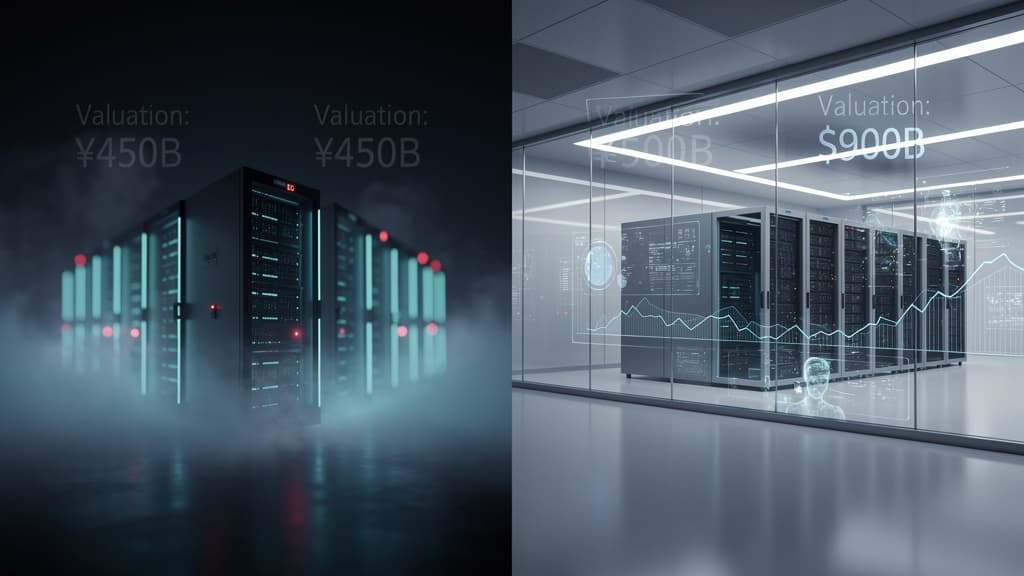
Enterprise AI is hitting an economic wall. Two new research breakthroughs—the Byte Latent Transformer and TwELL—are finally tackling the memory bandwidth bottleneck to make large-scale LLM deployment sustainable.
The Inference Bottleneck Is Killing Enterprise AI Economics
Large language model (LLM) deployment at scale has hit a wall — not a capability wall, but an economic one. While the AI research community celebrates ever-larger parameter counts and benchmark records, the engineers actually running these systems in production are grappling with a far more mundane crisis: inference costs are unsustainable, and memory bandwidth is the chokepoint.
Every token generated by a deployed LLM requires shuttling billions of parameters from GPU memory to compute cores — repeatedly, for every single request. At scale, this isn't a software problem you can patch away. It's physics. And it's why two research efforts published in May 2026 — Meta FAIR and Stanford's Byte Latent Transformer and Sakana AI and Nvidia's TwELL — represent something more significant than incremental progress. They represent convergent solutions to the same fundamental constraint, arriving from entirely different architectural directions.
This deep dive unpacks both breakthroughs: what they actually do at the systems level, why the numbers matter, and what they collectively signal for the future of enterprise AI infrastructure.
Why Memory Bandwidth Is the Real Bottleneck
To understand why these breakthroughs matter, you need to understand the inference compute profile of a modern LLM.
During inference, transformer models are memory-bandwidth-bound, not compute-bound. The arithmetic intensity — the ratio of floating-point operations to memory bytes accessed — is low enough that GPUs spend most of their time waiting for data to arrive from HBM (high-bandwidth memory), not actually computing. This is the opposite of training, where large batch sizes keep compute units saturated.
The practical consequence: a GPU that can theoretically deliver hundreds of teraflops of compute may be operating at a fraction of that utilization during LLM inference, bottlenecked entirely by how fast weights can be streamed from memory.
This dynamic has enormous cost implications. Inference serving at enterprise scale — millions of requests per day — requires either massive GPU clusters or aggressive optimization. Most organizations end up with both, and still find margins squeezed. The two systems examined here attack this problem from opposite ends of the architecture stack.
Breakthrough 1: The Byte Latent Transformer's Tokenization-Free Architecture
What Tokenization Actually Costs
Every mainstream LLM today processes text through a tokenizer — a lookup table that converts raw bytes or character sequences into discrete integer IDs. Tokenization was a pragmatic engineering choice: it compresses input sequences, making attention computation tractable. But it introduces a cascade of hidden costs.
Tokenizers are trained on specific corpora, which means they're uneven. Common English words get single tokens; rare words, code, or multilingual text gets fragmented into multiple tokens. This fragmentation inflates sequence lengths unpredictably, which inflates memory consumption, attention computation, and — critically — memory bandwidth requirements during inference.
Meta FAIR and Stanford's Byte Latent Transformer eliminates tokenization entirely. According to research published on MarkTechPost, the architecture operates directly on raw bytes, using a hierarchical encoding scheme to build latent representations without ever passing through a fixed vocabulary lookup.
The 50%+ Memory Bandwidth Reduction
The headline result is striking:
Meta FAIR and Stanford's Byte Latent Transformer reduces inference memory bandwidth by over 50% compared to tokenization-based transformer architectures — without sacrificing model quality.
How does operating on bytes — which naively would produce longer sequences — result in lower memory bandwidth? The answer lies in the architecture's hierarchical design. The Byte Latent Transformer uses local byte-level encoders that aggregate byte representations into patches before passing them to the global transformer backbone. The global model — the large, parameter-heavy component — sees a much shorter, more information-dense sequence than a tokenizer-based model would produce.
The practical effect: the expensive memory-bandwidth operations (loading the large transformer's weights for each forward pass) happen over shorter sequences. Fewer weight loads per token of output. Lower bandwidth pressure. Lower cost per inference.
Why This Matters Beyond the Benchmark
The tokenization-free approach has implications beyond bandwidth numbers. Fixed tokenizers create well-documented failure modes: they handle code poorly compared to natural language, they fragment low-resource languages, and they introduce subtle biases based on training corpus composition. A byte-native architecture sidesteps these structural limitations entirely.
For enterprise deployment specifically, this means a single model can handle multilingual workloads, code generation, and structured data without the performance degradation that tokenizer mismatch typically introduces. The bandwidth savings are the headline, but the architectural generality may be the longer-term value.
Breakthrough 2: TwELL's Sparse CUDA Kernels
A Different Attack on the Same Problem
Where the Byte Latent Transformer restructures what data flows through the model, TwELL — developed jointly by Sakana AI and Nvidia — restructures how computations execute on GPU hardware. These are complementary strategies, and understanding both reveals the full scope of what's now possible.
TwELL's approach centers on sparse CUDA kernels — highly optimized GPU code that exploits sparsity in LLM weight matrices to skip computations that would otherwise produce near-zero outputs. Sparsity in neural networks isn't new; pruning research has existed for decades. What TwELL contributes is the systems-level machinery to make sparsity actually fast on real hardware.
The Numbers: 20.5% Inference Speedup, 21.9% Training Speedup
According to research covered by MarkTechPost, TwELL delivers:
20.5% inference speedup and 21.9% training speedup in large language models through sparse CUDA kernel optimization.
These figures deserve careful interpretation. A 20.5% inference speedup sounds modest compared to the Byte Latent Transformer's 50%+ bandwidth reduction — but these metrics measure different things. The bandwidth reduction measures memory pressure; the speedup measures wall-clock latency on real hardware. A 20.5% reduction in inference latency translates directly to 20.5% more throughput from the same GPU cluster, or equivalently, 20.5% lower hardware cost for the same throughput target.
At enterprise scale — where GPU costs can run to tens of millions of dollars annually — a reliable 20.5% efficiency gain is not incremental. It's a budget line item.
Why Sparse Kernels Were Hard Before TwELL
The reason sparse computation hasn't been universally adopted despite decades of research is a hardware-software gap. Modern GPUs are optimized for dense matrix operations. Sparse matrix computations, even when they involve fewer total operations, often run slower on GPU hardware because irregular memory access patterns destroy cache efficiency and prevent the tensor cores from operating at full utilization.
TwELL's CUDA kernels are specifically engineered to navigate this gap — structuring sparse computations in ways that maintain memory locality and keep GPU utilization high. Nvidia's involvement is significant here: co-developing kernels with the hardware manufacturer means these optimizations are tuned to the actual memory hierarchy and execution model of current-generation GPUs, not a theoretical abstraction.
The 21.9% training speedup is an additional signal worth noting. Training optimization wasn't the primary stated goal, yet the sparse kernel approach delivers meaningful gains there too — suggesting the architectural insight generalizes across the compute graph, not just the inference path.
Convergent Progress: What These Two Systems Tell Us Together
Different Layers, Same Constraint
The Byte Latent Transformer and TwELL attack the inference cost problem at different levels of the stack:
| Dimension | Byte Latent Transformer | TwELL | |---|---|---|| | Primary target | Memory bandwidth | Compute efficiency | | Mechanism | Tokenization elimination + hierarchical encoding | Sparse CUDA kernels | | Key result | 50%+ bandwidth reduction | 20.5% inference speedup | | Architecture change | Fundamental (no tokenizer) | Additive (kernel-level) | | Hardware dependency | Architecture-agnostic | Nvidia GPU-optimized | | Deployment complexity | High (requires retraining) | Lower (can apply to existing models) |
This divergence in deployment complexity is practically important. TwELL's kernel-level approach can, in principle, be applied to models that already exist — existing LLMs that enterprises have already fine-tuned and validated. The Byte Latent Transformer requires training a model from scratch on the new architecture, which is a significant barrier for organizations without research-scale compute budgets.
The implication: TwELL may see faster near-term enterprise adoption, while the Byte Latent Transformer represents the longer-arc architectural shift.
The Compounding Question
A natural question: can these approaches be combined? A byte-latent model with sparse CUDA kernels for its global transformer backbone would theoretically capture both efficiency gains. The bandwidth reduction and the compute speedup operate on different parts of the inference profile, suggesting they're additive rather than competing.
No published work has yet demonstrated this combination, but it represents an obvious research direction — and one that hardware vendors and frontier labs are almost certainly already exploring.
What This Means for Enterprise LLM Deployment Strategy
The Deployment Economics Shift
For technology decision-makers evaluating large language model deployment infrastructure, these breakthroughs reframe the cost calculus in concrete ways.
The memory bandwidth bottleneck has been a primary driver of the "bigger GPU cluster" reflex — when inference is slow or expensive, the instinctive response is to add more hardware. Both of these approaches suggest that architectural and kernel-level optimization can deliver efficiency gains that would otherwise require significant hardware investment.
A 50% reduction in memory bandwidth pressure means that a given GPU can serve roughly twice the inference throughput for bandwidth-bound workloads — or that the same throughput can be achieved with half the memory capacity. At current GPU pricing, that's a material cost reduction.
What to Watch Next
Several developments will determine how quickly these breakthroughs translate into production deployment:
Open-weight availability: Whether Meta FAIR releases Byte Latent Transformer weights for enterprise use will determine how quickly the architecture sees real-world validation outside research settings.
TwELL kernel integration: Whether Nvidia integrates TwELL's sparse kernel approach into standard libraries like cuDNN or TensorRT will determine whether the speedup is accessible to organizations without CUDA engineering expertise.
Benchmark generalization: Both results need validation across diverse workloads — long-context reasoning, multimodal inputs, and agentic task patterns that differ significantly from standard benchmark distributions.
Competitive response: Google DeepMind, Anthropic, and other frontier labs have their own inference optimization research programs. Convergent pressure on the same bottleneck suggests the field is approaching an inflection point where inference efficiency becomes a primary competitive differentiator — not just a cost concern.
The Bigger Picture
The simultaneous emergence of two distinct, technically credible solutions to the memory bandwidth bottleneck in May 2026 is not coincidence — it's a signal that the field has identified inference cost as the critical constraint on AI's economic viability at scale.
For years, the dominant narrative in AI research was capability: bigger models, better benchmarks, emergent behaviors at scale. That narrative isn't wrong, but it's incomplete. A model that costs $0.10 per query to serve at scale is categorically different from a model that costs $0.05 — not in capability, but in the range of applications that become economically rational to build.
The Byte Latent Transformer's 50%+ bandwidth reduction and TwELL's 20.5% inference speedup are, in that framing, not just engineering achievements. They're expansions of the economic frontier of what AI can do in the real world.
Sources:
- Meta and Stanford Researchers Propose Fast Byte Latent Transformer That Reduces Inference Memory Bandwidth by Over 50% Without Tokenization — MarkTechPost, May 11, 2026
- Sakana AI and Nvidia Introduce TwELL with CUDA Kernels for 20.5% Inference and 21.9% Training Speedup in LLMs — MarkTechPost, May 11, 2026
Last reviewed: May 12, 2026