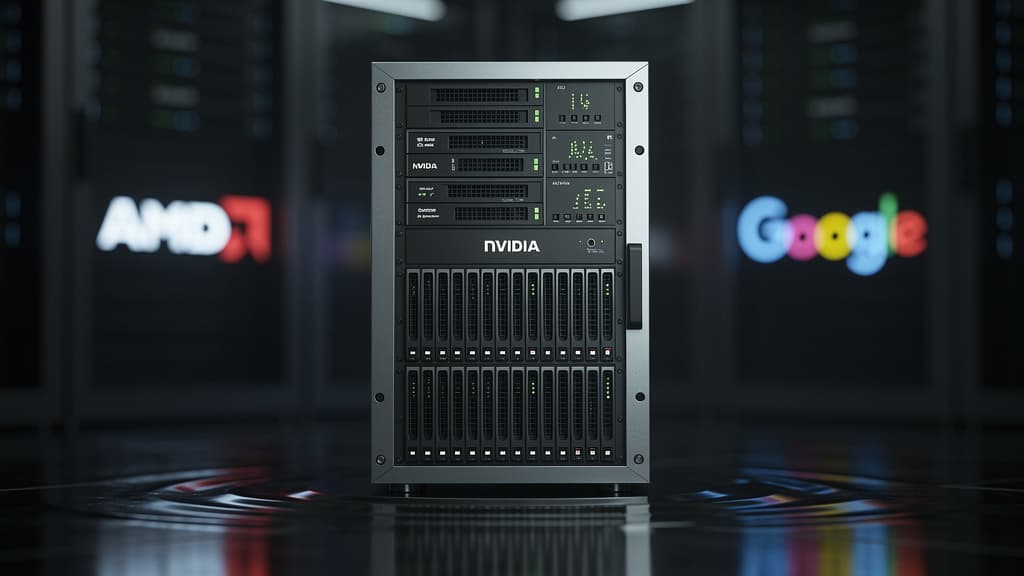
The year-long delay of Nvidia's Kyber NVL144 server rack is forcing enterprises to rethink their hardware roadmaps, creating a rare window of opportunity for competitors like AMD and Google to gain ground.
Nvidia's Kyber NVL144 delay isn't just a supply chain headache — it's a strategic inflection point that could reshape the AI infrastructure landscape for years to come. When a dominant platform misses a critical window, competitors don't politely wait. They accelerate.
According to reporting from The Decoder, Nvidia's next-generation AI server rack, the Kyber NVL144, has been pushed back more than a year to 2028 due to circuit board manufacturing issues. More significantly, the more powerful Rubin Ultra variant has been outright canceled. Asian suppliers reacted immediately, dropping double-digit percentages in market value — a visceral signal that the market understands the downstream consequences. The question now is who moves fastest to fill the gap.
The Strategic Weight of a Year-Long Slip
In consumer electronics, a one-year delay is annoying. In enterprise AI infrastructure, it can be existential for market position. Hyperscalers and large enterprises are committing multi-billion-dollar capex cycles right now. They're signing long-term supply agreements, building data center architectures, and training teams around specific hardware stacks. A year-plus delay forces those decision-makers to at least evaluate alternatives — and evaluation is opportunity.
Nvidia's nvidia ai infrastructure investment impact has been enormous and largely uncontested since the transformer era began. The H100 cycle created near-religious loyalty among AI teams. But loyalty in enterprise procurement is conditional on delivery. When delivery slips, procurement officers start returning calls from AMD and Google.
Asian suppliers dropped double-digit percentages in market value following the Kyber NVL144 delay announcement — a market signal that confidence in Nvidia's near-term supply chain is shaken.
The cancellation of Rubin Ultra is arguably the more damaging piece of news. Delays can be explained away as manufacturing complexity. Cancellations signal something deeper: either the architecture had fundamental problems, or Nvidia's internal roadmap prioritization shifted in ways that leave a specific customer segment — those who needed the highest-end rack-scale compute — without a clear path forward.
AMD's Window Is Real, Not Theoretical
For years, the AMD AI narrative has been "almost competitive." The MI300X showed genuine promise in inference workloads and attracted meaningful cloud deployments. But Nvidia's relentless cadence — Hopper to Blackwell to Rubin — kept AMD perpetually playing catch-up on the training side.
The Kyber delay changes the math. If Nvidia's highest-tier rack solution isn't available until 2028, AMD has a runway to close the gap in the workloads that matter most to the buyers who were waiting for Kyber. Those buyers aren't going to pause their AI buildouts for 12-plus months. They're going to deploy what's available, build operational expertise around it, and — critically — develop software stacks optimized for it.
Software lock-in is the real moat in AI infrastructure, not hardware specs. Every month an enterprise runs production workloads on AMD silicon, their switching costs back to Nvidia increase. AMD's ROCm ecosystem has been maturing steadily, and a forced adoption window could accelerate that maturation faster than any marketing campaign.
Google's TPU Moment
Google occupies a uniquely advantaged position here. Unlike AMD, Google isn't trying to sell hardware to enterprises in the traditional sense — it's selling compute access through Google Cloud, with TPUs as the differentiating infrastructure layer. The Kyber delay gives Google a compelling narrative to every enterprise that was planning to build Kyber-based private or hybrid infrastructure: why wait for 2028 when you can access cutting-edge AI compute today through GCP?
Google's Trillium TPU (v6) has demonstrated competitive performance on large-scale training runs, and Google has the software ecosystem — JAX, XLA, Vertex AI — to make the transition less painful than it once was. More importantly, Google can offer capacity now, which is the single most valuable thing in a supply-constrained market.
There's also a longer game here. If Google can attract even a subset of the enterprises that were planning Kyber deployments, it gains reference customers, workload data, and ecosystem momentum that compounds over time. The hyperscaler that wins AI infrastructure in 2026-2027 will have enormous structural advantages going into the next hardware generation.
The Counterargument Nvidia Would Make
Fair analysis requires engaging with the strongest version of Nvidia's position. The company would argue — correctly — that its software ecosystem (CUDA, cuDNN, NIM microservices, the entire MLOps toolchain) represents a switching cost so high that hardware delays don't meaningfully shift enterprise loyalty. They'd point to the fact that Blackwell-based systems are still shipping and remain highly capable. They'd note that their roadmap beyond Kyber continues, and that a delay to 2028 doesn't mean absence from the market.
These arguments have real merit. CUDA's network effects are genuinely extraordinary. The number of AI engineers who have never written production code for anything other than CUDA is staggering, and retraining that talent pool is expensive and slow.
But this argument assumes the competitive alternatives remain static, which they won't. AMD is investing heavily in ROCm compatibility with CUDA workflows. Google is abstracting hardware entirely through managed services. The switching cost argument is strongest when competitors offer a poor experience. That gap is narrowing.
What the Supplier Selloff Actually Tells Us
The double-digit drops among Asian suppliers deserve more analytical attention than they've received. These aren't speculative retail investors reacting to headlines — they're market participants with direct visibility into order flows, component commitments, and manufacturing schedules. When they sell, they're pricing in real information about revenue timing and volume.
The selloff also reveals how concentrated the Nvidia supply chain had become around the Kyber program specifically. That concentration is itself a risk factor that enterprise buyers are now being forced to internalize. Supply chain diversification — both for Nvidia's customers and for the suppliers themselves — becomes a rational response, and that diversification benefits AMD and Google by definition.
The Bigger Picture: AI Infrastructure Is No Longer a One-Horse Race
The Kyber NVL144 delay and Rubin Ultra cancellation don't end Nvidia's dominance. Let's be clear about that. Nvidia's installed base, software ecosystem, and talent network are not dismantled by a manufacturing setback. The company will ship Kyber eventually, and it will likely remain the preferred platform for many workloads.
But the AI infrastructure market in 2026 is not the same market it was in 2022. Buyers are more sophisticated. Software portability has improved. Cloud alternatives are more mature. The conditions that made Nvidia's position nearly unassailable — first-mover advantage in CUDA, supply chain control, and a performance gap so wide competitors couldn't close it — are all eroding at the margins.
A year-long gap in the highest-tier product category, combined with the outright cancellation of the most powerful planned variant, is exactly the kind of opening that allows erosion to accelerate into disruption. AMD and Google have the resources, the roadmaps, and now the market timing to make this moment count.
The question isn't whether Nvidia remains important. It's whether, by 2028, it remains irreplaceable.
Sources:
Last reviewed: July 07, 2026