Nvidia's RTX Spark chip challenges the cloud-first mandate for enterprise AI. With 1,000 TOPS and 128GB of memory, is local agent deployment finally here?
Are Nvidia's RTX Spark Chips the End of Cloud-Only AI Agents?
Autonomous AI agents for enterprise have, until now, carried an implicit asterisk: requires data center. The compute demands of running persistent, reasoning-capable agents — models large enough to handle multi-step planning, tool use, and context retention — have made cloud infrastructure not just convenient but effectively mandatory for most organizations. Nvidia's RTX Spark chip is a direct challenge to that assumption.
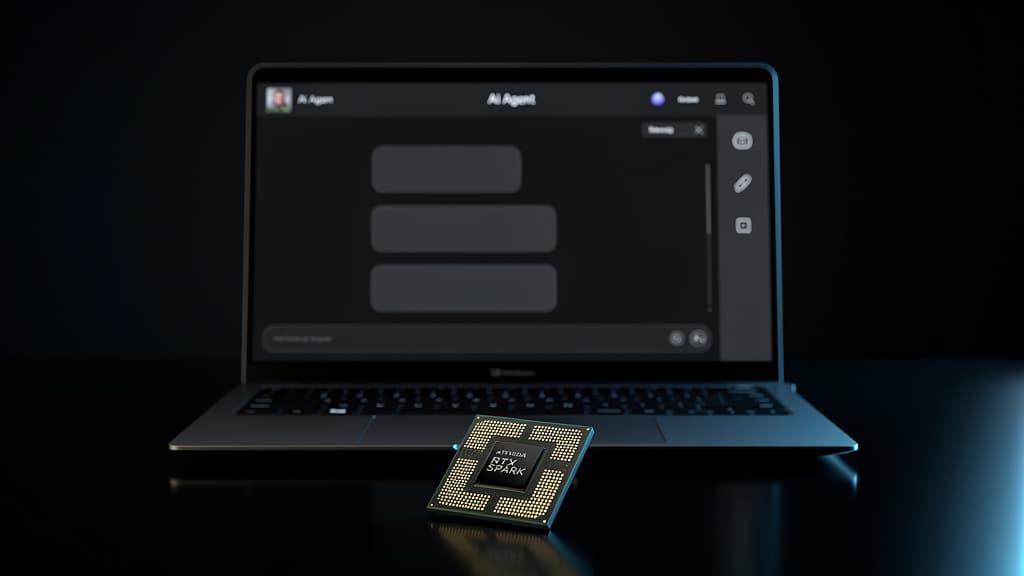
Announced in June 2026, the RTX Spark combines a Blackwell GPU with an Arm-based Grace CPU and up to 128 GB shared memory, targeting 1,000 TOPS in FP4 performance. That single specification — one trillion operations per second on a chip designed to fit inside a compact Windows PC — represents a meaningful architectural inflection point for enterprise AI deployment. Major OEMs including ASUS, Dell, HP, Lenovo, Microsoft Surface, and MSI are scheduled to ship RTX Spark-powered devices starting fall 2026, thrusting Nvidia into direct competition with Apple Silicon and Qualcomm for the AI-capable PC market.
The question worth examining isn't whether RTX Spark is impressive hardware. It clearly is. The more consequential question is whether 1,000 TOPS on local Windows hardware is enough to meaningfully displace the cloud for enterprise agent workloads — and what that displacement actually looks like in practice.
The Architecture Behind the Number
Understanding why RTX Spark matters for enterprise AI agents requires unpacking what makes agent workloads computationally distinct from standard inference.
A typical AI agent doesn't just run a single forward pass. It maintains context across multiple turns, calls external tools, reasons over retrieved documents, and often runs smaller specialized models in parallel — a routing model, a retrieval model, a code execution sandbox. This creates a workload profile that is simultaneously memory-bandwidth-intensive and latency-sensitive. Cloud GPUs handle this through brute-force parallelism and high-bandwidth memory (HBM), but they introduce round-trip latency, data egress costs, and — critically for enterprise buyers — data sovereignty concerns.
The RTX Spark's design addresses several of these constraints simultaneously:
Unified 128 GB shared memory eliminates the CPU-GPU data transfer bottleneck that plagues discrete GPU architectures. In agent pipelines where the orchestration logic runs on CPU and the inference runs on GPU, this shared pool means the system can load a 70B-parameter model quantized to FP4 and keep it resident without constant memory shuffling. For context, a 70B model in FP4 requires roughly 35 GB — comfortably within the 128 GB envelope, with headroom for context windows and tool-call buffers.
1,000 TOPS in FP4 is the raw throughput figure, but the practical implication is tokens-per-second at a given model size. Early projections from Nvidia's positioning suggest the chip can run 13B to 70B parameter models at speeds that feel interactive — the threshold most enterprise agent frameworks define as usable for synchronous workflows.
The Grace CPU component is architecturally significant beyond just CPU performance. Grace is an Arm-based design optimized for memory bandwidth and power efficiency, which matters enormously in an always-on agent scenario. Enterprise agents aren't batch jobs — they're persistent processes that need to respond within seconds across an eight-hour workday without throttling or thermal degradation.
Why Enterprise Agents Have Been Cloud-Locked
To appreciate the shift RTX Spark represents, it's worth being precise about why enterprise autonomous AI agents have remained cloud-dependent despite years of edge AI investment.
Model size requirements. The agent frameworks that actually work in enterprise settings — those capable of multi-step reasoning, code generation, and reliable tool use — have generally required models in the 13B to 70B parameter range. Below that threshold, reliability degrades on complex tasks. Above that threshold, previous-generation local hardware simply couldn't keep up. A 70B model in FP16 requires 140 GB of GPU memory; even in INT8, it's 70 GB. No consumer or prosumer GPU has offered that until now.
Latency and context retention. Cloud inference introduces 200–800ms round-trip latency on typical enterprise network configurations. For a single query, that's acceptable. For an agent running 15–20 tool calls in a single task completion loop, that latency compounds into multi-second delays that break the user experience and increase the probability of context window errors.
Data privacy and compliance. This is arguably the most acute pain point for enterprise buyers. Sending employee queries, internal documents, and business logic to third-party cloud APIs creates compliance exposure under GDPR, HIPAA, SOC 2, and sector-specific regulations. Many enterprises have responded by either avoiding agentic AI entirely or running heavily restricted, air-gapped cloud environments that negate many of the cost and scalability benefits of cloud deployment.
According to reporting by The Decoder, Nvidia is explicitly positioning RTX Spark as the chip that "finally makes local AI agents practical on Windows devices" — language that acknowledges the previous gap directly.
Cost at scale. Running cloud-based AI agents for a 500-person knowledge worker organization at moderate usage rates can cost $50,000–$200,000 annually in API and compute fees, depending on model selection and call volume. At that scale, the economics of a one-time hardware investment become competitive within 18–24 months.
The 1,000 TOPS Threshold: What It Actually Unlocks
Nvidia's 1,000 TOPS figure deserves scrutiny rather than acceptance at face value. TOPS (Tera Operations Per Second) is a marketing-friendly metric that can obscure as much as it reveals — the precision level (FP4 in this case), the memory bandwidth, and the software stack all determine real-world agent performance.
For context, Apple's M4 Ultra delivers approximately 800 TOPS. Qualcomm's Snapdragon X Elite reaches around 45 TOPS on its NPU. The RTX Spark's 1,000 TOPS in FP4 positions it above Apple Silicon on raw throughput, though Apple's unified memory architecture and mature Core ML software stack have given it a practical advantage in local LLM deployment that pure TOPS comparisons don't capture.
The more meaningful benchmark for enterprise agent use cases is effective throughput on quantized large models. In FP4 quantization, a 70B model runs with some quality degradation relative to FP16, but for most enterprise agent tasks — document summarization, code generation, structured data extraction, multi-step reasoning over internal knowledge bases — the quality gap is operationally acceptable.
Three specific enterprise agent capabilities become newly practical at the RTX Spark's performance tier:
1. On-Device RAG Pipelines
Retrieval-Augmented Generation (RAG) is the backbone of most enterprise AI agent deployments. It requires embedding generation, vector search, and LLM inference to run in a tight loop. On cloud infrastructure, each component can be independently scaled. On local hardware, they must share resources — which has historically meant either degraded performance or simplified pipelines.
With 128 GB unified memory, an RTX Spark device can hold a large embedding model, a vector index of tens of thousands of enterprise documents, and a 13–70B inference model simultaneously resident in memory. The practical result is sub-second RAG cycles that don't require network round-trips — a qualitative improvement for agents that need to consult internal knowledge bases repeatedly within a single task.
2. Persistent Agent State Without Cloud Dependency
Enterprise agents that handle ongoing workflows — project management assistants, compliance monitoring agents, customer service bots — need to maintain state across sessions. Cloud-based agents typically serialize this state to external databases, introducing latency and creating additional data exposure points.
Local deployment on RTX Spark hardware allows agent state to be maintained in fast local storage with encryption at rest, directly under the enterprise's physical control. For regulated industries, this is the difference between a deployable system and a non-starter.
3. Multi-Agent Orchestration at the Edge
The frontier of enterprise AI deployment is multi-agent systems — architectures where specialized sub-agents handle discrete tasks under the coordination of an orchestrator agent. Frameworks like Microsoft AutoGen, LangGraph, and CrewAI have made multi-agent orchestration increasingly accessible, but the compute requirements have kept serious deployments in the cloud.
At 1,000 TOPS with 128 GB shared memory, a single RTX Spark device can plausibly run a lightweight orchestrator model alongside two to three specialized 13B agents simultaneously. This opens the door to on-premise multi-agent deployments that were previously cost-prohibitive or architecturally infeasible.
The Competitive Landscape: Where RTX Spark Fits
Nvidia is entering a market that Apple and Qualcomm have been developing for several years, and the competitive dynamics are more nuanced than the raw TOPS comparison suggests.
Apple Silicon's advantage in local AI has never been purely about compute. It's been about the integration of hardware, operating system, and developer tools. Core ML, the Neural Engine, and Apple's on-device model optimization pipeline have given developers a coherent path to local deployment that Windows has historically lacked. The RTX Spark's success will depend substantially on whether Nvidia and Microsoft can deliver equivalent software infrastructure.
TechCrunch notes that Nvidia is "chasing the $200B CPU market" with AI agent PCs from Microsoft, Dell, and HP — a framing that situates RTX Spark as a platform play, not just a chip announcement.
Qualcomm's Snapdragon X Elite has made inroads in the Windows AI PC market, but its NPU-centric architecture is optimized for lighter inference workloads rather than the large-model, high-throughput scenarios that enterprise agents require. The RTX Spark's Blackwell GPU lineage gives it a credible claim to the higher end of that spectrum.
The OEM lineup is telling. ASUS, Dell, HP, Lenovo, Microsoft Surface, and MSI collectively represent the majority of enterprise PC procurement. This isn't a niche enthusiast launch — it's a coordinated push into enterprise IT refresh cycles. For CIOs evaluating AI infrastructure in 2026 and 2027, RTX Spark-powered devices will appear in the same procurement conversations as cloud AI subscriptions.
What Enterprises Should Actually Evaluate
For technology decision-makers, the RTX Spark announcement warrants a structured evaluation rather than either reflexive adoption or dismissal. Several critical dimensions deserve scrutiny before organizations commit to local-first agent architectures:
Software ecosystem maturity. The hardware capability is only as useful as the software stack that runs on it. Enterprise agent frameworks need to be optimized for RTX Spark's architecture, and Nvidia's CUDA ecosystem — while mature for data center workloads — has historically been less focused on client-side deployment. Watch for updates to Nvidia's TensorRT-LLM and integration with frameworks like LangChain, LlamaIndex, and AutoGen.
Total cost of ownership modeling. The hardware cost of RTX Spark devices will likely position them as premium workstations or high-end laptops. Enterprises need to model TCO against their current cloud AI spend, factoring in device refresh cycles (typically 3–4 years), IT support overhead for local model management, and the opportunity cost of less flexible scaling compared to cloud.
Hybrid architecture design. The most realistic near-term deployment pattern isn't cloud replacement — it's cloud augmentation. Local RTX Spark devices handle sensitive, latency-critical, or compliance-constrained workloads, while cloud infrastructure handles burst capacity, model fine-tuning, and workloads that benefit from centralized data access. Designing clean handoff protocols between local and cloud agent components is the practical architectural challenge.
Security model differences. Local deployment shifts the security perimeter. Instead of securing API keys and network traffic, enterprises must secure the device itself, the local model weights, and the agent's access to local file systems and applications. This is a different threat model, not necessarily a better or worse one — but it requires deliberate security architecture.
The Bigger Shift: Compute Gravity and Enterprise AI Strategy
The RTX Spark announcement is best understood not as a product launch but as a signal about where compute gravity is moving in the enterprise AI stack.
For the past four years, the dominant narrative has been centralization: foundation models trained at scale, served from hyperscaler infrastructure, accessed via API. That model delivered rapid capability improvements and low barriers to experimentation. It also created structural dependencies — on cloud providers, on model vendors, and on network connectivity — that are increasingly visible as strategic risks for enterprises.
The emergence of capable, cost-effective local inference hardware represents a rebalancing. Not an abandonment of cloud AI, but a maturation of the architecture toward a hybrid model where compute follows the data and the latency requirements, rather than the reverse.
Autonomous AI agents for enterprise are the application category that makes this rebalancing concrete. They are persistent, they handle sensitive data, they require low latency, and they need to integrate deeply with local systems and workflows. Those characteristics make them a poor fit for pure cloud deployment and a natural fit for the kind of local compute that RTX Spark represents.
Whether Nvidia executes on the software and ecosystem side of this vision — and whether enterprise IT organizations are ready to manage local AI infrastructure at scale — will determine how quickly the deployment paradigm actually shifts. The hardware case, with fall 2026 device availability from six major OEMs, is now substantially made.
Sources:
- Nvidia Pitches RTX Spark as the Chip That Finally Makes Local AI Agents Practical on Windows Devices — The Decoder
- Nvidia Chases $200B CPU Market with AI Agent PCs from Microsoft, Dell, and HP — TechCrunch
Last reviewed: June 02, 2026