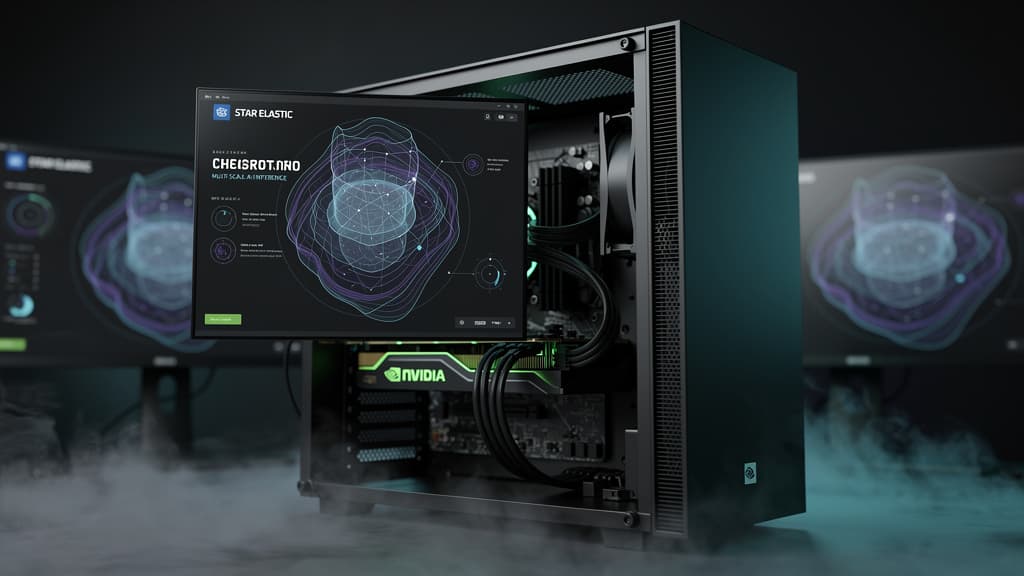
NVIDIA Star Elastic introduces a single-checkpoint approach to multi-scale inference, allowing enterprises to run 12B, 23B, and 30B models on existing hardware without the overhead of multiple deployments.
What Is NVIDIA Star Elastic — and Why Does It Matter for Enterprise AI?
NVIDIA Star Elastic is a post-training method that embeds three nested reasoning models — at 30B, 23B, and 12B parameters — into a single model checkpoint. Rather than maintaining separate deployments for each model size, Star Elastic allows a single artifact to serve all three scales on demand, with a zero-shot slicing mechanism that dynamically selects the appropriate sub-model at inference time.
For enterprise teams designing AI solution architecture for enterprise deployments, this is a meaningful shift. The dominant infrastructure assumption has been that frontier-scale reasoning requires data-center-grade hardware: A100s, H100s, or dedicated cloud clusters. Star Elastic challenges that assumption directly, bringing high-reasoning capability to RTX-class GPUs — the kind of hardware already sitting in workstations across engineering, legal, finance, and research teams.
This tutorial walks through three concrete ways Star Elastic changes the infrastructure calculus, what the benchmarks actually show, and how to think about integrating elastic inference into your own deployment stack.
Prerequisites and Context Before You Start
Before diving into implementation patterns, it helps to understand what Star Elastic is built on top of:
- Nemotron Elastic and Nemotron Nano v3 are the model families that Star Elastic's post-training method is applied to. These are NVIDIA's reasoning-optimized model lines.
- The training efficiency gain comes from a 160B-token training run shared across all three nested model sizes — rather than training each independently.
- The core metric NVIDIA researchers highlight is a 360× token reduction versus training the 30B, 23B, and 12B models separately from scratch.
- Deployment targets include RTX-class consumer and prosumer GPUs, not just enterprise data-center hardware.
With that framing in place, here are the three ways Star Elastic is reshaping enterprise AI inference architecture.
Way 1: Collapse Three Deployments Into One Checkpoint
The Old Architecture Problem
A common pattern in enterprise AI solution architecture is maintaining a model tier system: a small fast model for low-complexity queries, a medium model for moderate tasks, and a large model for high-stakes reasoning. In practice, this means three separate model artifacts, three separate serving endpoints, three separate GPU memory allocations, and a routing layer on top of all of it.
The operational overhead compounds quickly — version drift between tiers, separate fine-tuning pipelines, and the engineering cost of keeping routing logic in sync with model capability updates.
What Star Elastic Does Differently
Star Elastic's zero-shot slicing approach means all three model scales (30B, 23B, 12B) live inside a single checkpoint. The slicing is not a quantization trick or a distillation approximation — it's a structured post-training method where the nested sub-models are trained to be coherent sub-graphs of the full 30B model.
At inference time, you select the budget tier you need — high-accuracy reasoning at 30B, balanced performance at 23B, or low-latency throughput at 12B — without loading a different artifact. The checkpoint is the same. The serving infrastructure is the same.
360× token reduction versus training 30B, 23B, and 12B models separately — a direct consequence of the shared 160B-token training run across all nested scales.
Practical Implementation Pattern
For teams using NVIDIA's inference stack or compatible runtimes:
- Load the Star Elastic checkpoint once into your serving layer (e.g., TensorRT-LLM, vLLM with NVIDIA backend, or Triton Inference Server).
- Pass a budget parameter at the request level — this is the elastic budget control scheme that selects which sub-model slice handles the request.
- Route by task type in your application layer, not by model endpoint. A document summarization request routes to the 12B slice; a multi-step legal reasoning task routes to the 30B slice — same endpoint, different budget flag.
This collapses your model tier architecture from three managed deployments to one, with routing logic that lives in application code rather than infrastructure configuration.
Way 2: Use the Elastic Budget Control Scheme to Hit Accuracy and Latency Targets Simultaneously
The Accuracy-Latency Tradeoff Is Real — But Star Elastic Narrows It
Every enterprise AI deployment lives somewhere on the accuracy-latency curve. Larger models are more accurate but slower. Smaller models are faster but miss edge cases. The standard answer has been to pick a point on that curve and accept the tradeoff.
Star Elastic's elastic budget control scheme introduces a third variable: dynamic selection. Rather than committing to a fixed point on the curve at deployment time, you can move along it per request.
The benchmark results NVIDIA researchers published are specific:
Up to 16% higher accuracy and 1.9× lower latency — delivered by the elastic budget control scheme relative to fixed-size model baselines.
These numbers reflect the combined effect of two things: the 30B slice outperforming comparably-sized standalone models on reasoning benchmarks, and the 12B slice delivering latency competitive with much smaller dedicated models.
How to Apply This in Practice
The elastic budget control scheme is most powerful when you instrument your application to make budget decisions based on observable request properties. Here's a practical decision framework:
Use the 12B slice when:
- Query complexity is low (single-hop retrieval, classification, short-form generation)
- Latency SLA is under 500ms
- Volume is high and cost-per-token matters
Use the 23B slice when:
- Moderate reasoning depth is required (multi-document synthesis, structured extraction)
- You need a balance between throughput and accuracy
- You're running on RTX 4090 or equivalent with 24GB VRAM
Use the 30B slice when:
- High-stakes reasoning is required (legal analysis, financial modeling, code generation for critical systems)
- Accuracy is the primary constraint
- You have access to RTX 6000 Ada or multi-GPU RTX configurations
The key architectural insight here is that budget selection becomes a first-class parameter in your inference API contract, not an infrastructure-level decision. This shifts control to the application layer, where context about the request actually lives.
Way 3: Deploy Frontier Reasoning on RTX-Class Hardware
Why This Changes the Enterprise Hardware Conversation
The most significant democratization claim in Star Elastic's design is that it brings 30B-scale reasoning to RTX-class GPUs. This deserves some unpacking, because the hardware implications are substantial for enterprise AI solution architecture.
RTX-class GPUs — the RTX 4090, RTX 6000 Ada, and the newer RTX 5090 — are already deployed at scale in enterprise workstations. They're not data-center hardware, but they're not consumer toys either. The RTX 4090 has 24GB of GDDR6X; the RTX 6000 Ada has 48GB of ECC memory. These are capable inference platforms that have historically been limited to sub-20B models for serious reasoning workloads.
Star Elastic's single-checkpoint design, combined with the 12B and 23B slice options, means that a workstation with a single RTX 4090 can now serve as a local frontier reasoning endpoint — no cloud dependency, no data egress, no per-token API cost.
Architecture Pattern: Local-First Enterprise Inference
For enterprises with data sovereignty requirements, regulated industries (healthcare, finance, defense), or simply high-volume inference workloads where cloud costs are prohibitive, a local-first architecture built around Star Elastic looks like this:
-
Edge inference nodes: Developer workstations or departmental servers equipped with RTX 4090 or RTX 6000 Ada GPUs, running the Star Elastic checkpoint via a lightweight local inference server (Ollama, LM Studio with NVIDIA backend, or a custom TensorRT-LLM deployment).
-
Centralized 30B tier: A small on-premises server with multi-GPU RTX configuration or a single H100 handles the highest-complexity requests that require the full 30B slice — but this tier handles a fraction of total volume.
-
Intelligent routing: An application-layer router (built in FastAPI, LangGraph, or your orchestration framework of choice) classifies incoming requests and dispatches to the appropriate local node and budget tier.
-
No cloud dependency for standard workloads: The 12B and 23B slices handle the majority of enterprise use cases locally, reserving cloud or centralized GPU resources for genuine frontier-scale tasks.
The 160B-token shared training run means all three slices benefit from the same reasoning capability development — the 12B slice is not a stripped-down approximation but a coherently trained sub-model.
Cost and Compliance Implications
For a mid-sized enterprise running 10 million inference requests per month across legal, finance, and engineering teams:
- Cloud-only architecture: At typical frontier model API pricing ($10–15 per million tokens for 30B-class models), monthly inference costs run $100,000–$150,000.
- Local-first with Star Elastic: Hardware amortized over 3 years on RTX workstations already in the fleet, plus electricity, brings per-request costs down by an order of magnitude for the 12B and 23B slice workloads.
- Compliance: Data never leaves the premises for the majority of requests, satisfying HIPAA, SOC 2, and GDPR data residency requirements without architectural exceptions.
Putting It Together: A Reference Architecture
Here's how the three ways combine into a coherent enterprise inference architecture:
Incoming Request │ ▼ [Application Router] ├── Low complexity → Local RTX Node (12B slice, <500ms) ├── Medium complexity → Local RTX Node (23B slice, <1s) └── High complexity → Central GPU Tier (30B slice, <3s) │ [Star Elastic Checkpoint] (Single artifact, all three slices)
The single checkpoint is the unifying element. Your serving infrastructure manages one model artifact. Your DevOps team tracks one model version. Your fine-tuning pipeline (when you extend Nemotron Elastic for domain-specific tasks) produces one output.
What to Watch Next
Star Elastic is a post-training method, which means it's applicable beyond the specific Nemotron Elastic and Nemotron Nano v3 model families. The research direction points toward a future where any sufficiently large model can be post-trained into an elastic checkpoint — opening the door to elastic versions of domain-specific fine-tunes, multimodal models, and code-specialized architectures.
For enterprise architects, the near-term priorities are:
- Benchmark your specific workloads against the 12B, 23B, and 30B slices to validate the 16% accuracy and 1.9× latency claims in your domain.
- Evaluate your RTX fleet for local inference capacity — the hardware may already be there.
- Design budget selection logic as a first-class concern in your inference API, not an afterthought.
The infrastructure assumption that frontier reasoning requires frontier hardware is worth revisiting. Star Elastic is a concrete technical argument that it doesn't have to.
Sources
- NVIDIA AI Releases Star Elastic: One Checkpoint That Contains 30B, 23B, and 12B Reasoning Models With Zero-Shot Slicing — MarkTechPost, May 9, 2026
Last reviewed: May 10, 2026