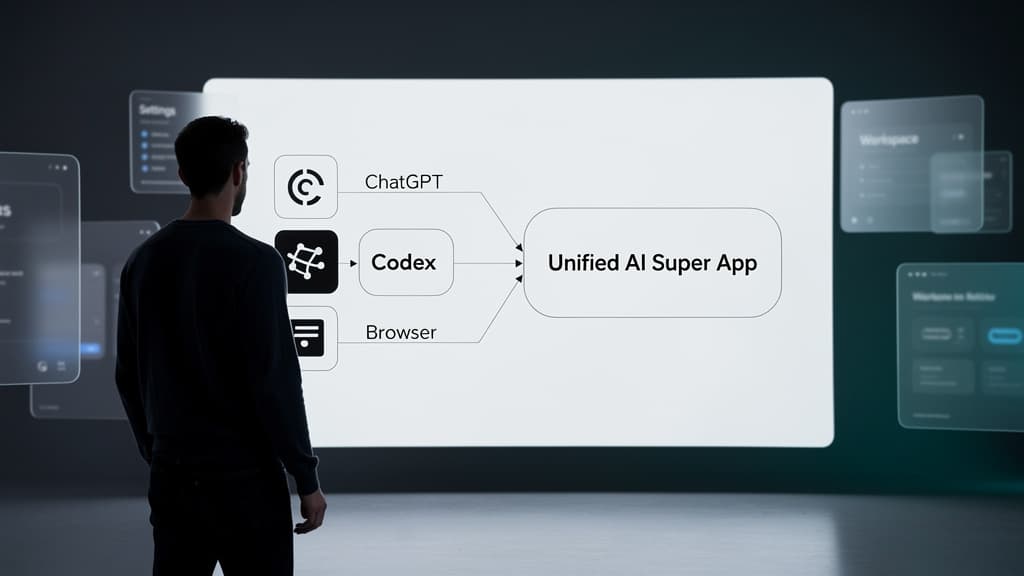
OpenAI is merging its core product teams to build a unified 'super app' architecture. This strategic pivot signals a major shift toward supporting autonomous AI agents for enterprise workflows.
OpenAI Bets on Unified Agentic Infrastructure With Major Reorganization
OpenAI is consolidating its core product lines — ChatGPT, Codex, and the developer API — under a single team led by Codex chief Thibault Sottiaux, with co-founder Greg Brockman stepping in to oversee product strategy. The reorganization, reported by The Decoder, signals a deliberate strategic pivot: rather than maintaining a portfolio of modular AI tools, OpenAI is building toward what it internally describes as a 'super app' — a unified platform capable of supporting autonomous AI agents for enterprise and consumer use alike.
At the center of this vision is Atlas, OpenAI's in-development browser, which the company intends to integrate directly into this consolidated product surface. The move suggests OpenAI is no longer treating ChatGPT, its coding tools, and its API as parallel product lines competing for internal resources — it's treating them as components of a single agentic operating environment.
Why Brockman's Return Changes the Equation
Greg Brockman, who took a sabbatical in late 2024 and returned to OpenAI earlier this year, is not simply a figurehead in this restructuring. His role as product strategy lead places one of the company's most technically credible co-founders directly in charge of the architecture decisions that will define OpenAI's next phase.
Brockman's involvement matters for a specific reason: the transition from AI-as-tool to AI-as-agent requires product decisions that are fundamentally different from those that built ChatGPT into a consumer hit. Agents need persistent memory, multi-step planning, tool access, and the ability to operate across environments — a browser, a codebase, an API, a file system — without constant human intervention. That kind of integration is an engineering and product design challenge as much as it is a model capability challenge.
By placing Sottiaux — who led Codex, OpenAI's software engineering agent — at the operational helm of the combined team, OpenAI is signaling that the agentic use case, not the chat interface, is the organizing principle going forward.
The Super App Thesis
The 'super app' framing is deliberate and worth unpacking. In the consumer technology context, super apps like WeChat or Grab bundled messaging, payments, logistics, and commerce into a single interface. OpenAI appears to be applying a similar logic to AI infrastructure: rather than requiring enterprise users and developers to stitch together ChatGPT for conversation, Codex for coding tasks, the API for custom integrations, and eventually a browser for web-based actions, the goal is a single, coherent surface where agents can operate end-to-end.
The Atlas browser is the piece that completes this picture. A proprietary browser gives OpenAI's agents native access to the web without relying on third-party tool integrations or scraping workarounds. Combined with Codex's ability to write and execute code, and ChatGPT's natural language interface, the resulting system would allow an agent to receive a task in plain language, research it on the web, write code to process the results, and return a completed output — all within a single product environment.
This architecture would position OpenAI not just as an AI model provider, but as the operating layer for autonomous AI agents for enterprise workflows.
What This Means for Enterprise Adoption
For enterprise technology leaders evaluating AI infrastructure, the consolidation carries several immediate implications.
Reduced integration complexity is the most obvious near-term benefit. Today, deploying AI agents in enterprise environments typically requires connecting multiple APIs, managing context windows across tool boundaries, and building custom orchestration layers. A unified OpenAI platform with native browser, code execution, and language model capabilities would substantially reduce that overhead.
Vendor concentration risk, however, increases in parallel. Organizations that build workflows on a consolidated OpenAI super app become more deeply dependent on a single provider's architectural decisions, pricing changes, and uptime guarantees. This is a trade-off that enterprise architects will need to weigh carefully, particularly given OpenAI's ongoing governance and structural evolution.
Competitive pressure on the ecosystem is also significant. Platforms like Microsoft Copilot (which runs on OpenAI models), Anthropic's Claude tooling, and Google's Gemini-based agent infrastructure are all pursuing variations of the same unified-agent thesis. OpenAI's reorganization accelerates the timeline on which this competitive dynamic plays out — and forces enterprise buyers to make earlier decisions about which agentic platform they are building on.
The Organizational Logic
Product consolidations at AI companies often reflect underlying model and infrastructure realities as much as strategic intent. The fact that ChatGPT, Codex, and the developer API are being merged suggests that the model capabilities underpinning them have converged sufficiently that maintaining separate product organizations no longer makes sense.
GPT-4o and its successors are capable enough at code generation that the distinction between a 'chat model' and a 'coding model' is increasingly artificial. Unifying the product teams eliminates the organizational friction that comes from maintaining that distinction — and allows OpenAI to ship a coherent agentic experience rather than incrementally patching together separate products.
Sottiaux's elevation is also a signal about where OpenAI sees the center of gravity in the agentic transition. Coding agents are among the most mature and commercially validated forms of autonomous AI — they operate on well-defined tasks, produce verifiable outputs, and have clear enterprise ROI. Leading with that competency as the organizational spine of the new team is a pragmatic choice.
What to Watch
Several developments will clarify how this reorganization translates into product reality over the coming months:
- Atlas browser availability: When and how OpenAI makes the Atlas browser accessible — whether as a standalone product, an enterprise API feature, or an embedded capability within ChatGPT — will determine the practical scope of the super app vision.
- Agent orchestration primitives: Whether OpenAI ships native multi-agent coordination tools, or continues to rely on third-party frameworks like LangChain or AutoGen, will signal how seriously it is pursuing the full-stack agentic infrastructure play.
- Enterprise pricing and packaging: How OpenAI packages the consolidated platform for business customers will determine whether the super app strategy accelerates enterprise adoption or creates new friction around cost and contract complexity.
- Brockman's product roadmap: Any public statements or technical writing from Brockman on the architectural direction of the unified platform will be worth tracking closely — his credibility within the technical community means his framing will shape how developers and enterprise architects evaluate the new direction.
OpenAI's reorganization under Greg Brockman is less a product announcement than a strategic declaration: the era of modular AI tools is giving way to integrated agentic systems, and OpenAI intends to own that transition at the infrastructure level.
Last reviewed: May 18, 2026