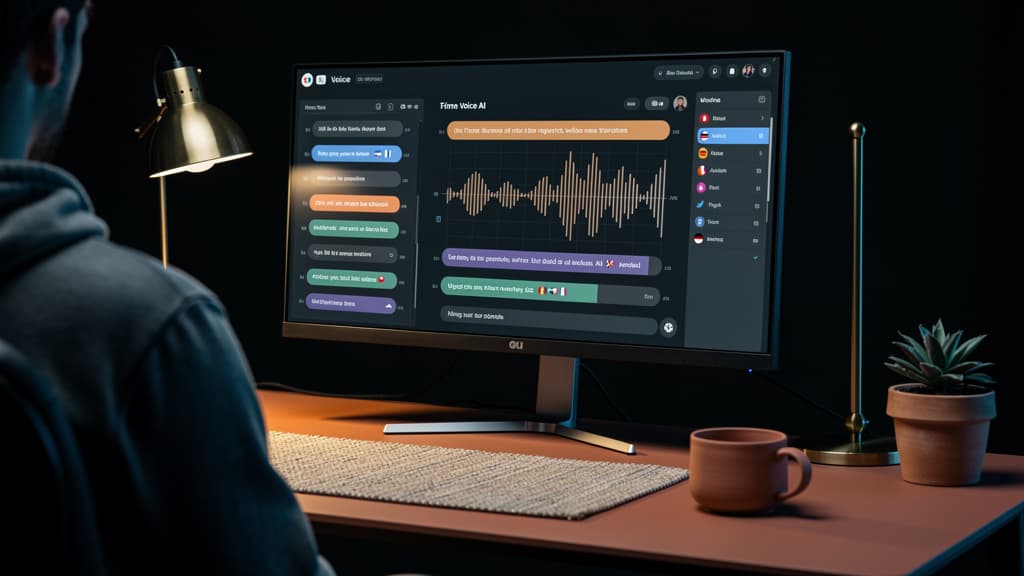
OpenAI has launched three new real-time audio models—GPT-Realtime-2, Translate, and Whisper—integrating GPT-5 reasoning into voice-driven applications.
OpenAI has released three new real-time audio models — GPT-Realtime-2, GPT-Realtime-Translate, and GPT-Realtime-Whisper — marking a significant shift in what developers can build with voice-driven AI. The models, now available through the Realtime API, bring GPT-5-level reasoning, live translation across more than 70 languages, and streaming transcription into a single, unified developer surface. For teams building conversational AI in 2026, this release reshapes the competitive landscape for the top generative AI tools available today.
What OpenAI Actually Shipped
The three models each address a distinct layer of the real-time voice stack:
- GPT-Realtime-2 is the flagship model, delivering reasoning capabilities on par with GPT-5 during live voice conversations. Unlike earlier voice models that relied on a speech-to-text → LLM → text-to-speech pipeline, GPT-Realtime-2 processes audio natively, reducing latency and preserving prosodic nuance — tone, pacing, and emphasis — that text-based pipelines typically discard.
- GPT-Realtime-Translate handles live spoken translation across 70+ languages, enabling developers to build real-time multilingual experiences without chaining separate translation services.
- GPT-Realtime-Whisper focuses on streaming transcription, bringing OpenAI's Whisper-class accuracy to low-latency, real-time use cases rather than batch processing.
All three are accessible through the Realtime API, which OpenAI has positioned as a production-ready interface rather than an experimental endpoint.
GPT-Realtime-2 brings reasoning capabilities that match GPT-5, significantly expanding developer options for voice-driven AI applications in customer service, education, and creator platforms.
Why GPT-5-Level Reasoning in Voice Matters
Previous real-time voice systems — including OpenAI's own earlier offerings — faced a fundamental trade-off: speed versus intelligence. Keeping a conversation responsive meant running lighter models; running smarter models introduced perceptible lag. GPT-Realtime-2 breaks that trade-off, at least according to OpenAI's positioning, by natively integrating reasoning into the audio processing loop.
For developers, this changes the calculus on several high-value use cases:
Customer service automation can now handle complex, multi-turn queries — billing disputes, technical troubleshooting, policy exceptions — without routing to a human or dropping to a text interface. The reasoning layer means the model can hold context, weigh options, and explain decisions in natural speech.
Education platforms gain a tutor that can adapt in real time to a student's spoken confusion, ask clarifying questions, and reason through problems aloud — capabilities that text-based chatbots approximate but voice-first interfaces make genuinely natural.
Creator tools and content platforms can deploy voice agents that improvise, stay in character, and respond to unexpected user inputs without breaking the experience.
GPT-Realtime-Translate: The Multilingual Layer
The 70+ language coverage in GPT-Realtime-Translate is the detail that matters most for global deployment. Competing approaches — stitching together a transcription model, a translation API, and a synthesis layer — introduce compounding latency and error rates at each handoff. A single model handling spoken translation end-to-end reduces both.
The practical implications are immediate for industries like travel, healthcare, and international customer support, where real-time spoken communication across language barriers has historically required human interpreters or accepted degraded quality from automated pipelines.
GPT-Realtime-Whisper and the Transcription Use Case
While GPT-Realtime-2 and GPT-Realtime-Translate capture most of the headline attention, GPT-Realtime-Whisper may have the broadest immediate adoption. Streaming transcription is a foundational capability for meeting assistants, accessibility tools, live captioning, and voice-driven search. Bringing Whisper-class accuracy to real-time streaming — rather than requiring developers to buffer audio and send it in chunks — removes a significant friction point from building these products.
Developers who previously built around third-party streaming transcription services now have a direct, first-party option integrated into the same API surface as their other OpenAI calls.
Where This Lands in the 2026 Developer Stack
The release arrives at a moment when voice interfaces have moved from novelty to expectation. Consumer familiarity with voice assistants, combined with the maturation of large language models, has created genuine demand for voice-native AI products. The question for developers in 2026 is no longer whether to build voice features — it's which infrastructure to build on.
OpenAI's three-model release consolidates reasoning, translation, and transcription under a single API contract, which simplifies vendor management and reduces integration surface area. That consolidation is itself a competitive argument, separate from raw model performance.
The primary alternatives — including real-time voice offerings from Google, ElevenLabs, and Deepgram — remain viable for specific use cases, particularly where cost optimization or on-premises deployment is a priority. But for developers already in the OpenAI ecosystem, the path of least resistance now includes production-grade real-time voice.
What to Watch Next
Three questions will determine how this release ages over the coming months:
- Pricing at scale. Real-time audio processing is compute-intensive. OpenAI has not yet published detailed pricing tiers for high-volume Realtime API usage, and cost-per-minute will be a deciding factor for customer service and telephony deployments.
- Latency benchmarks under load. GPT-5-level reasoning in a voice loop is a strong claim. Independent benchmarks measuring end-to-end response latency across conversation types will clarify whether the performance holds outside controlled demos.
- Enterprise compliance features. Healthcare, finance, and legal use cases require data residency guarantees, PII handling controls, and audit logging. OpenAI's enterprise API tier will need to address these explicitly for regulated industries to adopt the Realtime models at scale.
The release is available now through the OpenAI API. Full technical documentation is at the OpenAI platform docs, with additional coverage at MarkTechPost, TechCrunch, and The Decoder.
Last reviewed: May 08, 2026