Opera Neon has introduced a native Model Context Protocol (MCP) connector, transforming the browser into a powerful execution layer for AI agents. Learn how this integration bridges the gap between AI models and live, authenticated web workflows.
On March 31, 2026, Opera announced a major update to its Opera Neon browser, introducing a native Model Context Protocol (MCP) Connector. This release effectively transforms the web browser from a passive viewing application into an active execution layer for external artificial intelligence. Prior to this update, users working with external AI models had to manually copy and paste context, take screenshots, or rely on isolated, simulated browser environments. Now, any compatible ai agent workflow automation platform or standalone AI client—such as Claude, ChatGPT, or n8n—can plug directly into a user's live, authenticated browsing session. By acting as an MCP server, Opera Neon allows these external agents to securely read page content, navigate, click, and execute multi-step tasks autonomously on the user's behalf.
This integration marks a critical milestone in the evolution of agentic AI, shifting the paradigm from AI as an advisory chatbot to AI as a functional operator within the environments where digital work actually happens.
The End of the "Manual Interpreter"
For years, the friction in AI-assisted workflows has been the boundary between the AI's interface and the user's operational workspace. While Opera Neon previously featured built-in AI agents (such as Neon Do and Neon Make), users who preferred external ecosystems were left disconnected.
According to Opera's Director of R&D for browser AI, Monika Kurczyńska, the MCP Connector was designed specifically to eliminate this bottleneck.
"Last year, we launched Browser Operator as a first step toward an agentic browser. Now we are opening those capabilities to external AI clients through MCP, so they can act directly inside the browser, not outside it," Kurczyńska stated press.opera.com.
The technical differentiator here is headful browsing. Unlike headless browser automation scripts that operate in the background and often fail when encountering complex authentication flows or CAPTCHAs, external AI tools connecting via Opera Neon operate within the user's active, visually rendered session. If a user is already logged into a secure enterprise dashboard, the AI agent inherits that authenticated state, allowing it to perform tasks without requiring separate API keys or complex login scripts blogs.opera.com.
Empowering the AI Agent Workflow Automation Platform
The most significant implications of Opera Neon's MCP integration lie in enterprise automation. Historically, an ai agent workflow automation platform like n8n relied heavily on official APIs to interact with web services. If a legacy SaaS product or internal company portal lacked an API, automating tasks within it was notoriously brittle, requiring complex UI scraping.
With the browser itself acting as an MCP server, these automation platforms gain a universal interface: the visual web.
Opera's announcement highlighted several immediate use cases that demonstrate this shift:
- Software Development and Testing: Developers using Claude Code can instruct the AI to build a web application, and then autonomously open Opera Neon, navigate to the local staging environment, click through the UI, and verify that the application works as intended thurrott.com.
- Rapid UI Prototyping: Prototyping tools like Lovable can be directed to look at an authenticated, live web app open in Neon. The AI can analyze the layout, extract design tokens, and generate a matching user interface without the user ever needing to inspect code or take screenshots gadgetbond.com.
- Unstructured Data Extraction: Automation tools can connect to Neon to read live dashboards, extract specific metrics, and compile reports across multiple open tabs, operating exactly as a human analyst would.
By serving as a bridge between powerful AI models and the live web, Opera is positioning Neon as an essential infrastructure component for the next generation of enterprise automation.
Standardization Through MCP
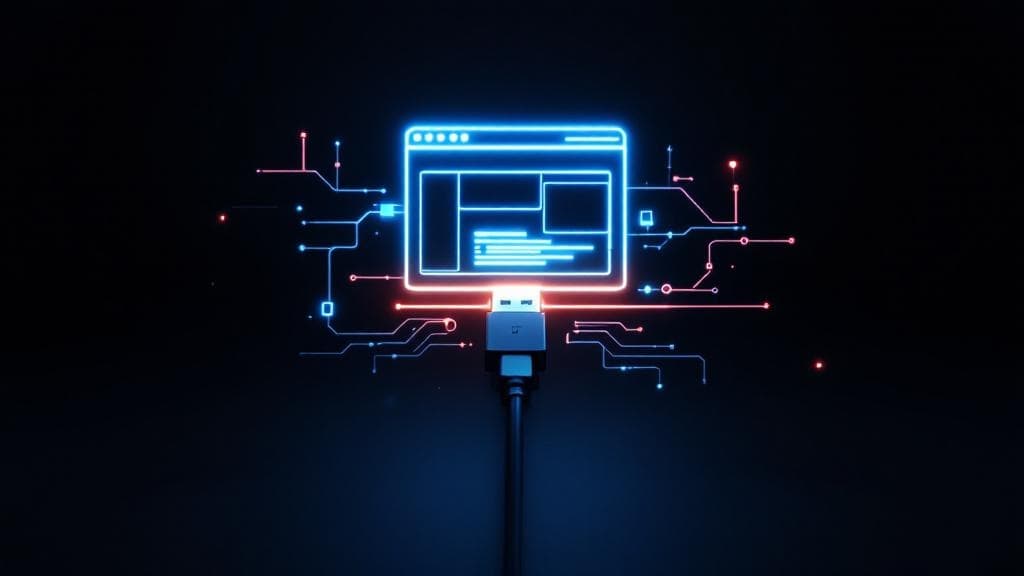
The rapid adoption of this feature is made possible by the Model Context Protocol. Originally introduced by Anthropic in late 2024 as an open standard, MCP has quickly become the "USB-C port" for AI applications. It provides a universal language for AI models to connect to external tools, databases, and environments without requiring bespoke integrations for every single service.
Opera Neon's distinction is becoming the first major web browser to natively offer an MCP server makeuseof.com. Instead of AI developers needing to build and maintain fragile browser extensions to interact with the web, they can simply route their agents through the standardized MCP endpoint exposed by Neon.
This open-ecosystem approach contrasts sharply with closed AI environments. By allowing users to bring their own AI—whether it's OpenAI's ChatGPT, Anthropic's Claude, or an open-source model running locally—Opera is decoupling the browser's execution capabilities from the underlying intelligence engine.
What to Watch Next
While the MCP Connector is currently available to Opera Neon users, Opera has signaled intentions to bring simplified versions of these capabilities to its mainstream Opera One and Opera GX browsers in the future.
As this technology matures, the industry will be closely watching several key developments:
- Security and Governance: Allowing an external AI to autonomously click and navigate authenticated sessions introduces novel security risks. Enterprises will need robust auditing tools to monitor exactly what actions an AI agent took within a browser session, especially when handling sensitive corporate data.
- Competitor Response: With Opera setting the benchmark for built-in MCP server support, pressure will mount on major players like Google Chrome and Microsoft Edge to offer similar, standardized agentic execution layers, rather than relying solely on their proprietary AI assistants (Gemini and Copilot).
- Evolution of Web Design: If a significant portion of web traffic shifts from human eyes to AI agents "reading" the live browser DOM via MCP, web developers may need to prioritize semantic HTML and accessibility markers not just for screen readers, but for autonomous AI operators.
Opera Neon's MCP integration is more than a feature update; it is a foundational shift in human-computer interaction. By turning the browser into a programmable, standardized execution layer, the gap between what AI can understand and what it can actually do has grown significantly smaller.
Last reviewed: April 03, 2026