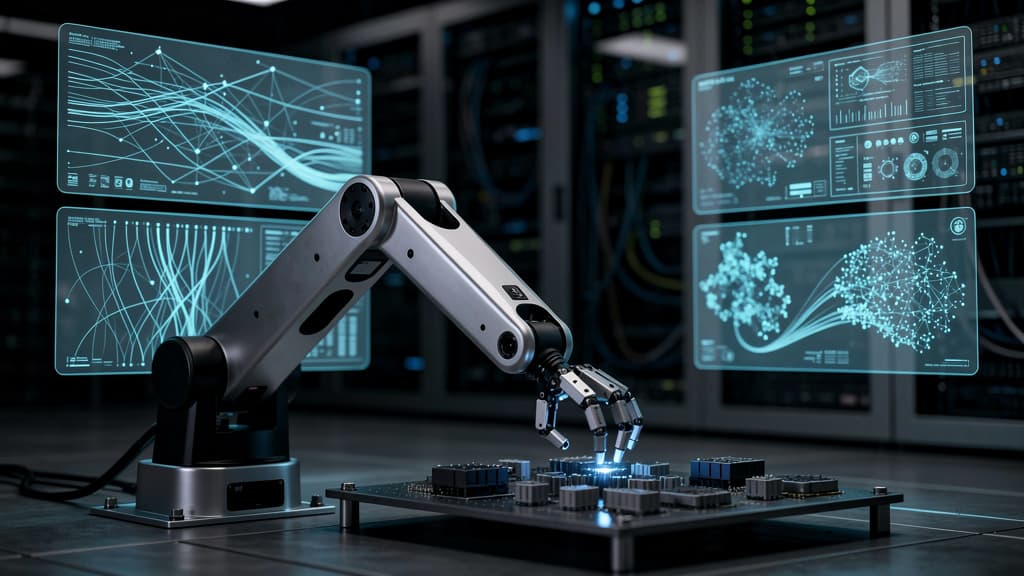
Physical AI is moving from research to boardroom mandate. Discover the critical architectural shifts required to integrate embodied intelligence into your enterprise infrastructure.
The Inflection Point Every Enterprise Architect Needs to Understand
Physical AI — the integration of AI reasoning into robots, autonomous vehicles, industrial systems, and other embodied hardware — has crossed from research curiosity to boardroom imperative. According to a Deloitte survey cited by the AI Accelerator Institute, 80% of businesses plan to deploy physical AI within two years. That number would have seemed implausible in 2023, when most enterprise AI conversations centered on chatbots and document summarization.
The shift is structural, not cyclical. Language models optimized for text tokens cannot pick up a component off an assembly line, navigate a hospital corridor, or respond to an unexpected physical variable. The next competitive frontier — and the next architectural challenge — is building enterprise infrastructure that bridges the digital and physical worlds.
For enterprise architects and technology decision-makers, the question is no longer whether to plan for physical AI, but how to design systems that can support it at scale. This deep dive maps the transition, the key technology players reshaping the stack, and the concrete architectural decisions organizations need to make today.
Why Software-Only LLMs Hit a Physical Ceiling
Large language models are extraordinarily capable within their domain: they process, generate, and reason over discrete tokens. But the physical world does not communicate in tokens. It communicates in force, torque, spatial geometry, sensor noise, and real-time feedback loops operating at millisecond latencies.
The gap between language-model intelligence and physical-world deployment reveals itself in three critical failure modes:
1. Perception-Action Loops A software LLM receives a prompt and returns a response. A robot operating in an unstructured environment must continuously perceive its surroundings, plan a sequence of actions, execute motor commands, receive proprioceptive feedback, and adjust — all within tight real-time constraints. Current transformer architectures are not natively designed for this closed-loop control paradigm.
2. Sim-to-Real Transfer Models trained purely on internet-scale data have no grounding in physical causality. A model that has read millions of descriptions of how to pour liquid into a glass still has no learned understanding of fluid dynamics, container geometry, or the motor control required to execute the task. Bridging this gap requires simulation environments, physics engines, and domain randomization — none of which are part of a standard LLM deployment.
3. Safety and Determinism Requirements Enterprise software tolerates probabilistic outputs — a hallucinated sentence in a summary is embarrassing but recoverable. A robot arm operating near human workers cannot afford stochastic behavior. Physical AI deployments introduce hard safety constraints, regulatory compliance requirements (particularly in manufacturing, healthcare, and logistics), and liability considerations that demand architectural guarantees no current LLM can provide out of the box.
These are not bugs to be patched with prompt engineering. They are fundamental architectural gaps that require a new infrastructure approach.
The Market Signal: Jensen Huang's 'ChatGPT Moment for Robotics'
When Nvidia CEO Jensen Huang declared that the robotics industry is experiencing its 'ChatGPT moment,' the statement carried weight beyond marketing. Nvidia has systematically repositioned itself as the foundational infrastructure layer for physical AI — not just the GPU supplier for model training.
Nvidia's strategy to tap the robotics ecosystem involves several interlocking bets: the Isaac robotics platform for simulation and deployment, Omniverse as the physics-accurate digital twin environment, and Jetson edge compute modules for on-device inference. Together, these form a vertical stack that mirrors what AWS did for cloud infrastructure — commoditize the platform so the ecosystem can build on top.
The analogy to ChatGPT is instructive. ChatGPT did not introduce a new capability so much as it made an existing capability — language model inference — accessible enough to trigger mass adoption. Huang's argument is that the combination of mature simulation environments, improved foundation models for robotics, and cheaper edge compute has created a similar accessibility threshold for physical AI.
For enterprise architects, this means the tooling is maturing rapidly. The question is whether your organization's infrastructure is positioned to consume it.
Genesis AI and the Full-Stack Robotics Model
One of the clearest illustrations of where the technology is heading comes from Genesis AI, a Khosla-backed startup that recently went full-stack with a public demonstration of its GENE-26.5 model.
As TechCrunch reported on the Genesis AI demo, the GENE-26.5 model showcased robotic hand demonstrations that highlight a critical architectural philosophy: the model is not a language model with a robotic wrapper. It is a system designed from the ground up for physical manipulation, with the intelligence layer tightly coupled to the actuation layer.
The 'full-stack' framing is significant for enterprise architects. It signals that the industry is moving away from bolt-on robotics integrations — where a pre-existing software AI is awkwardly connected to hardware via middleware — toward purpose-built systems where the model architecture, the simulation pipeline, the hardware interface, and the deployment environment are co-designed.
This has direct implications for how enterprises should evaluate robotics vendors and structure their own AI solution architecture. A full-stack physical AI system is not a drop-in replacement for an LLM API call. It requires rethinking the entire integration surface.
Architecting Enterprise Infrastructure for Physical AI
Given these market and technology signals, what does a sound AI solution architecture for enterprise physical AI deployment actually look like? The following framework breaks the problem into five interconnected layers.
Layer 1: Simulation and Digital Twin Infrastructure
Before any physical robot is deployed, enterprises need a high-fidelity simulation environment. This is where models are trained, tested, and validated without the cost and risk of real-world trials.
Key architectural decisions at this layer:
- Physics engine selection: Nvidia Omniverse, Isaac Sim, MuJoCo, and PyBullet each offer different fidelity-performance tradeoffs. For industrial manipulation tasks, high-fidelity contact simulation is critical.
- Domain randomization pipelines: Systematically varying lighting, object geometry, surface friction, and sensor noise during simulation training dramatically improves real-world transfer.
- Digital twin synchronization: For ongoing operations, the simulation environment must stay synchronized with the physical deployment — meaning sensor telemetry from deployed robots feeds back into the simulation to continuously update the digital model.
Enterprises that skip simulation infrastructure and attempt direct real-world training face costs that are 10–100x higher, with significantly longer iteration cycles.
Layer 2: Edge Compute and Inference Architecture
Physical AI inference cannot live in the cloud. The round-trip latency of sending sensor data to a remote API and waiting for a response is incompatible with real-time control loops, which typically require decisions at 100–1000 Hz.
This forces a fundamental shift in enterprise compute architecture:
- On-device inference modules (Nvidia Jetson, Qualcomm Robotics RB-series, or custom ASICs) must be provisioned as first-class infrastructure components, not afterthoughts.
- Hierarchical control architectures separate high-level task planning (which can tolerate higher latency and may involve cloud-resident models) from low-level motor control (which must be fully local).
- Model compression and quantization become critical engineering disciplines. A model that runs acceptably on an A100 cluster must be distilled or quantized to run on a Jetson Orin without unacceptable accuracy degradation.
Layer 3: Sensor Fusion and Data Pipeline
Robots generate heterogeneous sensor data — RGB cameras, depth sensors, LiDAR, IMUs, force-torque sensors — at high throughput. Enterprise data pipelines designed for structured business data are not equipped to handle this.
Architectural requirements:
- Real-time streaming infrastructure: Apache Kafka or ROS 2's DDS middleware for high-throughput, low-latency sensor data transport.
- Multimodal data lakes: Storage and indexing systems capable of handling time-series sensor data, point clouds, video streams, and event logs in a unified query-able format.
- Annotation and labeling pipelines: Physical AI models require labeled training data from the physical domain — which means building or procuring tooling for annotating robot demonstrations, sensor recordings, and failure cases.
Layer 4: Safety, Monitoring, and Governance
This layer is where many enterprise physical AI programs will succeed or fail. The governance frameworks that work for software AI — model cards, bias audits, output logging — are necessary but insufficient for physical systems operating near humans.
- Runtime safety monitors: Dedicated safety layers that operate independently of the primary AI model, enforcing hard constraints on robot velocity, force limits, and workspace boundaries. These must be certifiable and, in regulated industries, auditable.
- Anomaly detection and human-in-the-loop escalation: Systems that detect when a robot is operating outside its training distribution and gracefully transfer control to a human operator.
- Regulatory mapping: Depending on the deployment context, physical AI systems may fall under ISO 10218 (industrial robots), IEC 62443 (industrial cybersecurity), FDA guidance (medical devices), or sector-specific regulations. Architecture must be designed with these compliance surfaces in mind from day one.
Layer 5: MLOps and Continuous Improvement for Embodied Systems
The MLOps practices enterprises have built for software models need significant extension for physical AI:
- Fleet management: Managing model versions across hundreds or thousands of deployed robots, with controlled rollout and rollback capabilities.
- Failure case collection: Automated pipelines that flag and capture robot failures in the field, route them to annotation, and feed them back into retraining — closing the improvement loop.
- Sim-to-real gap monitoring: Continuous measurement of the divergence between simulated performance and real-world performance, triggering simulation updates when the gap exceeds defined thresholds.
The Organizational Architecture Challenge
Technology architecture is only half the problem. The organizational structure required to execute physical AI programs is fundamentally different from software AI programs.
Successful physical AI deployments require tight collaboration between disciplines that rarely sit in the same reporting structure: robotics engineers, ML researchers, embedded systems engineers, safety engineers, facilities and operations teams, and regulatory affairs specialists. Enterprises that treat physical AI as a software project managed by a data science team will encounter predictable failure modes.
The AI Accelerator Institute's guidance on preparing for physical AI emphasizes cross-functional readiness as a prerequisite — not an afterthought. This means standing up dedicated physical AI centers of excellence, establishing hardware procurement and lifecycle management capabilities, and building relationships with simulation and robotics platform vendors well before deployment commitments are made.
What to Prioritize in the Next 12 Months
For enterprises that accept the Deloitte finding at face value — that 80% of businesses will be deploying physical AI within two years — the window for infrastructure preparation is narrow. The following priorities are sequenced by dependency:
- Audit your edge compute readiness. Most enterprise networks were not designed for the bandwidth and latency requirements of robot sensor streams. Assess your OT/IT convergence posture now.
- Stand up a simulation environment. Even if robot deployment is 18 months away, building simulation infrastructure today accelerates everything downstream.
- Identify your first physical AI use case with the highest ROI and lowest safety complexity. Logistics (goods-to-person picking, autonomous mobile robots) typically offers faster regulatory clearance than manufacturing or healthcare.
- Evaluate full-stack vendors against point solutions. The Genesis AI full-stack approach signals where the market is heading. Assess whether your integration strategy assumes a full-stack partner or a best-of-breed assembly.
- Begin safety and governance framework design. Retrofitting safety architecture onto a deployed physical AI system is expensive and sometimes impossible. Design it in from the start.
The Bottom Line
The 80% deployment intention figure from Deloitte is not a prediction about a distant future — it is a signal about decisions being made in boardrooms right now. Jensen Huang's ChatGPT moment framing, Nvidia's aggressive ecosystem buildout, and Genesis AI's full-stack GENE-26.5 demonstration are all pointing at the same inflection: physical AI is transitioning from pilot projects to production infrastructure.
The enterprises that will capture disproportionate value from this transition are not necessarily those with the most advanced robotics today. They are the ones building the architectural foundations — simulation pipelines, edge compute networks, sensor data infrastructure, safety governance frameworks — that allow them to deploy, iterate, and scale physical AI systems faster than their competitors.
The architectural work starts now. The deployment window is two years.
Sources
- AI Accelerator Institute — 5 Ways to Prepare for Physical AI Today
- AI Business — Nvidia Taps Robotics Ecosystem to Scale Physical AI
- TechCrunch — Khosla-Backed Genesis AI Has Gone Full-Stack, Demo Shows
Last reviewed: May 07, 2026