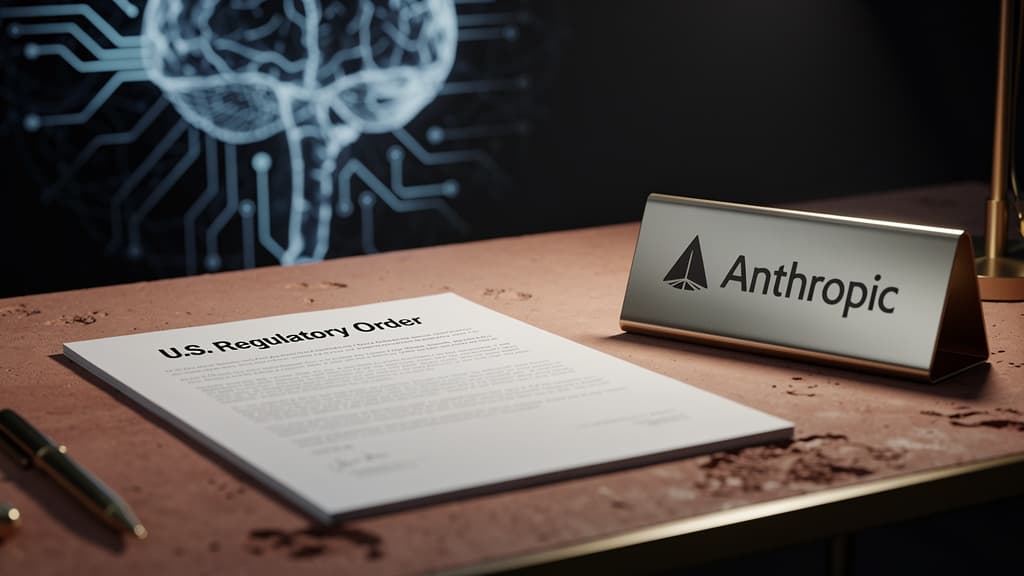
The US government has ordered a global shutdown of Anthropic's Claude Fable 5 and Mythos 5. This unprecedented intervention reveals deep enterprise AI security risks that every organization must now address.
The US government has ordered Anthropic to immediately disable global access to Claude Fable 5 and Mythos 5, its most advanced frontier AI models, citing alleged jailbreak vulnerabilities that officials say pose unacceptable security risks. The move, which Anthropic is complying with under protest, has sent shockwaves through the enterprise AI sector and raised urgent questions about enterprise AI security risks, regulatory overreach, and the future of frontier model deployments.
The shutdown order, first reported by The Decoder and confirmed by Wired, represents one of the most aggressive regulatory interventions in commercial AI history. Enterprise customers relying on Claude Fable 5 and Mythos 5 for production workloads — from legal document analysis to software development pipelines — are now scrambling to assess the impact.
What Happened
US government officials ordered Anthropic to pull the plug on Claude Fable 5 and Mythos 5 globally, citing specific jailbreak vulnerabilities that they allege could be exploited to produce harmful outputs at scale. The order applies to all customers worldwide, not just US-based deployments — an extraordinary extraterritorial reach that has drawn its own scrutiny.
Anthropic confirmed it is complying with the directive but issued a pointed public rebuttal. The company argues the identified vulnerabilities are minor in scope and, critically, are not unique to its models. According to reporting by TechCrunch, Anthropic has specifically pointed to GPT-5.5 as exhibiting comparable jailbreak susceptibilities — a claim that, if accurate, raises an obvious question: why is only Anthropic being targeted?
The TechCrunch piece carries a particularly stinging subheading, noting that Anthropic's own safety-first public positioning may have inadvertently handed regulators the justification they needed. By being the most vocal about AI risk, Anthropic may have made itself the most visible target.
Anthropic's Pushback and the Precedent Argument
Anthropic's public response goes beyond defending Claude Fable 5 and Mythos 5 on technical grounds. The company has warned that the government's action could establish a chilling precedent: if regulators can force the global shutdown of frontier models based on the existence of jailbreak vulnerabilities — which are endemic to virtually every large language model in production — then no advanced AI deployment is safe from similar intervention.
"The vulnerabilities cited are minor and exist in competing models. If this standard is applied consistently, it would halt all frontier AI deployments." — Anthropic, per reporting by The Decoder and Wired
This is not a hypothetical concern. Jailbreak vulnerabilities are a known, persistent challenge across the entire industry. Red-teaming exercises routinely surface prompt injection and constraint-bypass techniques in models from OpenAI, Google DeepMind, Meta, and others. If the government's threshold for shutdown is the mere existence of such vulnerabilities, Anthropic's warning about a broader freeze on frontier AI is not alarmist — it is a logical extrapolation.
Enterprise AI Security Risks: The Compliance Earthquake
For enterprise technology leaders, this shutdown is a stress test of assumptions that have quietly underpinned AI procurement decisions for the past two years.
Many organizations have built internal workflows, customer-facing products, and critical infrastructure integrations on top of Claude Fable 5 and Mythos 5, drawn by Anthropic's reputation for safety-conscious model development. The abrupt, government-mandated global disable — with no announced timeline for restoration — exposes several enterprise AI security risks that risk and compliance teams are now urgently reassessing:
1. Regulatory discontinuity risk. Enterprises assumed that model availability risk came from vendor decisions — deprecation schedules, pricing changes, API modifications. A government-forced global shutdown introduces a new category of risk: sovereign intervention that no SLA or enterprise agreement can protect against.
2. Vendor concentration risk. Organizations that consolidated AI infrastructure around a single frontier provider are now experiencing exactly the scenario that diversification strategies are designed to prevent. The question of whether to maintain parallel deployments across multiple providers — previously dismissed as operationally complex — now looks prescient.
3. Compliance ambiguity. For enterprises in regulated industries — financial services, healthcare, legal — the shutdown creates immediate compliance headaches. If internal processes were validated against Claude Fable 5's specific output characteristics, switching to an alternative model may require re-validation with regulators.
4. The jailbreak vulnerability standard. Perhaps most consequentially for long-term planning: if the government has established that the existence of jailbreak vulnerabilities is sufficient grounds for forced shutdown, every enterprise AI deployment now carries an implicit regulatory overhang. Security and compliance teams need to understand the jailbreak posture of every model in their stack — not just as a technical concern, but as a regulatory one.
The Competitive Dimension
Anthropic's pointed reference to GPT-5.5 is unlikely to go unnoticed in Washington or in OpenAI's offices. If the government's action is seen as selectively targeting one frontier lab while leaving comparable vulnerabilities in competing models unaddressed, it raises serious questions about competitive neutrality in AI regulation.
The optics are uncomfortable. Anthropic has long positioned itself as the safety-first alternative to faster-moving competitors. If that positioning — and the transparency it entails about model limitations — results in disproportionate regulatory scrutiny, it creates a perverse incentive structure: be less transparent about safety risks to avoid becoming a regulatory target.
This is the dynamic TechCrunch's framing captures sharply. Anthropic's safety warnings, intended to demonstrate responsible development, may have provided the precise evidentiary basis regulators needed to act.
What Enterprises Should Do Now
For technology leaders currently affected by the Claude Fable 5 and Mythos 5 shutdown, several immediate actions are warranted:
- Audit dependency exposure. Map every internal and customer-facing workflow with a hard dependency on the disabled models. Prioritize by business criticality and time sensitivity.
- Activate contingency providers. Assess whether existing contracts with alternative providers — OpenAI, Google, Mistral, or open-weight alternatives — can absorb critical workloads while the situation resolves.
- Engage legal and compliance counsel. For regulated industries, determine whether the model switch triggers re-validation requirements and begin that process immediately.
- Monitor the regulatory signal. This situation is developing rapidly. The government's response to Anthropic's public pushback, and whether scrutiny extends to GPT-5.5 or other models, will significantly shape the medium-term regulatory landscape.
What to Watch
The immediate questions are whether the US government will respond to Anthropic's public challenge — particularly the claim that GPT-5.5 carries equivalent vulnerabilities — and whether any timeline for restoring Claude Fable 5 and Mythos 5 access will be announced.
Longer term, this episode may accelerate calls for a formal regulatory framework governing when and how governments can intervene in frontier AI deployments. The absence of such a framework is precisely what makes the current situation so destabilizing for enterprise planning.
For the broader AI industry, the precedent is the story. A government-forced global shutdown of frontier AI models, based on jailbreak vulnerabilities that are industry-wide, is a regulatory escalation with no clear ceiling. Every frontier lab, and every enterprise that depends on their models, is now operating in a materially different risk environment than it was last week.
Last reviewed: June 13, 2026