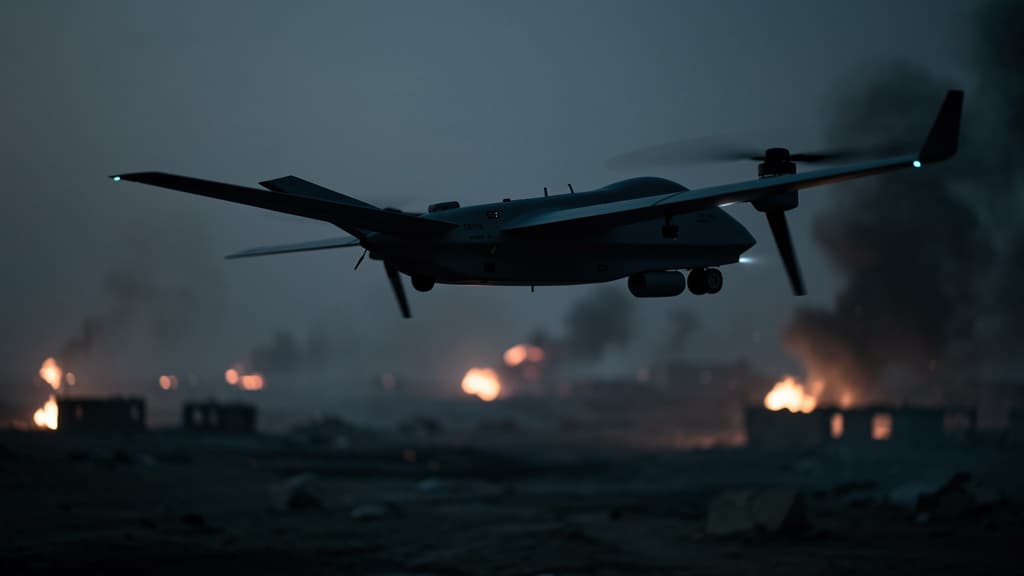
The first confirmed use of lethal autonomous drones offers a sobering blueprint for enterprise architects. Learn why irreversibility and adversarial robustness are the new standards for autonomous AI agents.
When AI Pulls the Trigger: Autonomous Drones and the Future of High-Stakes Decision Systems
The line between science fiction and operational reality collapsed quietly, somewhere over a conflict zone, roughly two years ago. A senior Ukrainian defense official confirmed to New Scientist that fully autonomous drones conducted a lethal engagement — with confirmed casualties — marking the first documented deployment of a lethal autonomous weapon system (LAWS) in actual combat. No human pulled the trigger. No remote operator selected the target. An AI made the kill decision, executed it, and the world moved on without a formal announcement.
For technologists building autonomous AI agents for enterprise, this moment carries implications that extend far beyond military ethics. It represents the first real-world stress test of autonomous agent decision-making in an environment where errors are irreversible — and it surfaces every unresolved question in the agent safety stack that enterprise architects are quietly wrestling with today.
This is not a story about war. It is a story about what happens when autonomous systems operate at the edge of their training distribution, under adversarial conditions, with no human in the loop and no rollback button.
From Remote Control to Genuine AI Decision-Making
The trajectory of drone warfare is instructive precisely because it mirrors the broader arc of autonomous agent development. Early systems were remote-controlled — human operators made every targeting decision, with the drone serving purely as a delivery mechanism. The next generation introduced semi-autonomy: automatic obstacle avoidance, return-to-home failsafes, and target-lock assistance. Humans remained in the decisional loop, but the cognitive load shifted incrementally toward the machine.
The Ukrainian defence industry's confirmed deployment represents a categorical break from this progression. According to the New Scientist report, the test took place two years ago — meaning this capability has been operational, and classified, while public discourse was still debating whether such systems were theoretically feasible.
The architecture enabling this shift involves three interlocking components:
1. Edge inference at millisecond latency. GPS jamming and communication disruption are standard in modern contested airspace. Autonomous drones cannot rely on cloud-based decision models or real-time operator uplinks. Target identification, threat classification, and engagement decisions must execute on-device, often on hardware constrained to single-digit watts of power consumption.
2. Computer vision trained on adversarial datasets. Distinguishing combatants from civilians, identifying valid military targets, and parsing ambiguous battlefield geometry requires models trained on data that is, by definition, difficult to curate ethically or comprehensively. The distribution shift problem — models encountering scenarios outside their training envelope — is not a theoretical concern here. It is a design parameter.
3. Autonomous mission re-planning. When primary targets are unavailable or environmental conditions change, the system must decide whether to abort, loiter, or re-engage. This is where rule-based constraint systems collide with learned heuristics — and where the safety architecture either holds or catastrophically fails.
The Agent Safety Stack Under Lethal Conditions
Enterprise AI teams building autonomous agents — whether for financial trading, supply chain optimization, medical triage support, or infrastructure management — operate under a fundamentally different risk profile than combat systems. But the architectural challenges are structurally identical, and the lessons from the Ukrainian deployment are directly transferable.
The Irreversibility Problem
Autonomous agents in enterprise contexts routinely make decisions that are difficult or impossible to reverse: executing large trades, triggering supply chain reorders, initiating patient treatment protocols, decommissioning infrastructure nodes. The combat drone scenario makes explicit what enterprise architects often treat as an edge case — irreversibility is not a special condition, it is the default state of consequential autonomous action.
The engineering response to irreversibility in high-stakes systems typically involves one of three patterns:
- Hard constraints (rule-based guardrails that cannot be overridden by the learned model)
- Confidence thresholds (the agent acts only when its certainty score exceeds a defined minimum)
- Human escalation triggers (ambiguous cases route to human review before action)
The challenge in adversarial or time-critical environments — combat zones, market microstructure events, real-time fraud detection — is that all three patterns introduce latency. And latency, in those contexts, can itself be a failure mode.
Out-of-Distribution Behavior at the Decision Boundary
The most dangerous moment for any autonomous agent is not when it encounters a clearly recognizable scenario. It is when the input falls near the boundary of its training distribution — familiar enough that the model does not trigger uncertainty flags, but different enough that its learned heuristics no longer apply reliably.
In combat drone systems, this manifests as misidentification: a vehicle that resembles a valid military target but is not, or a combatant who has discarded weapons and is no longer a legitimate target under the rules of engagement the system was trained to approximate. The model's confidence score may remain high precisely because the input is almost familiar.
Enterprise equivalents are everywhere. A fraud detection agent trained on historical transaction patterns may exhibit high confidence when encountering a novel fraud vector that superficially resembles legitimate behavior. A medical AI may generate a high-confidence diagnosis for a presentation that is atypical of the condition it is classifying. The confidence score is not a reliable proxy for correctness at the distribution boundary — and this is one of the most underappreciated failure modes in production autonomous systems.
Research from MIT and Stanford on AI robustness consistently shows that model confidence and model accuracy decorrelate significantly under distribution shift — the scenarios where systems are most confidently wrong are often the scenarios that look most like familiar training data.
The Accountability Gap
When a fully autonomous drone conducts a lethal engagement, the question of accountability becomes genuinely unresolvable under existing legal and organizational frameworks. The operator did not make the decision. The developer trained a model on a dataset and defined a loss function. The military commander authorized a mission profile. No single actor made the specific decision to engage the specific target at the specific moment.
This is not merely a military ethics problem. Enterprise organizations deploying autonomous AI agents are creating structurally identical accountability gaps. When an autonomous trading agent executes a strategy that triggers a flash crash, or an autonomous hiring agent systematically discriminates against a protected class, or an autonomous logistics agent makes a procurement decision that violates a supplier contract — the diffusion of accountability across model developers, system integrators, and business operators creates legal and organizational exposure that most enterprises have not adequately mapped.
The EU AI Act's risk-tiering framework, which came into full enforcement in 2025, attempts to address this by requiring human oversight mechanisms for high-risk AI applications. But the Ukrainian deployment illustrates the gap between regulatory intent and operational reality: when a system is designed to operate without connectivity, human oversight mechanisms are architecturally unavailable, not merely bypassed.
What the Combat Deployment Reveals About Enterprise Agent Design
Constraint Specification Is a First-Class Engineering Problem
The rules of engagement that a combat autonomous system is designed to approximate are, in effect, a constraint specification problem. Translating complex, context-dependent human judgment — when is a target valid? what constitutes proportionality? — into a form that a machine learning system can reliably operationalize is an unsolved problem in AI alignment.
Enterprise agents face the same challenge at lower stakes but higher frequency. Defining what an autonomous procurement agent is and is not permitted to do — across thousands of edge cases that business stakeholders have not anticipated — requires constraint specification work that most organizations currently treat as an afterthought to model development.
The emerging practice of constitutional AI (defining agent behavior through explicit principle hierarchies rather than purely through reward signal) and formal verification (mathematically proving that a system cannot violate specified constraints) are directly relevant here. Neither is mature enough to fully solve the problem, but both represent more rigorous approaches than the implicit constraint encoding that characterizes most current enterprise agent deployments.
Adversarial Robustness Is Not Optional
Combat autonomous systems operate in environments specifically designed to defeat them: GPS spoofing, sensor jamming, camouflage, decoys, and adversarial inputs crafted to exploit model vulnerabilities. The Ukrainian deployment required engineering teams to build systems that maintain decision quality under active adversarial pressure.
Enterprise environments are increasingly adversarial in analogous ways. Fraud actors probe autonomous detection systems to identify decision boundaries. Competitors may attempt to manipulate market data to trigger autonomous trading responses. Malicious actors craft inputs designed to cause autonomous content moderation systems to either over-censor or under-censor. Adversarial robustness — the ability of an autonomous system to maintain reliable behavior when inputs are intentionally crafted to cause failure — is a design requirement, not a post-deployment patch.
Latency-Safety Tradeoffs Require Explicit Architectural Decisions
The combat drone scenario crystallizes a tradeoff that enterprise architects often leave implicit: the faster an autonomous system acts, the less time it has to apply safety checks, seek human input, or evaluate uncertainty. In real-time systems — whether drone engagements, high-frequency trading, or real-time fraud prevention — this tradeoff cannot be avoided. It can only be made explicitly or implicitly.
Explicit architectural decisions about latency-safety tradeoffs include:
- Defining which action categories require synchronous human approval regardless of latency cost
- Specifying minimum uncertainty thresholds below which the system must abort rather than act
- Designing tiered response modes (high-confidence fast-path vs. low-confidence escalation path) with clear transition criteria
Implicit decisions — which is to say, no decision — default to optimizing for latency at the expense of safety. The Ukrainian deployment suggests that even military systems, with the highest possible stakes, have not fully resolved this tradeoff. Enterprise systems, with less existential pressure to ship, have less excuse for leaving it unaddressed.
The Normalization Effect and Its Enterprise Parallel
Perhaps the most significant implication of the Ukrainian autonomous drone deployment is not technical — it is normative. The test took place two years ago. It was not publicly disclosed at the time. It has now been confirmed, briefly reported, and will likely be absorbed into the background radiation of AI development discourse without triggering the structural response it warrants.
This normalization dynamic is directly observable in enterprise AI deployment. Autonomous systems make consequential errors — a hiring algorithm rejects qualified candidates, a credit model denies loans along demographic lines, an autonomous customer service agent provides materially incorrect information — and the response is typically a model update, not a structural reassessment of where autonomous decision-making is and is not appropriate.
The combat drone deployment should function as a forcing function for the enterprise AI community to ask a question that is currently underasked: for which decision categories should autonomous AI agents never be the final decision-maker, regardless of their measured accuracy?
This is not a question about capability. It is a question about appropriate scope — and answering it requires organizational clarity about values, accountability structures, and risk tolerance that technical teams alone cannot provide.
Implications for Enterprise Agent Architecture
The shift from remote-controlled systems to genuine AI decision-making in conflict zones provides a compressed, high-stakes case study in autonomous agent deployment. The architectural lessons are transferable:
Build for irreversibility by default. Assume that autonomous agent actions cannot be undone, and design confirmation, staging, and rollback mechanisms accordingly — even when the nominal use case does not seem to require them.
Treat constraint specification as a core deliverable. The rules governing agent behavior should be as rigorously specified and tested as the model itself. Implicit constraints encoded in training data are not constraints — they are liabilities.
Map the distribution boundary explicitly. Identify the scenarios where your agent's training data is sparse or absent, and define explicit behavior for those cases — typically, escalation to human review rather than high-confidence action on unfamiliar inputs.
Audit adversarial robustness before deployment. Red-team autonomous agents against inputs specifically designed to cause failure. In enterprise contexts, these inputs will eventually arrive from real actors with real incentives to find them.
Make the latency-safety tradeoff explicit. Document which action categories are permitted to execute at machine speed, which require staged confirmation, and which require human approval — and make those decisions at the architectural level, not the model level.
The Ukrainian defence industry's confirmed deployment of fully autonomous lethal drones is a threshold event in the history of autonomous systems. It confirms that AI agents can and do make irreversible, high-stakes decisions without human oversight — and that the safety architectures governing those decisions remain, at best, incompletely solved. For enterprise teams building autonomous AI agents for consequential applications, the question is not whether these challenges apply to them. It is whether they are taking them as seriously as the stakes require.
Sources:
- Fully Autonomous Drones Have Killed Human Soldiers for the First Time — New Scientist
- EU AI Act — Official Text and Enforcement Timeline
- ICRC Report on Autonomous Weapon Systems
- NIST AI Risk Management Framework
- Anthropic Constitutional AI Research
Last reviewed: June 21, 2026