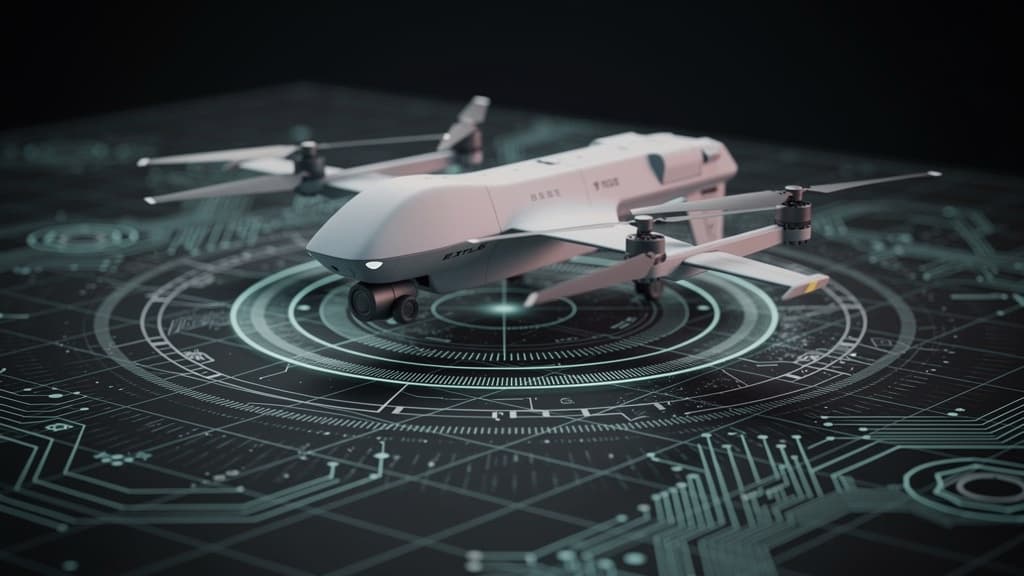
The line between battlefield autonomy and enterprise software has blurred. As autonomous drones see combat, enterprise leaders must rethink the accountability architectures governing their own AI agents.
The line between science fiction and battlefield reality collapsed quietly, without a formal announcement or a United Nations resolution. A senior Ukrainian defence official confirmed to New Scientist that fully autonomous drones have killed human soldiers in combat — with a test occurring two years ago involving autonomous systems programmed to destroy anything that moved within a designated area. No human pulled a trigger. No human made a targeting decision. The machine did.
This is the inflection point that AI ethicists, military strategists, and enterprise technologists have been debating in the abstract for years. It is no longer abstract.
And yet, in the same week that news broke, enterprise software teams across Silicon Valley were busy debating the appropriate "guardrails" for AI agents that schedule meetings and summarize documents. The contrast is not just jarring — it reveals a profound inconsistency in how we think about autonomous AI agents and the accountability frameworks we build around them.
The Battlefield Has Already Moved On
According to the New Scientist report, the Ukrainian defence industry did not wait for international consensus on lethal autonomy. Facing an adversary with significant numerical advantages in personnel and materiel, Ukrainian engineers and military planners made a pragmatic decision: delegate the kill decision to the algorithm.
The operational logic is coldly rational. Human pilots operating FPV drones are vulnerable to electronic jamming. Communication links can be severed. Reaction times are bounded by human neurology. An autonomous system with onboard inference — running a trained model locally, without a radio link — sidesteps all of those vulnerabilities simultaneously.
"Fully autonomous drones have killed human soldiers in combat" — confirmed by a senior Ukrainian defence official, New Scientist, 2026
This is not a prototype. This is not a test range demonstration. This is a confirmed casualty event produced by a machine acting on its own judgment within a defined operational zone. The two-years-ago timeline places the first lethal autonomous engagement around 2024 — meaning the technology has had time to mature, proliferate, and almost certainly be studied and replicated by other actors.
The implications for international humanitarian law are severe and largely unresolved. The Geneva Conventions require distinction between combatants and civilians, proportionality in attack, and precaution. None of those principles were designed with an algorithm as the decision-maker. Who is legally responsible when a drone autonomously kills the wrong person? The software engineer? The commanding officer who designated the kill zone? The procurement official who approved the system?
These are not rhetorical questions. They are the questions that will define military accountability for the next generation of conflict.
Enterprise AI Agents Are Not Drones — But the Architecture Is Closer Than You Think
Here is where the argument becomes uncomfortable for the enterprise technology community.
The same architectural patterns powering autonomous drones — perception models, decision engines, action execution loops, minimal human-in-the-loop intervention — are the patterns being deployed in autonomous AI agents for enterprise workflows. The agent observes an environment (inbox, database, API surface), reasons about a goal (close this ticket, execute this trade, update this record), and takes action without waiting for a human to approve each step.
The difference, obviously, is stakes. An enterprise agent that miscategorizes a support ticket causes inconvenience. An autonomous drone that misidentifies a target causes death. The moral weight is incomparable.
But the structural lesson from the battlefield is directly applicable to the enterprise: autonomy without accountability is a liability that scales with the power of the system. The Ukrainian defence industry accepted that liability consciously, in a context where the alternative was losing the war. Enterprise organizations adopting agentic AI are, in many cases, accepting the same liability unconsciously, in contexts where the trade-off is far less clear.
The Safety Protocol Gap
Enterprise-grade agent safety has matured considerably in the past 18 months. Leading platforms now implement layered controls: sandboxed execution environments, human-in-the-loop approval gates for high-stakes actions, audit trails, rate limiting on consequential operations, and rollback mechanisms. Anthropic's model specification for Claude, OpenAI's operator/user permission hierarchy, and Google DeepMind's published alignment research all reflect genuine engineering investment in constraining autonomous behavior.
But deployment reality frequently diverges from design intent. Organizations eager to realize the productivity gains of fully autonomous agents often disable or bypass approval gates. "Human-in-the-loop" becomes a checkbox rather than a genuine oversight mechanism. The agent is given broad permissions because restricting permissions requires effort and slows deployment timelines.
This is the enterprise equivalent of setting a drone to destroy anything in a designated area and walking away. The zone is defined. The rules of engagement are encoded. The human has technically made a decision — but the human is no longer present for the consequences.
The structural lesson from the battlefield: autonomy without accountability is a liability that scales with the power of the system.
What the Drone Precedent Actually Teaches Us
The Ukrainian case should not be read purely as a cautionary tale about military AI. It should be read as a data point about what happens when capability outpaces governance — and how quickly that gap can close in one direction while remaining open in the other.
Capability closed fast. Governance remains open.
For enterprise AI practitioners, the practical takeaways are specific:
1. Define your kill zone explicitly. In autonomous drone deployment, the kill zone is a geographic boundary within which the system has lethal authority. In enterprise agent deployment, the equivalent is the permission scope: what systems can the agent read, what systems can it write, what actions can it take without approval? Vague permission scopes are the enterprise equivalent of an undefined kill zone — the agent will act, and the boundary of acceptable action will only become clear after something goes wrong.
2. Distinguish between automation and autonomy. Automation executes predefined rules. Autonomy involves goal-directed reasoning and novel action selection. The Ukrainian drones were autonomous, not merely automated. Many enterprise deployments labeled as "automated" are actually autonomous in the relevant sense — they are making judgment calls, not just following scripts. The safety protocols appropriate for each are different.
3. Build accountability into the architecture, not the policy document. The reason military lawyers are struggling with autonomous drone accountability is that the accountability structure was never engineered into the system — it was assumed to exist in the chain of command around the system. Enterprise organizations make the same mistake when they assume that existing approval workflows will catch agent errors. If the agent can act faster than the approval workflow, the workflow is decorative.
4. Treat edge cases as design inputs, not post-deployment surprises. Autonomous systems fail at the edges of their training distribution. The drone misidentifies a civilian because the civilian's thermal signature resembles a combatant's. The enterprise agent misroutes a transaction because the transaction has an unusual flag combination. Both failures were predictable from the training data. Both were treated as surprises. Adversarial testing and red-teaming for autonomous agents is not optional — it is the engineering equivalent of rules-of-engagement review.
The Ethics Are Not Separate From the Engineering
There is a tendency in enterprise technology to treat ethics as a compliance layer — something applied to a system after it is built, managed by a responsible AI team that reviews outputs rather than shapes architecture. The drone precedent exposes this as inadequate.
The decision to deploy fully autonomous lethal systems was an engineering decision, a procurement decision, a command decision, and an ethical decision simultaneously. There was no clean separation between "building the capability" and "deciding how to use it." The capability itself encoded the decision.
The same is true of enterprise agents. When you design an agent with write access to a production database and no mandatory human review gate for schema changes, you have made an ethical decision about acceptable risk. When you give an agent access to customer communications and allow it to send responses autonomously, you have made a decision about whose interests the agent represents and what errors are tolerable.
These decisions are being made right now, at scale, by engineering teams under delivery pressure. They deserve the same deliberate scrutiny that — ideally — military planners apply to weapons deployment decisions. In practice, they are receiving considerably less.
A Different Kind of Arms Race
The confirmation that fully autonomous drones have killed human soldiers will accelerate development, not constrain it. Every military that was waiting for proof-of-concept now has it. Every defence contractor that was hedging on autonomous systems investment now has a market signal. The arms race dynamic — if your adversary deploys autonomous lethal systems and you do not, you accept an asymmetric disadvantage — will drive adoption faster than any international treaty process can respond.
The enterprise AI adoption dynamic is structurally similar, if existentially different in stakes. Organizations that deploy autonomous agents gain productivity advantages over those that do not. Competitive pressure drives adoption. Governance frameworks lag capability. The organizations that move fastest accept the most risk — and externalize some of that risk onto their customers, employees, and partners.
The question for enterprise technology leaders is not whether to deploy autonomous AI agents. That question is already answered by competitive reality. The question is whether to deploy them with the accountability architecture that the capability demands — or to treat governance as an obstacle to speed and discover the consequences later.
The battlefield has already provided one answer to what "later" looks like.
Sources:
- Fully autonomous drones have killed human soldiers for the first time — New Scientist, 2026
- Anthropic Model Specification: https://www.anthropic.com/research/model-specification
- ICRC Position on Autonomous Weapon Systems: https://www.icrc.org/en/document/icrc-position-autonomous-weapon-systems
- NIST AI Risk Management Framework: https://www.nist.gov/system/files/documents/2023/01/26/AI%20RMF%201.0.pdf
Last reviewed: June 11, 2026