Researchers from Nvidia, CMU, and UC Berkeley have achieved a 99% success rate in dexterous robotics using AI coding agents. Learn how this three-layer architecture is setting a new standard for enterprise automation.
What This Tutorial Covers
Researchers from Nvidia, Carnegie Mellon University, and UC Berkeley have achieved something that seemed out of reach just two years ago: AI coding agents autonomously training fleets of physical robots to perform dexterous grasping tasks with up to 99 percent success rates under real-world conditions. This tutorial breaks down exactly how that integration works — from the agent architecture to the training loop to the physical deployment — so you can understand how the same pattern might apply to enterprise robotics pipelines.
Prerequisites: Familiarity with LLM-based agent frameworks (LangChain, AutoGen, or similar), basic reinforcement learning concepts, and a working understanding of robotic manipulation terminology (end-effectors, grasp planning, sim-to-real transfer).
What you'll learn: The three-layer integration model connecting AI coding agents to robot fleets, how the 99 percent success rate was validated, and what architectural decisions made scale possible across eight robots operating in parallel.
Why Dexterous Robotics Is the Hard Problem
Before unpacking the breakthrough, it's worth understanding why dexterous manipulation has resisted automation for so long. Unlike locomotion — walking, navigating — grasping requires the robot to reason about object geometry, surface friction, approach angle, and grip force simultaneously, often with incomplete sensor data.
Traditional approaches relied on hand-coded motion planners or narrow reinforcement learning policies trained for single objects in controlled environments. Neither scales. The moment you introduce a new object shape or a slightly different lighting condition, performance collapses.
This is precisely the gap that the Nvidia–CMU–Berkeley team targeted: not just a better grasp planner, but a self-improving training system where AI agents generate, test, and refine robot policies without human intervention at each iteration.
Step 1 — Understand the Agent-Robot Architecture
The core architectural insight is a three-layer stack that separates concerns cleanly.
Layer 1: The AI Coding Agent (Reasoning + Code Generation)
At the top sits an LLM-based coding agent — conceptually similar to what practitioners know from tools like GitHub Copilot or Devin, but purpose-built for robotics policy generation. The agent's job is to:
- Interpret a high-level task description (e.g., "grasp a cylindrical object from a cluttered bin")
- Generate executable robot control code — typically a reward function or a motion primitive — in a simulation-compatible format
- Analyze failure logs and rewrite the policy when performance degrades
This is the critical departure from prior work. Instead of a human robotics engineer iterating on reward functions, the AI coding agent performs that loop autonomously. It reads structured feedback from the simulation environment, identifies which grasp attempts failed and why, and produces a revised code artifact.
Layer 2: Simulation Environment (Validation + Filtering)
Generated policies don't go directly to hardware. They first run in a high-fidelity physics simulator — likely Nvidia Isaac Sim, given the institutional affiliation — where thousands of grasp attempts are evaluated in compressed time. Policies that fail to meet a threshold success rate are returned to the coding agent with structured error reports.
This sim-in-the-loop design is what makes scale possible. The compute cost of running 10,000 simulated grasps is negligible compared to the cost of running 10,000 physical attempts across a robot fleet.
Layer 3: Physical Robot Fleet (Real-World Validation)
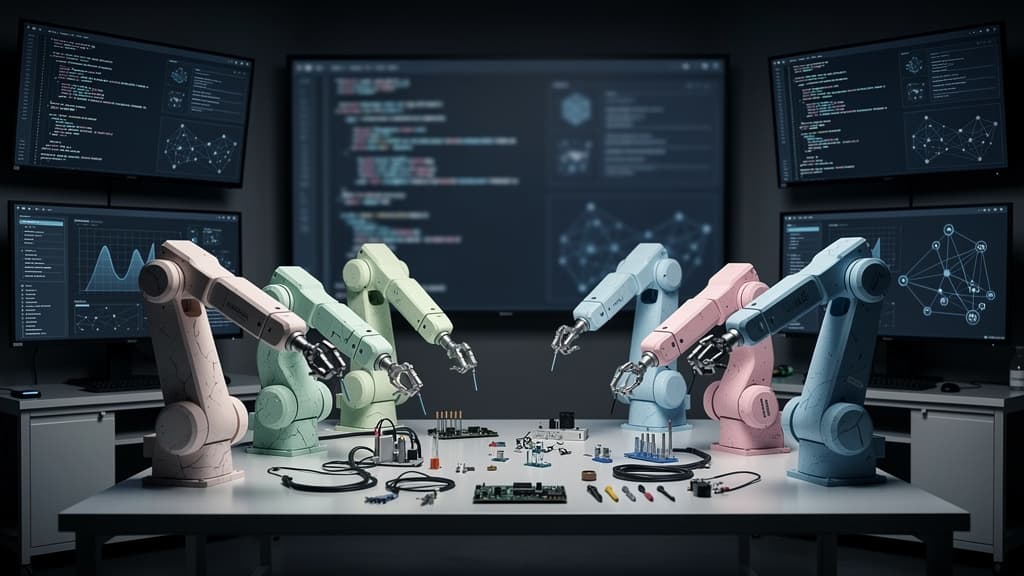
Policies that clear the simulation threshold are deployed to eight robots operating in parallel. This parallel deployment serves two purposes: it accelerates real-world data collection and it stress-tests whether the policy generalizes across minor hardware variations between units — differences in joint calibration, sensor noise, and gripper wear that simulation cannot fully capture.
The 99 percent success rate reported by the Nvidia–CMU–Berkeley team reflects performance on real-world hardware after this full three-layer pipeline, not simulation-only results.
Step 2 — Trace the Training Loop in Detail
Understanding the loop is essential if you're considering adapting this architecture for enterprise deployments. Here's the sequence:
1. Task specification input — A natural language or structured task description enters the coding agent. For the research demonstration, tasks centered on dexterous grasping of varied objects.
2. Policy code generation — The agent produces a reward function or low-level control policy. The output is executable code, not a natural language plan. This matters because it can be directly evaluated by the simulator without an additional translation step.
3. Simulation rollout — The generated policy runs N episodes in simulation. Metrics collected include grasp success rate, contact force profiles, and failure mode categorization (missed approach, slip during lift, collision with bin edge, etc.).
4. Structured feedback to agent — Failure data is formatted into a structured prompt and returned to the coding agent. This is where the agent's reasoning capability matters most — it must correctly attribute failures to specific policy decisions and generate a targeted fix rather than a random perturbation.
5. Iteration until threshold — Steps 2–4 repeat until the policy clears the simulation success threshold. Research in related agent-code systems suggests this loop typically converges in 3–7 iterations for well-scoped tasks.
6. Real-world deployment and telemetry — The validated policy deploys to the eight-robot fleet. Real-world telemetry feeds back into the system, and significant performance gaps between simulation and reality trigger another coding-agent revision cycle.
This closed loop is what distinguishes the approach from earlier sim-to-real transfer methods, which treated simulation and physical deployment as sequential rather than iterative stages.
Step 3 — Interpret the 99 Percent Success Rate Correctly
A 99 percent success rate is a striking number, and it's worth being precise about what it measures and what it doesn't.
What it measures: Successful dexterous grasps on the target object set, under the tested environmental conditions, after the full agent-training pipeline has converged.
What to watch for when applying this benchmark:
- Object diversity scope: Research benchmarks often use a defined object set. Enterprise applications typically face far more varied SKUs or part geometries. The relevant question is how quickly the agent loop converges on new objects not seen during initial training.
- Environmental variation: Lighting, bin fill level, and object orientation all affect grasp success. The 99 percent figure reflects controlled real-world conditions, not arbitrary factory-floor variability.
- Fleet consistency: Eight robots is a meaningful proof of scale, but enterprise deployments may run dozens or hundreds of units with greater hardware heterogeneity.
None of these caveats diminish the significance of the result. They frame where the next engineering work lives.
Step 4 — Map This to Enterprise AI Agent Deployments
For practitioners building autonomous AI agents for enterprise applications, the Nvidia–CMU–Berkeley architecture offers a transferable pattern well beyond robotics.
The Agent + Simulator + Real Environment Pattern
The three-layer stack maps cleanly onto enterprise software contexts:
| Robotics Layer | Enterprise Analog |
|---|---|
| AI Coding Agent | LLM agent generating automation scripts or workflow code |
| Physics Simulator | Staging environment or sandboxed test harness |
| Physical Robot Fleet | Production system or live API endpoints |
The key principle is identical: never let agent-generated code touch production until it has cleared a structured validation layer, and feed structured failure data back to the agent rather than relying on human debugging.
Structured Feedback Is the Differentiator
The research team's approach works because failure data is structured — categorized, attributed, and formatted for agent consumption. In enterprise agent pipelines, this means investing in observability tooling that produces machine-readable failure reports, not just human-readable logs.
Parallelism Accelerates Convergence
Running eight physical robots in parallel isn't just about throughput — it's about faster convergence on robust policies by exposing them to hardware variance simultaneously. Enterprise teams should consider analogous parallel validation strategies: running agent-generated workflows across multiple tenant environments or data profiles before broad rollout.
The Broader Significance for Embodied AI
The Nvidia–Carnegie Mellon–UC Berkeley result, detailed in The Decoder's coverage, marks a meaningful inflection point. It demonstrates that LLM-scale reasoning, applied through coding agents, can close the sim-to-real gap that has bottlenecked dexterous robotics for years.
The implications extend beyond grasp tasks. If an AI coding agent can autonomously iterate a robot manipulation policy to 99 percent real-world success, the same architecture is a credible candidate for assembly tasks, surgical robotics, warehouse picking, and any domain where dexterous manipulation has been the rate-limiting step.
For enterprise technology decision-makers, the signal is clear: the integration of AI agent reasoning with physical or digital execution environments is no longer a research curiosity. It is an engineering pattern with demonstrated, measurable results — and it will define the next generation of autonomous systems.
Last reviewed: June 18, 2026