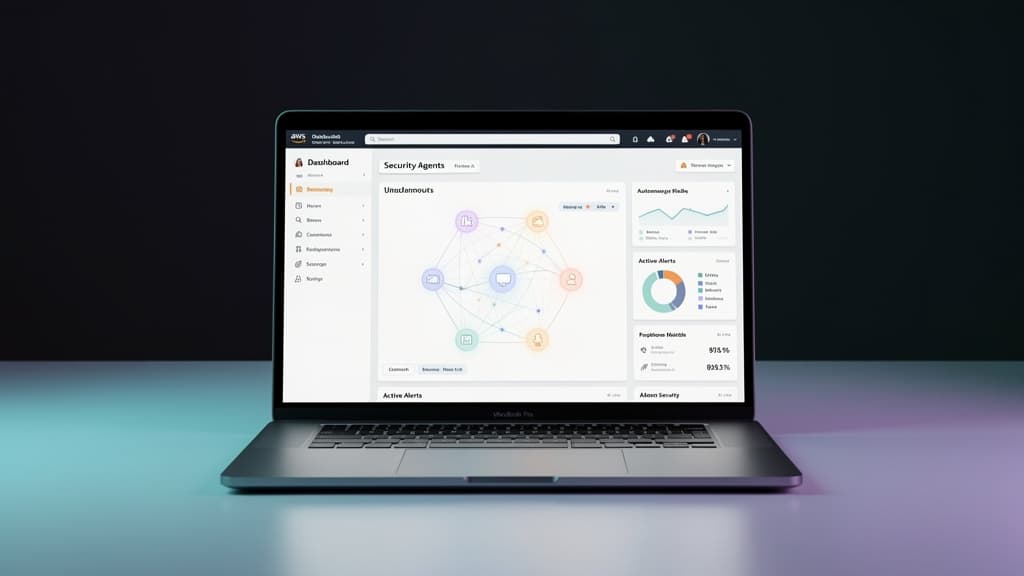
AWS has launched Continuum and Context to address the security and organizational awareness gaps preventing the widespread adoption of autonomous AI agents in enterprise environments.
AWS has introduced two new services—Continuum and Context—designed to close the security and business-awareness gaps that have made enterprises hesitant to deploy autonomous AI agents at scale. The announcements, made in mid-2026, come as organizations increasingly recognize that agents capable of generating and executing code rapidly are only useful if they can be trusted not to introduce vulnerabilities or act without organizational awareness.
The Problem AWS Is Solving
Enterprise adoption of autonomous AI agents has stalled not because the technology lacks capability, but because it lacks guardrails. Agents can produce working code in seconds, autonomously call APIs, and chain together complex workflows—but they do so without inherent knowledge of a company's security posture, compliance requirements, or internal business logic. This creates two distinct failure modes that Continuum and Context are each built to address.
The first failure mode is security exposure. Agents that write code can just as easily write insecure code—introducing SQL injection vulnerabilities, hardcoding credentials, or generating dependencies with known CVEs. The second failure mode is context blindness: an agent that doesn't know your organizational hierarchy, data classification policies, or existing system architecture is likely to make decisions that are technically correct but operationally wrong.
AWS's position is blunt: AI agents currently lack both the security safeguards and the organizational awareness that enterprise deployment demands.
Continuum: Security Scanning Built Into the Agent Loop
Continuum is AWS's answer to the security exposure problem. Rather than treating code review as a downstream step that happens after an agent has already committed output, Continuum integrates vulnerability detection and remediation directly into the agent's workflow.
The service is designed to scan agent-generated code for known vulnerability patterns, flag issues in real time, and—critically—suggest or apply fixes without requiring a human to manually intervene at every step. This positions Continuum as an active participant in the agent loop rather than a passive audit tool.
For enterprise security teams, this distinction matters considerably. Traditional application security tools are built around human developers who write code in discrete sessions. Agents operate continuously, at volume, and across multiple systems simultaneously. A scanning tool that produces a report after the fact is of limited value when an agent has already pushed hundreds of code changes. Continuum's inline approach is designed to match the speed and scale at which agents actually operate.
The service also reflects a broader architectural principle gaining traction in enterprise AI: shift-left security for agentic systems. Just as DevSecOps moved security earlier in the software development lifecycle, Continuum attempts to embed security judgment into the agent's generation process itself.
Context: Giving Agents Organizational Intelligence
The second service, Context, addresses a different but equally critical problem. Even a perfectly secure agent is a liability if it doesn't understand the organization it's operating within. Context is a knowledge graph service that allows enterprises to structure and expose their internal business information—org structures, data ownership, system dependencies, compliance frameworks, and operational policies—in a form that agents can query and reason over.
Knowledge graphs are not a new concept in enterprise software, but their application to agent grounding represents a meaningful architectural shift. Rather than relying on agents to infer organizational context from unstructured documents or prompt engineering alone, Context provides a structured, queryable representation of business reality that agents can reference when making decisions.
The practical implications are significant. An agent tasked with modifying a database schema, for example, could query Context to determine which downstream systems depend on that schema, which data classification tier the database falls under, and which team owns the approval workflow—before taking any action. Without something like Context, that same agent might proceed based solely on the immediate task description, with no visibility into organizational consequences.
Why This Matters for Enterprise Agent Deployment
The dual announcement signals that AWS has absorbed a clear message from its enterprise customers: the barrier to agentic AI deployment is not model capability—it is trust infrastructure. Organizations that have piloted autonomous agents consistently report the same concerns: agents that act outside their intended scope, generate outputs that require extensive human review, or make decisions that are locally rational but globally problematic.
Continuum and Context are AWS's attempt to build that trust infrastructure into the cloud platform layer, rather than leaving it to individual enterprises to construct from scratch. This is strategically significant. By making security scanning and business context services native to the AWS agent ecosystem, AWS is positioning itself as the platform of record for enterprise-grade agentic AI—not just a compute provider.
The move also puts pressure on competitors. Microsoft Azure and Google Cloud have both invested heavily in agent frameworks and orchestration tooling, but neither has yet announced services with this specific combination of inline security remediation and structured business context for agents. Enterprises evaluating platforms for agentic workloads now have a concrete differentiator to assess.
What to Watch Next
Several questions will determine how much traction Continuum and Context actually gain in enterprise environments.
Integration depth will be the first test. If these services work seamlessly with Amazon Bedrock Agents and the broader AWS agent orchestration stack, adoption friction will be low. If they require significant custom integration work, enterprises may find the value proposition harder to realize.
Coverage breadth for Continuum will also matter. Vulnerability detection is only as valuable as the breadth of its rule set and its false-positive rate. Enterprises will want to understand which vulnerability classes Continuum covers, how it handles novel or framework-specific patterns, and whether it can be customized to enforce organization-specific security policies.
For Context, the critical question is knowledge graph maintenance. Business context is not static—organizations restructure, systems change, and policies evolve. A knowledge graph that is accurate at deployment but drifts over time could become a source of incorrect agent decisions rather than a safeguard against them. AWS will need to provide clear tooling for keeping Context graphs current.
Finally, pricing and operational overhead will influence adoption. Enterprises are already managing significant complexity in their AI stacks. Services that add cost and operational burden without a clear, measurable reduction in risk or rework will face internal resistance regardless of their technical merits.
The underlying direction, however, is clear. AWS is betting that the next phase of enterprise AI adoption belongs to whoever can make autonomous agents trustworthy—and it is building that trust layer directly into its platform.
Sources:
- AWS Says AI Agents Lack Business Context and Security, Launches Two Services to Patch the Gaps — The Decoder
Last reviewed: June 22, 2026