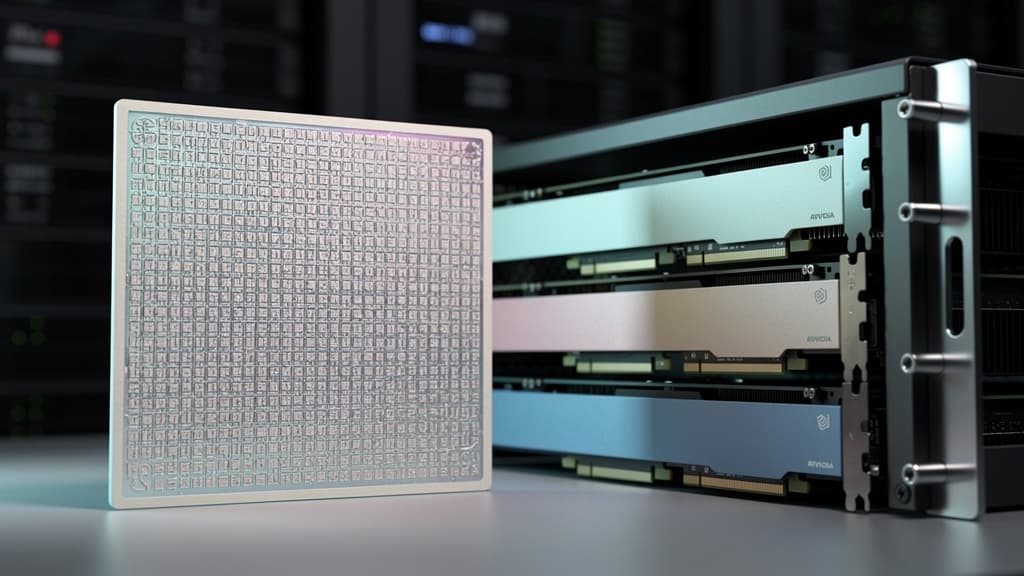
Cerebras Systems is aiming for a $40 billion valuation in its latest IPO attempt. We analyze how this move challenges Nvidia's market dominance and shifts the landscape for enterprise AI infrastructure investment.
Cerebras Systems Targets $40B Valuation in Second IPO Attempt — and Nvidia Is Watching
AI chip maker Cerebras Systems is making its second run at the public markets, this time with considerably more momentum behind it. The company launched its IPO roadshow on Monday, targeting a listing on Nasdaq under the ticker CBRS, with share pricing set between $115 and $125 — a range that would place its post-money valuation at approximately $40 billion. The offering aims to raise roughly $3.5 billion, according to reporting from Bloomberg and The Decoder.
The timing is deliberate. Enterprise AI infrastructure spending is accelerating at a pace that is straining Nvidia's supply chain and drawing scrutiny over single-vendor concentration risk. Cerebras is positioning itself as the credible alternative — and a $40 billion valuation would make that argument harder to dismiss.
A Hardware-First Challenger in a GPU-Dominated Market
Cerebras built its identity around a single, audacious engineering bet: the Wafer-Scale Engine (WSE), a chip so large it occupies an entire silicon wafer rather than the postage-stamp-sized dies that conventional GPUs use. The WSE-3, the company's current flagship, contains 4 trillion transistors and 900,000 AI-optimized cores — figures that dwarf anything in Nvidia's current lineup on a per-chip basis.
The architectural philosophy behind this approach is fundamentally different from Nvidia's. Where Nvidia scales performance by networking thousands of discrete GPUs together — a strategy that introduces significant inter-chip communication overhead — Cerebras eliminates that bottleneck by keeping computation on a single, massive die. For certain workloads, particularly large language model training and inference on long-context inputs, this translates into measurable latency and throughput advantages.
This is precisely the kind of hardware differentiation that enterprise buyers evaluating nvidia ai infrastructure investment impact on their total cost of ownership are beginning to scrutinize more carefully.
Why the Valuation Number Matters
A $40 billion post-money valuation is not just a financial milestone — it is a strategic signal. It places Cerebras in a tier of AI infrastructure companies that institutional investors, hyperscalers, and enterprise procurement teams are required to take seriously.
For context, Nvidia's market capitalization has oscillated between $2 trillion and $3.5 trillion over the past 18 months, making a direct comparison almost absurd. But valuation in this context is less about parity and more about credibility threshold. At $40 billion, Cerebras crosses into territory where it becomes a viable second-source supplier for organizations that have board-level mandates to diversify AI chip exposure.
Cerebras is targeting a $40 billion post-money valuation, with shares priced between $115 and $125 — positioning the company as a direct rival to Nvidia in the AI infrastructure buildout.
The IPO also arrives after Cerebras withdrew a previous filing, reportedly due to regulatory complications tied to its relationship with G42, a UAE-based AI investment group. The successful navigation of that scrutiny, and the decision to re-file with an aggressive valuation target, suggests the company and its underwriters believe the market window is open.
The Competitive Landscape Is Shifting
Cerebras is not operating in a vacuum. The broader AI chip competitive landscape has grown meaningfully more complex over the past 24 months. AMD's MI300X has captured meaningful share in inference workloads. Google's TPU v5 continues to power a significant portion of the company's internal AI training. Intel's Gaudi line, despite mixed market reception, remains a factor in price-sensitive deployments. And a wave of custom silicon from hyperscalers — Amazon's Trainium, Microsoft's Maia — is quietly pulling workloads off third-party chips entirely.
Against this backdrop, Cerebras occupies a specific and defensible niche: ultra-high-throughput inference and fast training runs for organizations that cannot afford the latency penalties of multi-GPU cluster communication. The company has publicly demonstrated inference speeds on frontier models that significantly exceed what comparably priced GPU clusters deliver.
The question the IPO roadshow will need to answer is whether that niche is large enough — and sticky enough — to justify the valuation and sustain growth as Nvidia continues to iterate aggressively with its Blackwell and upcoming Rubin architectures.
What to Watch as the IPO Progresses
Institutional demand signals will be the first meaningful data point. If the book is oversubscribed at the top of the $115–$125 range, it confirms that sophisticated investors see Cerebras as a durable infrastructure play rather than a speculative bet. If pricing comes in below range, it suggests the market is discounting execution risk or the narrowness of the addressable market.
Customer concentration will also draw scrutiny. Cerebras has disclosed a relatively small number of large customers driving the majority of revenue — a common profile for early-stage hardware companies, but one that creates vulnerability if a single account shifts strategy.
Finally, watch for Nvidia's response. The company has a history of accelerating roadmap announcements and pricing adjustments when competitive pressure becomes visible. A successful Cerebras IPO at $40 billion would almost certainly prompt a strategic response, whether in the form of accelerated Blackwell availability, more aggressive enterprise pricing, or expanded software ecosystem investments designed to raise switching costs.
The Broader Implication for AI Infrastructure Investment
The Cerebras IPO is, in one sense, a single company event. In another, it is a referendum on whether the AI infrastructure market can support a genuine multi-vendor ecosystem — or whether Nvidia's dominance will prove as durable as Intel's was in the PC era (until it wasn't).
For technology decision-makers evaluating AI infrastructure investments today, the emergence of a well-capitalized, publicly traded Cerebras changes the procurement calculus. It provides a benchmark, a negotiating lever, and — if the technology delivers on its benchmarks — a genuine alternative for specific workload classes.
The roadshow is live. The pricing decision is imminent. The AI chip market's next chapter is being written in real time.
Last reviewed: May 04, 2026