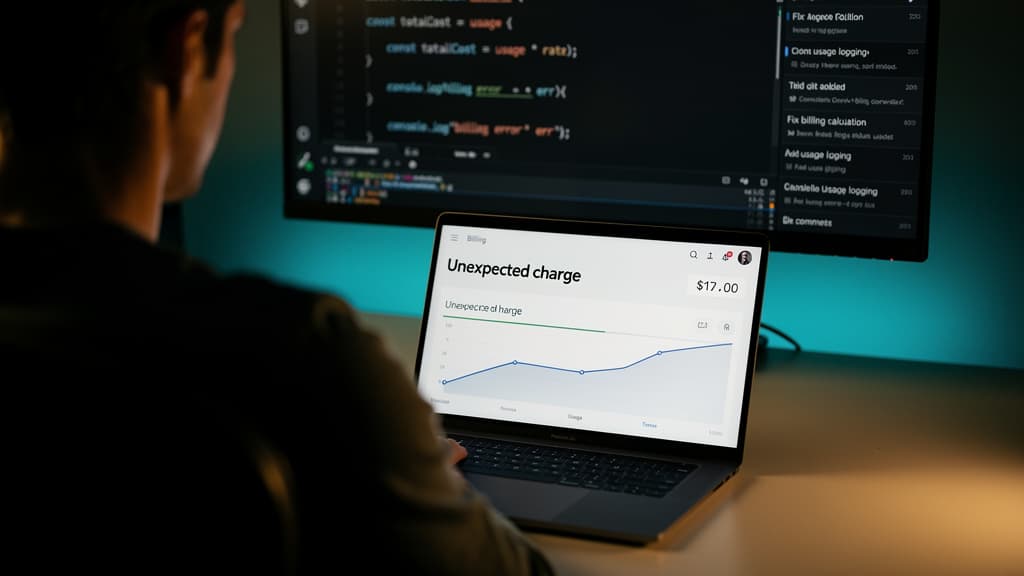
A recent billing incident with Anthropic's Claude Code exposes a new category of risk: platform control bugs that silently alter service delivery based on your codebase content.
The enterprise AI security conversation has long focused on the obvious threats: data leakage through model prompts, adversarial inputs, supply chain poisoning. But Anthropic's recent Claude Code billing incident points to a category of risk that gets far less attention — and may be far more insidious: platform control bugs that silently alter service delivery based on what your code says, not what you do.
This wasn't a breach. No attacker was involved. The threat came from inside the platform itself.
What Actually Happened
On Matt Wolfe's YouTube channel, Anthropic Users Are Getting Screwed Over lays out the incident with uncomfortable specificity. A user on the Claude Max 20X plan — the $200/month tier — suddenly received an "out of extra usage" message despite his dashboard showing 13% weekly usage and 0% current session usage. His actual charge: $200.98 in unexpected overage fees.
His debugging process was methodical and revealing:
"He started binary searching repos and commits until he found the trigger, the string hermes.md in a recent git commit message."
The culprit was a mention of Hermes, a third-party AI harness, buried in a commit message. Claude Code's system had apparently been scanning git context pulled into the system prompt and flagging references to competing or non-Anthropic harnesses — including Open Claw — either by refusing service or by rerouting billing in ways that generated unexpected charges.
Anthropics support team initially acknowledged the issue, labeled it an "authentication routing issue," and then declined to issue a refund. Only after the original posts accumulated over 2.4 million combined views did Tariq from Anthropic step in publicly:
"Sorry, this was a bug with the third-party harness detection and how we pull git status into the system prompt. We're reaching out to affected users and giving them a refund plus another month's worth of credit."
The happy ending shouldn't obscure what the incident revealed. Here are five reasons enterprise security teams should treat this as a signal, not an anomaly.
1. Your Codebase Is Now Part of the Attack Surface
Traditional software billing is determined by metered API calls, compute consumed, or seat licenses. None of those models create a scenario where the content of your repository influences your invoice.
Claude Code changed that equation. By pulling git status into the system prompt — a reasonable design choice for giving the model context — Anthropic inadvertently created a pathway where repository content influenced service routing. For enterprise users, this is a fundamental shift: your intellectual property, your dependency choices, your commit history are now inputs to a billing and access control system you don't govern.
The security implication isn't theoretical. If a bug in harness detection can trigger billing rerouting, a more sophisticated flaw — or a deliberate policy change — could do the same based on any string in your codebase. Competitor names. Open-source licenses. Internal tool references. The blast radius is difficult to bound.
2. "Authentication Routing" Is a New and Poorly Understood Attack Vector
The term Anthropic used — authentication routing issue — deserves scrutiny. In conventional security architecture, authentication and billing are separate concerns. Authentication determines who you are; billing determines what you owe. A bug that conflates the two isn't just a billing error. It's a sign that service-layer logic is doing work that spans multiple trust boundaries simultaneously.
For enterprise security architects, this is a red flag. When a single system component — in this case, the mechanism that reads git context — can simultaneously affect access control and financial liability, you have a high-value target with a large blast radius. Attackers who understand this architecture could theoretically craft repository content designed to trigger specific routing behaviors. Defenders who don't understand it can't model the threat.
No CVE will be filed for this incident. It won't appear in a threat intelligence feed. But it belongs in your enterprise AI risk register.
3. The Refund Only Happened Because of Viral Pressure
This is the point Matt Wolfe makes that enterprises should sit with:
"I do wonder if Anthropic would have had this response had this post from Aman Patel not gotten 1.4 million views and this post from Theo getting 1 million views."
The initial support response was a flat refusal: "We are unable to issue compensation for degraded service or technical errors that result in incorrect billing routing." The policy reversal came after public outrage, not after internal escalation or a formal enterprise SLA process.
For individual consumers, viral pressure is a legitimate recourse mechanism. For enterprises running production workloads on these platforms, it is not. Enterprise procurement teams negotiate SLAs, uptime guarantees, and liability caps precisely because they cannot rely on Twitter to resolve billing disputes. If the de facto remediation path for a platform bug is social media virality, that is a material gap in enterprise-grade service delivery — and it should be reflected in contract negotiations and vendor risk assessments.
4. Competitive Intelligence Flows Both Ways
Here's the dimension that hasn't received enough attention: Claude Code was reading commit messages that mentioned competing products and responding differently based on that content.
Set aside whether this was intentional. The architecture that made it possible means that an AI coding assistant has visibility into which other tools your team is evaluating, integrating, or migrating away from. For enterprises, commit history is a rich signal about technology strategy, vendor relationships, and competitive positioning.
Most enterprise AI contracts include data handling provisions, but few explicitly address what the platform does with metadata derived from your code context — commit messages, file names, dependency manifests. The Hermes/Open Claw incident demonstrates that this metadata is being processed in ways that affect service delivery. Enterprises should be asking: what else is being inferred from that context, and where does that inference go?
5. The Ethical AI Positioning Makes the Governance Gap Worse
Anthropics brand identity is built substantially on being the responsible, safety-focused AI lab. Wolfe captures the irony bluntly:
"It's a good thing Anthropic tells us how ethical they are or we might worry about their morality, right? They're the ethical AI, yet they have practices where if they don't like that you have the word Hermes or Open Claw in your code, they're going to go and charge you extra for that."
This matters for enterprise risk management in a specific way. Organizations that adopt AI vendors partly on the basis of their stated ethical commitments are making an implicit governance bet — that the vendor's values will translate into responsible platform behavior even in edge cases. The Claude Code incident is a stress test of that bet, and the initial response (acknowledge bug, deny refund) suggests the institutional values didn't propagate cleanly to the support layer.
Strong ethics messaging without strong internal governance creates a specific kind of enterprise risk: the risk of misplaced trust. Security teams that rely on a vendor's reputation rather than contractual obligations and audit rights are exposed when the reputation and the reality diverge.
What Enterprises Should Do Now
This incident doesn't mean enterprises should abandon Claude Code or Anthropic's platform. It means they should engage with more rigor:
Audit your AI vendor contracts for explicit provisions around billing dispute resolution, not just uptime SLAs. Ensure refund and remediation processes are contractual, not discretionary.
Classify what context your AI tools consume. If a coding assistant ingests git history, treat that as a data flow requiring the same scrutiny as any other external data transfer. Map what metadata leaves your environment.
Build monitoring for anomalous billing events. The affected user found the bug through manual binary search of his commit history. Enterprises should have automated alerting for billing deviations against subscription baselines.
Include platform control behavior in vendor risk assessments. Ask vendors directly: under what conditions does your platform modify service delivery based on the content of user inputs? Require written answers.
Don't let ethical branding substitute for contractual accountability. Vendor values statements belong in marketing evaluation, not in your risk register. Your risk register needs SLAs, audit rights, and liability terms.
The Bigger Picture
The Claude Code billing incident is a small event with large implications. No enterprise was materially harmed. Refunds were issued. The bug, by all accounts, is being fixed.
But the architectural reality it exposed — that AI platform logic can silently alter billing and access based on the content of your codebase — represents a genuinely new category of enterprise risk. It sits at the intersection of platform dependency, data governance, and financial liability in ways that existing security frameworks weren't built to address.
The enterprises that treat this as a curiosity will be the ones caught off guard when the next platform control bug surfaces. The ones that treat it as a signal will start asking harder questions of their AI vendors — and getting better answers — before the next incident goes viral.
Last reviewed: May 04, 2026