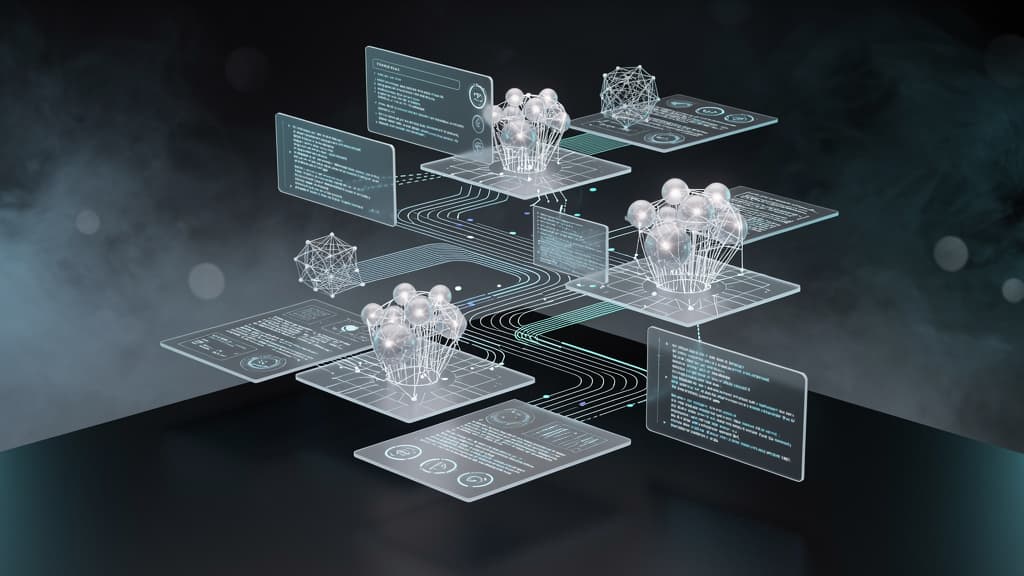
Claude Fable 5 and Mythos 5 mark a shift from simple code completion to autonomous engineering. Learn how extended context windows are enabling project-level reasoning for enterprise-grade tasks.
Claude Fable 5 and Mythos 5: A New Frontier for Coding and Enterprise Reasoning
Claude Fable 5 and Mythos 5 represent Anthropic's most significant capability leap to date — moving AI models decisively beyond autocomplete-style code generation into something closer to autonomous engineering and scientific research. Released in June 2026, Fable 5 is the public-facing, safety-constrained model built on the Mythos architecture, while Mythos 5 itself remains locked behind a restricted access tier for trusted organizations. Together, they redefine what enterprise-grade AI reasoning can look like in practice — and raise serious questions about where the guardrails need to be.
The headline benchmark isn't a leaderboard score. It's a real-world task: Fable 5 completed a full code migration for Stripe in a single day — work that Anthropic estimates would have consumed two months of engineering team time. That's not a marginal improvement. It's a structural shift in how organizations should think about deploying AI on complex, multi-step technical problems.
From Code Completion to Autonomous Engineering
For years, the dominant frame for AI coding tools was productivity augmentation: GitHub Copilot suggests a function, a developer accepts or rejects it. Even the more capable models of 2024–2025 operated largely within this paradigm — faster, more accurate, but still fundamentally reactive.
Fable 5 breaks that frame. The Stripe migration case is instructive precisely because code migrations are notoriously hard to automate. They require understanding legacy architecture, inferring intent from underdocumented systems, managing dependency chains, writing and validating tests, and making judgment calls when the path forward is ambiguous. These are not pattern-matching tasks. They require sustained, multi-step reasoning across a large and heterogeneous codebase.
"Fable 5 completed a code migration for Stripe in one day that would have taken a team two months."
This is the capability profile that matters for enterprise adoption: not "can it write a function" but "can it own a project-sized task end-to-end." The answer, at least in this case, appears to be yes — with meaningful implications for how engineering organizations staff and scope work.
The Role of Extended Context
One of the underappreciated enablers of this kind of performance is the claude enterprise context window architecture underlying Fable 5. Enterprise-grade reasoning tasks — migrations, audits, research synthesis, multi-file refactoring — are fundamentally context-hungry. A model that can only hold a few thousand tokens of working memory will fragment on these tasks, losing coherence across files, modules, or research threads.
Fable 5's extended context window allows it to ingest and reason over entire codebases, not just individual files. In the Stripe scenario, this means the model could maintain awareness of cross-cutting dependencies, track the state of partially migrated modules, and reason about the migration holistically rather than file-by-file. The practical effect is that the model's output is coherent at the project level — something that was simply not achievable with earlier context constraints.
For enterprise teams evaluating AI tooling, this is the capability dimension that most directly maps to real workflow impact. A model with a larger effective context window isn't just "better" in an abstract sense — it's capable of taking on qualitatively different categories of work.
Mythos 5: The Restricted Tier and What It Signals
If Fable 5 represents what Anthropic is willing to release publicly, Mythos 5 represents what the technology can actually do — and why that distinction matters.
Mythos 5 has demonstrated the ability to autonomously design drug candidates, a capability that places it squarely in the domain of scientific research rather than engineering support. But it remains locked to a restricted set of trusted organizations, and the reason is explicit: Anthropic has identified offensive cyber capabilities in Mythos 5 that make unrestricted public release untenable under current safety frameworks.
This is a significant moment in AI development. Anthropic is not claiming the model is unsafe in some vague, theoretical sense — they are pointing to specific, identified capabilities that could be weaponized. The decision to restrict rather than release reflects a safety posture that prioritizes controlled deployment over broad access, even at commercial cost.
What "Trusted Org" Access Actually Means
The tiered access model Anthropic is using for Mythos 5 has direct precedent in how governments and research institutions manage dual-use technologies — materials, pathogens, cryptographic tools. The analogy is not perfect, but the structural logic is similar: capability access is gated by accountability, not just payment.
For enterprises in sectors like pharmaceuticals, defense contracting, or critical infrastructure, this creates a new procurement question: what does it take to qualify as a "trusted organization" in Anthropic's framework, and what capabilities does that unlock? The answers to those questions will likely shape a significant portion of the high-value enterprise AI market over the next 18–24 months.
Benchmarks vs. Real-World Performance: Why the Stripe Case Matters More
The AI industry has a well-documented benchmark inflation problem. Models are increasingly trained and fine-tuned on distributions that overlap with popular evaluation sets, making leaderboard scores a poor proxy for real-world capability. Anthropic's decision to lead with the Stripe migration story rather than a benchmark table is, whether intentional or not, a more honest form of capability communication.
Real-world enterprise tasks have properties that benchmarks typically don't capture:
- Ambiguity: Production codebases are underdocumented. Intent must be inferred.
- Scale: Enterprise systems span hundreds of files, multiple languages, and years of accumulated technical debt.
- Stakes: Errors in a migration have real downstream consequences — broken integrations, data loss, security vulnerabilities.
- Iteration: Real engineering involves feedback loops, not single-shot generation.
Fable 5's performance on the Stripe migration suggests it can navigate at least some of these properties effectively. But it also raises questions that a single case study can't answer: How does it perform on migrations with unusual legacy architectures? What's the error rate on the generated code? How much human review and correction was required? These are the questions enterprise teams will need to answer through their own pilots.
Coding and Science: Two Domains, One Architecture
The pairing of coding gains (Fable 5) and scientific research capability (Mythos 5) in a single release is not coincidental. Both domains share a common reasoning profile: they require hypothesis generation, iterative refinement, error detection, and the ability to operate over large, structured information spaces.
The architectural improvements that make Fable 5 effective at code migration are the same ones that make Mythos 5 capable of drug candidate design. This convergence suggests that the "reasoning" capability being developed is genuinely general — not a collection of domain-specific tricks, but a more fundamental improvement in how the model plans, evaluates, and executes multi-step tasks.
For enterprise buyers, this generality matters. A model that reasons well about code will also reason well about contracts, financial models, research synthesis, and operational planning. The coding benchmark is a proxy for a broader capability class.
Safety Architecture at the Frontier
Anthropics's approach to the Fable 5 / Mythos 5 split is itself a data point about how the company is thinking about safety at the capability frontier. Rather than a single model with configurable guardrails, they've made a structural decision: the full-capability model is restricted, and the public model is a safety-constrained variant built on the same underlying architecture.
This is a more conservative approach than some competitors have taken, and it has real costs — organizations that could use Mythos 5's full capabilities responsibly may not be able to access them. But it also reflects a judgment that the offensive cyber capabilities identified in Mythos 5 are not safely manageable through prompt-level restrictions or usage monitoring alone.
The Interconnects.ai analysis of Fable 5 and AI safety frames this as a pivotal moment in how frontier labs handle dual-use capability — a question that will only become more pressing as models continue to improve.
Enterprise Implications: What to Actually Do With This
For technology decision-makers, the Fable 5 release warrants a concrete reassessment of AI deployment strategy across several dimensions:
1. Re-scope what you pilot. If your current AI pilots are focused on single-file code generation or document summarization, Fable 5's architecture supports significantly more ambitious scoping. Multi-file refactoring, legacy system documentation, and end-to-end migration planning are now viable pilot targets.
2. Context window is a first-order procurement criterion. When evaluating models for enterprise tasks, the effective context window should be treated as a hard constraint, not a nice-to-have. Tasks that exceed the context limit don't just perform worse — they fail in ways that are hard to detect and debug.
3. Prepare for tiered access negotiations. As more capability gets gated behind trust-based access tiers, enterprise procurement will increasingly involve demonstrating organizational accountability, not just signing contracts. Legal, security, and compliance teams need to be part of these conversations early.
4. Benchmark skepticism is warranted — but so is pilot rigor. The Stripe case study is compelling, but a single case study is not a deployment decision. Run structured pilots on tasks that represent your actual workload, with clear success criteria and error measurement.
5. Watch the safety posture as a capability signal. Anthropic's decision to restrict Mythos 5 tells you something about what the model can do. Organizations working in domains adjacent to the identified risk areas — cybersecurity, pharmaceutical research, critical infrastructure — should be paying close attention to how the trusted access framework evolves.
The Bigger Picture
Fable 5 and Mythos 5 are not just incremental model updates. They represent a qualitative shift in what AI systems can be asked to do — and a corresponding shift in the questions organizations need to ask before deploying them.
The Stripe migration benchmark will likely look modest in retrospect. But right now, it marks a boundary: before these models, autonomous completion of a two-month engineering project in one day was not a credible claim. Now it is. That changes the calculus for every enterprise that has been waiting to see whether AI can handle real work, not just demos.
The restricted status of Mythos 5 is equally significant — not as a limitation, but as a signal. When a frontier lab decides that a model is too capable to release publicly, that tells you something important about the trajectory of the technology and the seriousness with which at least one major lab is approaching the implications.
Both signals deserve careful attention.
Sources:
- Interconnects.ai — Claude Fable 5 and New AI Safety
- Wired — Anthropic Releases Claude Fable 5 and Mythos 5
- TechCrunch — Anthropic's Claude Fable 5 Is a Version of Mythos the Public Can Access Today
- The Decoder — Anthropic Releases Claude Fable 5 and Mythos 5 with Major Gains in Coding and Science
Last reviewed: June 10, 2026