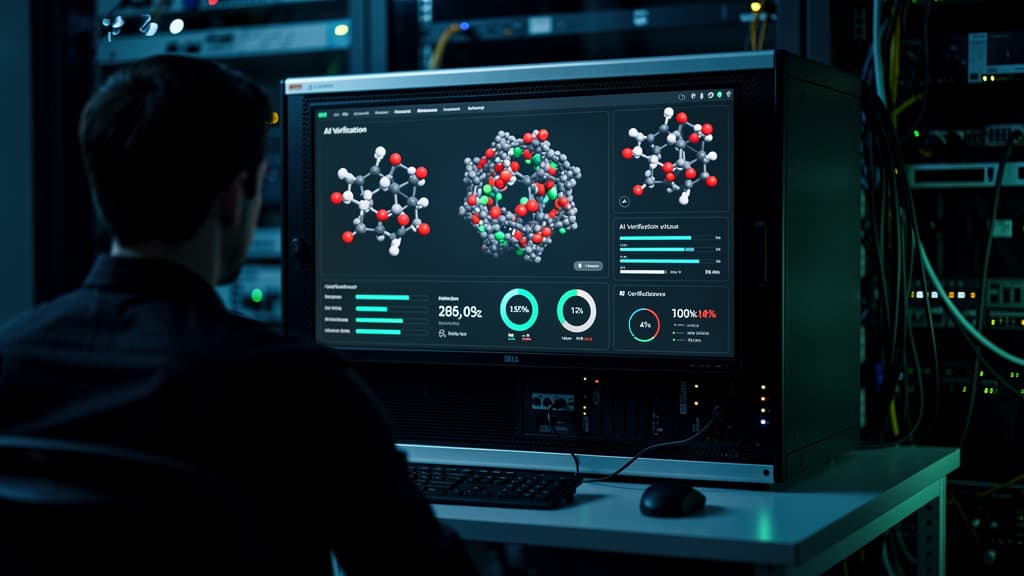
Anthropic's Claude Science workbench addresses critical enterprise AI security risks by enabling local, on-premises research workflows with automated verification.
Claude Science Workbench: A New Standard for Research Security
For years, enterprise AI security risks have kept some of the most data-sensitive organizations—pharmaceutical research divisions, national laboratories, academic genomics centers—on the sidelines of the AI productivity revolution. The calculus was straightforward and damning: send proprietary compound libraries or patient-linked sequencing data to a cloud-hosted large language model, and you've potentially violated data residency requirements, institutional review board protocols, or competitive confidentiality agreements. The hallucination problem compounded the concern. A model that confidently fabricates citations or miscalculates a molecular weight isn't a productivity tool in a research context—it's a liability.
Anthropic's answer to both problems is Claude Science, a purpose-built AI workbench for computational researchers that launched in late June 2026. The platform doesn't introduce a new foundation model. Instead, it bets that the right architecture—local execution, domain-specific tooling, and a dedicated verification layer—can unlock AI adoption in labs that have been waiting for a trustworthy on-premises option.
The Two Failure Modes That Blocked Lab Adoption
Data Residency and the Cloud Exposure Problem
The institutional research environment operates under a web of overlapping data governance obligations. A genomics lab processing human subjects data is bound by IRB protocols and, depending on jurisdiction, HIPAA, GDPR, or national equivalents. An industrial computational chemistry team working on pre-patent drug candidates cannot expose molecular structures to third-party cloud infrastructure without triggering IP risk reviews. A defense-adjacent materials science group may face outright contractual prohibitions on external data transmission.
Cloud-hosted AI assistants, however capable, force a binary choice: accept the data exposure risk or forgo the productivity benefit. Most risk-averse institutions chose the latter. The result has been a widening gap between AI adoption rates in consumer and enterprise-general contexts versus sensitive research environments.
Studies from 2024 and 2025 consistently showed that data security and regulatory compliance were the top two barriers to AI adoption in life sciences and pharmaceutical R&D, cited by more than 70% of surveyed organizations.
Claude Science addresses this directly by running locally or on HPC clusters within institutional infrastructure. Research data never leaves the organization's compute environment. The model operates where the data lives, inverting the traditional cloud-AI architecture. For institutions with existing high-performance computing investments—which describes virtually every major research university and pharmaceutical company—this means Claude Science can slot into existing infrastructure rather than requiring a new cloud procurement and security review cycle.
Hallucination and the Citation Integrity Problem
The second failure mode is arguably more insidious because it's harder to detect operationally. A data breach is an event with a discoverable timestamp. A hallucinated citation in a literature review, or an incorrect stoichiometric calculation in a synthesis protocol, can propagate through a research workflow for weeks before anyone catches it—if anyone catches it at all.
The scientific community's early experiences with general-purpose LLMs in research contexts produced a catalog of failure cases: papers citing studies that don't exist, AI-generated code producing numerically plausible but physically impossible results, and protein structure predictions that looked reasonable but violated known biochemical constraints. These weren't edge cases. They were systematic enough that several journals updated submission guidelines specifically to address AI-assisted errors.
Claude Science's response is a dedicated verification agent that automatically checks citations and calculations as part of the workflow. Rather than treating verification as a post-hoc human review step, the architecture makes it a first-class automated process embedded in the research loop.
Architecture: What 60 Preconfigured Skills Actually Means
The headline feature count—60 preconfigured skills covering genomics and computational chemistry—deserves unpacking, because "skills" in this context means something more specific than general model capability.
In a standard LLM deployment, a researcher asking about CRISPR off-target effects or asking the model to help write a density functional theory calculation is relying on the model's general training distribution. The model may have seen relevant papers, but it has no structured access to domain-specific tools, databases, or validated computational pipelines.
Preconfigured skills in Claude Science represent pre-built integrations: connections to genomics databases, validated computational chemistry workflows, domain-specific prompt architectures that have been tested against known-correct outputs, and tool-use configurations that let the model invoke specialized software rather than attempting to replicate its logic in natural language. This is the difference between asking a generalist assistant to estimate a protein's melting temperature and giving that assistant a direct interface to established thermodynamic modeling tools.
The 60-skill library spanning genomics and computational chemistry reflects the two domains where AI-assisted research has the highest near-term productivity ceiling and, not coincidentally, the highest data sensitivity. Genomics workflows handle patient-linked or proprietary sequence data. Computational chemistry workflows handle pre-patent molecular structures. Both domains have mature HPC infrastructure that Claude Science can run alongside.
The Verification Agent in Practice
The verification agent is the architectural component most directly targeted at the hallucination problem. Its function is twofold.
For citation verification, the agent cross-references claims and referenced works against accessible literature databases, flagging citations that cannot be confirmed or that appear to mismatch the attributed claim. This doesn't eliminate the need for human review, but it catches the most egregious fabrications—non-existent DOIs, author name mismatches, papers that exist but don't say what the model claims—before they reach a human reviewer's desk.
For calculation verification, the agent applies domain-specific sanity checks: unit consistency, order-of-magnitude plausibility, constraint satisfaction against known physical or biochemical limits. A calculation that produces a negative molecular weight or a reaction yield above 100% gets flagged rather than silently passed to the next workflow step.
The combined effect is a shift from AI-as-oracle to AI-as-collaborative-draft, where the model's outputs arrive pre-annotated with confidence signals and flagged anomalies. This is a more honest representation of what current LLMs can reliably do in high-stakes research contexts.
Competitive Positioning and the "Workflow, Not Model" Bet
As TechCrunch noted in its coverage of the launch, Claude Science is explicitly betting on workflow architecture rather than model capability as its primary differentiator. This is a meaningful strategic choice in a market where foundation model performance gaps between frontier providers have narrowed considerably.
The implicit argument is that for research applications, the marginal difference between state-of-the-art models matters less than whether the deployment architecture is trustworthy. A slightly less capable model running locally with verified outputs is more valuable to a pharmaceutical company than a marginally more capable model running in a cloud environment that triggers data governance reviews.
This positions Claude Science less as a competitor to general-purpose AI assistants and more as a challenger to the existing category of scientific software platforms—electronic lab notebooks, computational workflow managers, and literature management tools—that have historically been the infrastructure layer for research productivity.
"Claude Science bets on workflow, not a new model, to win over scientists" — TechCrunch, June 30, 2026
The competitive moat, if Anthropic can build it, comes from the combination of local execution trust, domain-specific skill depth, and verification infrastructure—none of which is easily replicated by pointing a general-purpose model at a research task.
Unresolved Challenges and Adoption Friction
The architecture addresses the two primary blockers, but several adoption challenges remain.
Integration complexity is the first. Running Claude Science on institutional HPC infrastructure requires IT and research computing staff involvement. For large research universities and pharmaceutical companies with dedicated research computing teams, this is manageable. For smaller academic labs or mid-sized biotech companies without that infrastructure, the on-premises deployment model may introduce more friction than it removes.
Skill coverage gaps are the second. Sixty preconfigured skills is a meaningful starting library, but computational research spans a much wider domain surface: structural biology, climate modeling, materials science, high-energy physics, and dozens of other fields with their own specialized toolchains and data types. The genomics and computational chemistry focus reflects Anthropic's initial market prioritization, but labs outside those domains will be evaluating whether the platform's general capabilities justify the deployment overhead.
Verification completeness is the third, and arguably most important, unresolved question. The verification agent's effectiveness is bounded by the quality of the databases and constraint libraries it checks against. Citation verification is only as good as the literature coverage of the underlying index. Calculation verification is only as good as the domain models encoding physical and biochemical constraints. Neither is complete, and both require ongoing maintenance as research fields evolve.
What This Signals for Enterprise AI Security Architecture
Claude Science's design choices reflect a broader maturation in how AI providers are thinking about enterprise AI security risks in regulated and sensitive environments. The early wave of enterprise AI deployment assumed that security could be handled primarily through contractual data processing agreements with cloud providers. That assumption has been stress-tested by regulatory scrutiny, high-profile data incidents, and the practical reality that many research institutions have governance structures that can't move as fast as commercial contracting.
The local execution model that Claude Science embodies—AI capability delivered to the data rather than data delivered to the AI—is likely to become a standard architectural pattern for sensitive enterprise deployments, not just research contexts. Financial services, legal, healthcare, and government sectors all have analogous data residency and confidentiality requirements.
The verification layer is equally instructive. As AI systems take on more consequential tasks in professional workflows, the expectation that outputs arrive pre-annotated with reliability signals will become a baseline requirement rather than a differentiator. The research context, where the cost of an undetected error can be a retracted paper or a failed drug candidate, is simply the most visible forcing function for that requirement.
Anthropic's move with Claude Science is, at its core, a recognition that winning in sensitive enterprise contexts requires solving the trust architecture problem, not just the capability problem. For the research labs that have been waiting for an AI workbench they can actually deploy, that recognition may be what finally moves them off the sidelines.
Sources:
- Anthropic Launches Claude Science, an AI Workspace Built Specifically for Researchers — The Decoder
- With Claude Science, Anthropic Targets Application — AI Business
- Anthropic's Claude Science Bets on Workflow, Not a New Model, to Win Over Scientists — TechCrunch
Last reviewed: July 01, 2026