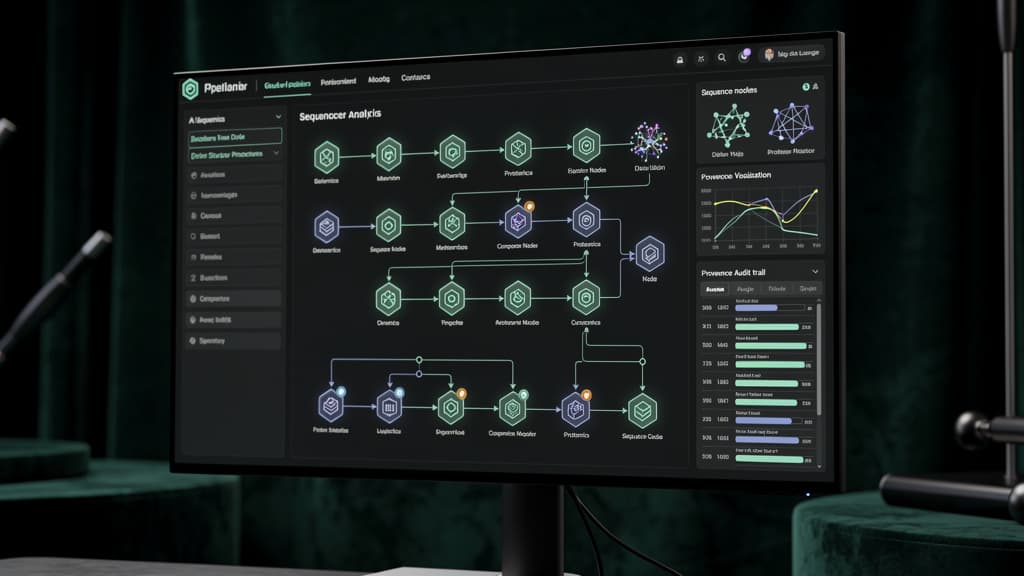
Anthropic's Claude Science workbench introduces a multi-agent framework that solves reproducibility crises, offering a new blueprint for enterprise AI architecture.
Claude Science: Anthropic's Multi-Agent Workbench Redefines Enterprise Research Infrastructure
Reproducibility has been the silent crisis of computational biology for over a decade. Studies fail to replicate not because the science is wrong, but because the environment, the exact code version, the database snapshot, and the compute configuration that produced a given figure are rarely captured alongside the result itself. On June 30, 2026, Anthropic released Claude Science in beta — a multi-agent AI workbench purpose-built for genomics, proteomics, and cheminformatics workflows that attacks this problem at the infrastructure level. For enterprise scientists and the AI solution architects who support them, Claude Science represents a meaningful shift in how reproducible research pipelines can be designed, deployed, and audited at scale.
This deep dive examines three specific breakthroughs embedded in Claude Science's architecture: its coordinated multi-agent specialist model, its provenance-complete figure generation system, and its hybrid compute orchestration layer — and what each means for enterprise AI solution architecture.
Breakthrough 1: Coordinated Domain-Specialist Agents Replace the Generalist Bottleneck
The most architecturally significant decision Anthropic made with Claude Science is the rejection of a single generalist model as the primary interface for scientific work. Instead, Claude Science deploys a multi-agent workbench in which domain-specialist agents — tuned for genomics, proteomics, and cheminformatics respectively — operate in coordination, overseen by reviewer agents that check outputs for methodological consistency before results are surfaced to the researcher.
This design directly addresses a failure mode well-known to enterprise ML teams: generalist large language models produce plausible-sounding but methodologically inconsistent outputs when asked to reason across highly specialized scientific domains simultaneously. A single model asked to interpret a proteomics mass spectrometry result while simultaneously querying a genomics variant database and proposing a cheminformatics lead optimization step is working at the edge of its reliable competence in each domain. The multi-agent architecture distributes that cognitive load.
What This Means for Enterprise AI Solution Architecture
For organizations building AI solution architecture for enterprise research environments, the specialist-coordinator pattern Claude Science uses is directly portable. The key design principles are:
- Domain isolation with shared context: Each specialist agent maintains its own tool access and domain-specific reasoning chain, but shares a unified context window with coordinator and reviewer agents. This prevents cross-domain contamination of reasoning while preserving the ability to synthesize findings.
- Reviewer agents as automated QA gates: Rather than relying on human review at every step, Claude Science inserts reviewer agents that validate intermediate outputs — checking, for example, whether a genomic variant annotation is consistent with the database version queried. Enterprise architects can model this pattern for any high-stakes analytical pipeline.
- Auditability by design: The full message history between agents is preserved and attached to every output. This is not a logging afterthought — it is a first-class artifact of the system.
For pharmaceutical enterprises, contract research organizations, and academic medical centers operating at scale, this architecture provides a defensible audit trail that satisfies both internal governance requirements and emerging regulatory expectations around AI-assisted research.
Breakthrough 2: Provenance-Complete Figure Generation
The second breakthrough is arguably the most immediately impactful for research reproducibility: every figure generated by Claude Science ships with the exact code that produced it, the precise environment specification, and the complete agent message history that led to its creation.
This is a harder problem than it sounds. In most computational research workflows, a figure is the end product of a chain of decisions — which database version was queried, which normalization method was applied, which statistical threshold was chosen — that are rarely fully documented in the methods section of a paper, let alone in the figure itself. Reproducing that figure six months later, on a different machine, by a different team member, is frequently impossible without the original researcher's active involvement.
Claude Science makes provenance non-optional. The system does not allow a figure to be exported without its full computational lineage attached.
Every figure ships with exact code, environment, and full message history — making the artifact of science the unit of reproducibility, not the paper.
The Enterprise Implications: From Reproducibility to Regulatory Readiness
For enterprise environments — particularly in pharma, biotech, and clinical genomics — this has implications that extend well beyond academic reproducibility norms:
Regulatory submissions: FDA guidance on AI/ML-based software as a medical device (SaMD) and the broader trend toward requiring computational audit trails in IND and NDA submissions means that provenance-complete outputs are moving from best practice to regulatory expectation. Claude Science's architecture positions enterprise users to meet these requirements without retrofitting documentation processes.
Internal reproducibility at scale: Large research organizations routinely face the problem of rebuilding analyses when a lead scientist leaves, a project is paused and restarted, or a result needs to be defended in a legal or regulatory context. Provenance-complete figures directly reduce the cost of these scenarios.
Version-controlled science: When the environment specification is part of the figure artifact, it becomes possible to systematically track how results change across database versions, model updates, or methodological revisions — enabling a form of scientific version control that mirrors software engineering best practices.
The technical mechanism here — capturing environment as a reproducible specification rather than a description — draws on containerization principles familiar to DevOps practitioners. Claude Science applies those principles at the level of the scientific result itself.
Breakthrough 3: Hybrid Compute Orchestration Across HPC, Cloud, and Local Environments
The third breakthrough is the compute layer. Claude Science manages workload distribution across local machines, HPC clusters accessed over SSH, Modal cloud infrastructure, and integrates with NVIDIA BioNeMo skills for GPU-accelerated biological model inference. It also connects to 60+ databases spanning genomics, proteomics, and cheminformatics data sources.
This is not a trivial engineering achievement. The challenge of hybrid compute orchestration in scientific workloads is that different steps in a pipeline have radically different resource profiles. A sequence alignment step may require a large-memory HPC node. A protein structure prediction call may be best served by a BioNeMo GPU endpoint. A literature search and synthesis step may run efficiently on a local CPU. Stitching these together into a coherent, reproducible pipeline — where the compute environment for each step is as well-documented as the code — requires infrastructure that most research organizations have not built.
Architecture Breakdown: How the Compute Layer Works
Based on the released details, Claude Science's compute orchestration operates on several levels:
1. Environment-aware job routing: The workbench determines, based on the task type and resource requirements, whether to execute locally, dispatch to an HPC cluster via SSH, or invoke a Modal serverless function. This routing decision is logged as part of the provenance record.
2. NVIDIA BioNeMo integration: BioNeMo provides pre-trained biological foundation models — including protein language models, molecular property predictors, and structure prediction capabilities — as callable skills within the Claude Science environment. This means enterprise users can invoke state-of-the-art biological AI models without managing the underlying GPU infrastructure, while still having the call logged in the provenance chain.
3. 60+ database connectors: The breadth of database integration — spanning variant databases, protein structure repositories, compound libraries, and pathway databases — means that data retrieval is handled within the same audited environment as computation. Queries, versions, and retrieval timestamps are captured automatically.
4. SSH-based HPC access: The inclusion of SSH-based HPC connectivity is a pragmatic acknowledgment that enterprise research environments — particularly in pharma and academic medical centers — have significant existing investments in on-premises HPC infrastructure that will not be migrated to cloud in the near term. Claude Science meets those environments where they are.
Implications for Enterprise Architecture Teams
For AI solution architects designing research infrastructure, Claude Science's compute layer suggests a reference architecture pattern worth examining:
- A unified orchestration plane that abstracts over heterogeneous compute targets, exposing a consistent interface to the scientific workflow layer above
- Capability-based routing that dispatches tasks to the most appropriate compute resource based on declared requirements rather than manual configuration
- Provenance-coupled logging at the compute layer, not just the application layer — so that "which machine ran this step" is as auditable as "what code ran this step"
This pattern is applicable beyond Claude Science itself. Enterprise teams building custom research AI platforms can adopt the same architectural principles using open-source orchestration tools, though Claude Science provides a pre-integrated implementation.
What Claude Science Signals for Enterprise AI Investment
Claude Science's beta release on June 30, 2026 arrives at a moment when enterprise investment in AI for scientific research is accelerating rapidly, but when the infrastructure to support reproducible, auditable, regulatory-ready AI-assisted research has lagged behind the model capabilities themselves. The three breakthroughs examined here — multi-agent specialization, provenance-complete outputs, and hybrid compute orchestration — each address a distinct layer of that infrastructure gap.
For enterprise technology decision-makers, the near-term questions are practical:
- Pilot scope: Claude Science is in beta, and enterprise pilots should focus on workflows where the reproducibility and auditability benefits are most immediately valuable — regulatory-facing analyses, high-turnover research teams, or cross-functional projects where methodology alignment is a recurring friction point.
- Integration assessment: The 60+ database connectors and BioNeMo integration cover a broad surface, but enterprise environments will have proprietary data sources and internal models that require custom integration work. Evaluating that integration surface early is critical.
- Governance alignment: The provenance architecture Claude Science provides is a foundation, not a complete governance solution. Enterprise teams will need to align Claude Science's output artifacts with their existing data governance, IP protection, and regulatory submission workflows.
The deeper signal is architectural: Anthropic is positioning Claude Science not as a chatbot for scientists but as infrastructure for scientific computation — a layer in the enterprise research technology stack that sits between raw compute and the researcher, managing the complexity of multi-domain AI coordination, provenance capture, and hybrid compute orchestration. That is a different product category than most AI tools currently on the market, and it reflects a more mature understanding of what enterprise scientific environments actually require.
Sources
- Anthropic Launches Claude Science Beta for Reproducible Research Pipelines — MarkTechPost
- NVIDIA BioNeMo Platform
- FDA Guidance on Artificial Intelligence and Machine Learning in Software as a Medical Device
- Modal Cloud Infrastructure
Last reviewed: July 05, 2026