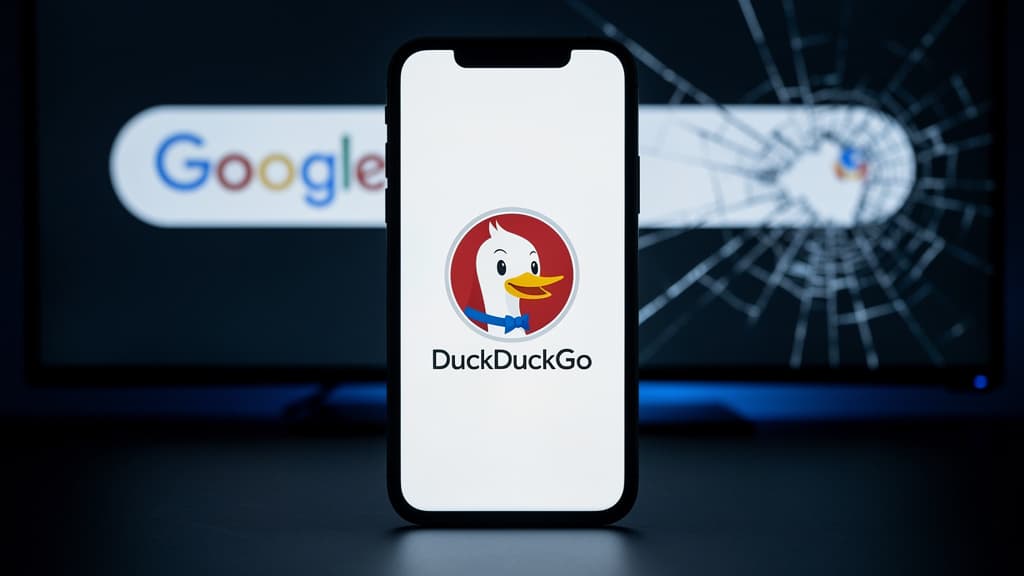
When Google replaced search results with AI agents, users revolted. A 30% surge in DuckDuckGo installs offers a critical lesson for generative AI business trends 2026 regarding user agency and trust.
The numbers don't lie, and right now they're telling a story that every AI product strategist should be reading carefully: when Google replaced its traditional search results with AI agents at Google I/O 2026, users didn't just grumble — they left. DuckDuckGo installations surged 30% in the immediate aftermath, a signal so sharp it deserves more than a footnote in the generative AI business trends 2026 conversation. It deserves a reckoning.
This isn't a niche privacy-advocate story. This is a mainstream consumer revolt, and it has profound implications for how the AI industry thinks about adoption, trust, and the dangerous assumption that better technology automatically means better reception.
The Trigger: Google I/O 2026's Overreach
At Google I/O 2026, Google made its most aggressive move yet in the search wars: wholesale replacement of the traditional blue-link results paradigm with AI-generated answer agents. The intent was clear — position Google not as a directory to the web, but as the answer itself. From a product vision standpoint, it's coherent. From a consumer psychology standpoint, it was a miscalculation.
According to reporting from TechCrunch, the backlash was swift and measurable. DuckDuckGo app installations climbed 30% — not over a quarter, not over a product cycle, but in direct response to a single announcement. That kind of correlation is rare and meaningful.
The phrase in TechCrunch's own headline is worth sitting with: users are rejecting being "force-fed" AI search. The language of coercion matters here. Google didn't offer users an AI-enhanced option. It made a choice on their behalf.
Why This Matters Beyond the Privacy Crowd
DuckDuckGo has long been the refuge of the privacy-conscious — a loyal but relatively contained demographic. A 30% installation spike suggests the current wave of defectors extends well beyond that base. These are ordinary Google users who, when confronted with an AI-first interface they didn't ask for, looked for the exit.
This tells us something uncomfortable about the state of AI adoption in consumer products: enthusiasm in the boardroom does not translate to enthusiasm at the keyboard. There is a growing gap between what AI companies believe users want and what users actually want when given the choice.
Consider the psychology at play. Traditional search gave users a sense of agency — here are ten sources, you decide. AI-generated answers collapse that agency into a single authoritative response. For users who have spent years learning to triangulate sources, cross-check claims, and distrust single points of authority, this feels like a regression, not a feature.
A 30% spike in DuckDuckGo installations following Google I/O 2026 is one of the clearest consumer signals the AI industry has received: agency matters, and removing it has consequences.
The Privacy Dimension Is Inseparable From the Control Dimension
It's tempting to frame this entirely as a privacy story — DuckDuckGo's core value proposition is data protection, so of course privacy-concerned users migrate there. But that framing undersells what's actually happening.
The users fleeing to DuckDuckGo aren't just worried about data collection. They're worried about epistemic control — who decides what information they receive, in what form, with what framing. AI-generated search answers are, by definition, curated and synthesized. The model decides what's relevant, what's authoritative, what gets included and excluded. That's a significant transfer of interpretive power from the user to the system.
Privacy and control are two sides of the same coin. When users say they want privacy-preserving search, they're also saying they want search that doesn't presume to think for them. DuckDuckGo, whatever its limitations, offers a familiar contract: here is what the web says, unmediated by a language model's synthesis.
What This Signals for Generative AI Business Trends in 2026
The DuckDuckGo surge is a data point, not a death knell for AI search. Google remains dominant by almost any measure, and a 30% installation spike for a challenger still leaves Google with an enormous structural advantage. But the business implications for the broader AI industry are worth mapping carefully.
Forced adoption creates backlash debt. When companies remove optionality — when AI becomes the only mode, not an enhanced option — they accumulate user resentment that eventually surfaces as churn, regulatory pressure, or competitor growth. The Google I/O 2026 response suggests that debt can come due faster than product teams expect.
Transparency is becoming a competitive differentiator. In a world where AI answers are ubiquitous, the ability to show your work — to surface sources, to acknowledge uncertainty, to let users drill down — is no longer a nice-to-have. It's a trust mechanism. Companies that treat AI transparency as a core product feature, not an afterthought, will have an advantage with the growing segment of users who've been burned by opaque systems.
The privacy-AI tension is a genuine market opportunity. DuckDuckGo's growth isn't just a protest vote. It's a signal that there is real, monetizable demand for AI tools that operate within a privacy-respecting framework. Startups and established players who can credibly offer AI-enhanced functionality without surveillance-based business models are sitting on an underserved market.
Enterprise buyers are watching consumer signals. CIOs and procurement teams making decisions about AI search and knowledge management tools in 2026 are not operating in a vacuum. When they see consumer backlash against forced AI interfaces, it informs their risk calculus. Vendors who offer configurable, transparent AI deployments — where organizations can tune the balance between AI synthesis and source transparency — will find a more receptive enterprise audience.
The Counterargument Worth Taking Seriously
Fair-minded analysis requires acknowledging the other side. Google's bet on AI-first search isn't irrational. The data on AI search engagement — time-on-task reduction, query resolution rates, user satisfaction in controlled studies — often favors AI-generated answers for well-defined informational queries. For a large segment of users, getting a direct answer faster is genuinely preferable to sifting through ten blue links.
And DuckDuckGo's 30% spike, while striking, may prove to be a protest install phenomenon — users downloading the app as a statement, then drifting back to Google's convenience within weeks. Consumer behavior is sticky, and Google's ecosystem integration (Android, Chrome, Gmail) creates switching costs that a privacy search engine cannot easily overcome.
But here's why the counterargument doesn't fully land: even if half of those 30% return to Google within a month, the signal has been sent. Competitors have seen it. Regulators have seen it. And Google's own product teams have seen it. The question isn't whether the migration is permanent — it's whether the industry recalibrates its assumptions about how aggressively it can push AI-first experiences without offering users a meaningful choice.
The Harder Question for the AI Industry
The DuckDuckGo surge forces a question that the AI industry has been reluctant to confront directly: Are we building AI products for users, or are we building them for our own metrics?
AI-generated search answers are excellent for reducing bounce rates, increasing session depth, and keeping users inside a platform's walled garden. They are also, by design, less transparent about sourcing, harder to fact-check in real time, and more dependent on trust in the underlying model. The business case and the user case are not always aligned.
The companies that will define the next phase of generative AI business trends in 2026 and beyond are the ones that resolve this tension honestly — not by papering over it with better UI, but by building systems where user agency and AI capability reinforce each other rather than trade off against each other.
The 30% spike in DuckDuckGo installs is a small number in absolute terms. As a directional signal about where user trust is heading, it's one of the most important data points of the year.
Last reviewed: May 27, 2026