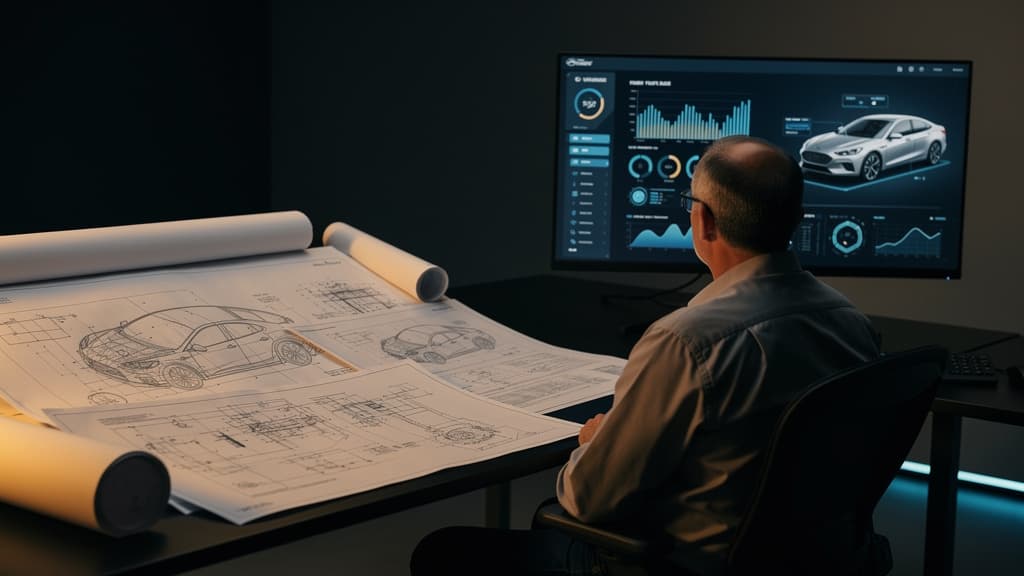
Ford's decision to rehire veteran engineers reveals a harsh truth: AI agents excel at iteration but lack the tacit knowledge and accountability of human experts.
The AI-versus-human debate in engineering just got a lot more concrete. Ford Motor Company is rehiring experienced 'gray beard' engineers — veterans who were quietly shown the door during a wave of AI-driven workforce restructuring — after discovering that an AI-only design strategy produced results that simply weren't good enough. It's a cautionary tale that cuts to the heart of a question every technology leader is wrestling with right now: when does AI agent vs traditional automation thinking lead us astray, and what does genuine human-AI collaboration actually look like in high-stakes product development?
The answer, it turns out, involves more humility than most AI evangelists are comfortable with.
The Admission That Changes Everything
The story broke via TechCrunch's reporting on Ford's reversal, and the most important detail is a direct quote from a Ford executive:
"Mistakenly we thought that by just introducing artificial intelligence... that would produce a high-quality product."
That sentence deserves to sit with you for a moment. This isn't a startup founder reflecting on a failed prototype. This is a senior executive at one of the world's largest and most storied manufacturing companies admitting, publicly, that the premise behind a major workforce and product strategy was wrong.
Ford isn't alone in this realization — but it may be the most prominent company to say the quiet part out loud. And the implications ripple far beyond the automotive sector.
Reason 1: AI Optimizes Within Known Boundaries — It Doesn't Redefine Them
The fundamental limitation of current AI systems in engineering contexts isn't raw capability — it's the nature of what AI actually does when it "designs" something. Modern AI agents, even sophisticated ones, are extraordinarily good at pattern recognition, interpolation within training distributions, and rapid iteration across parameter spaces. What they are not good at is recognizing when the boundary conditions themselves are wrong.
Veteran engineers — the gray beards Ford let go — carry something that no model trained on historical data can fully replicate: tacit knowledge. This is the accumulated understanding of why certain design decisions were made, what failure modes appeared in field conditions that never made it cleanly into any dataset, and which engineering constraints are genuinely immovable versus which ones are organizational folklore.
When Ford leaned into AI-only design workflows, the models almost certainly produced outputs that were locally optimal — they satisfied the specified constraints and scored well on defined metrics. The problem is that the most important engineering knowledge often lives in the constraints that experienced engineers know to add before the optimization begins. Without that upstream judgment, you can get a design that passes every automated test and still performs poorly in the real world.
This is the core failure mode that distinguishes AI agent capabilities from what traditional automation — and human expertise — provides: AI agents are powerful executors but poor boundary-setters.
Reason 2: Complex Products Accumulate Institutional Memory That Doesn't Fit in a Prompt
A modern vehicle contains somewhere between 30,000 and 40,000 individual parts. The engineering decisions governing how those parts interact were made across decades, by thousands of engineers, in response to failures, regulatory changes, supplier constraints, and customer feedback that spans generations of products.
You cannot fully encode that history in a training dataset. You cannot fully encode it in documentation. Some of it lives in the heads of people who were in the room when a decision was made — people who remember that a particular fastener spec was changed not because of cost, but because a specific supplier had a quality problem in 2009 that was never formally documented.
This is what institutional memory means in practice, and it's what Ford discovered it had discarded along with its gray beard engineers. AI systems trained on available data will reconstruct the what of past designs reasonably well. They will struggle with the why — and in complex product development, the why is often the most important part.
The distinction matters enormously when we frame it as AI agent vs traditional automation. Traditional automation, including rule-based systems and expert systems built in earlier eras, was explicitly designed to encode and preserve this kind of structured domain knowledge. Modern AI agents are more flexible and more powerful in many respects, but they don't automatically inherit the institutional knowledge that made those older systems valuable. Someone still has to put that knowledge in — and that someone needs to be a domain expert who actually has it.
Reason 3: Quality Accountability Requires Human Judgment in the Loop
There is a third dimension to Ford's reversal that goes beyond technical capability: accountability and quality ownership.
When an experienced engineer signs off on a design, they are making a professional judgment backed by personal accountability. They are pattern-matching against a mental library of past failures, asking questions that aren't on any checklist, and applying a form of risk intuition that comes from having been wrong before in ways that mattered. That accountability loop — where the person making the decision also bears some responsibility for the outcome — is a feature of engineering culture, not a bug.
AI systems, as currently deployed, don't carry accountability in this sense. They produce outputs; humans are responsible for those outputs. When the human in that loop lacks deep domain expertise — because the experts were laid off — the accountability structure breaks down. You have people approving AI-generated designs without the knowledge to meaningfully evaluate them. The result is exactly what Ford experienced: substandard products.
This isn't an argument against using AI in engineering. It's an argument that AI augments expert judgment; it doesn't replace the need for expert judgment to exist in the first place.
What This Means for the AI Agent vs Traditional Automation Debate
The framing of AI agents versus traditional automation often positions the debate as a question of which technology is more capable. Ford's experience suggests that's the wrong question. The right question is: what is the appropriate role for human expertise in a workflow that includes powerful AI tools?
The answer varies by domain, but in complex physical product development, the evidence is increasingly clear:
- AI agents excel at rapid iteration, simulation at scale, pattern recognition across large design spaces, and surfacing non-obvious tradeoffs.
- Human experts are irreplaceable for defining the right problem, encoding tacit constraints, evaluating outputs against real-world failure modes, and owning quality accountability.
The companies that will build the best products over the next decade aren't the ones that replaced the most engineers with AI. They're the ones that figured out how to make their best engineers dramatically more productive with AI — while preserving the institutional knowledge and judgment that makes those engineers valuable in the first place.
Ford is learning this lesson the expensive way. The more interesting question is whether other organizations will learn it from Ford's experience, or whether they'll need to repeat the same mistake before they reach the same conclusion.
The gray beards are coming back. That's not a failure of AI — it's a more accurate understanding of what AI actually is.
Sources:
Last reviewed: June 29, 2026