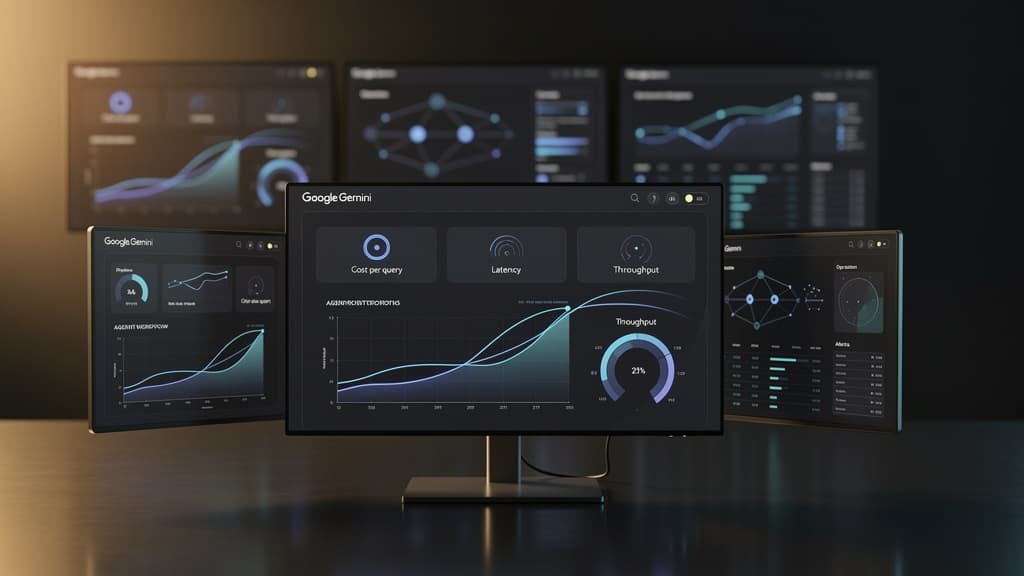
Gemini 3.5 Flash is transforming enterprise AI by cutting costs and latency. Learn how this model enables real-time code review, agentic loops, and document processing at scale.
Gemini 3.5 Flash and the New Economics of Enterprise AI
Reducing operational costs with AI has long been a boardroom priority, but the math rarely worked out cleanly. High-capability models were expensive to run at scale; cheaper models couldn't handle the complexity of real enterprise workflows. Google's launch of Gemini 3.5 Flash at I/O 2026 breaks that tradeoff in a way that deserves serious analytical attention.
The headline numbers are striking: Gemini 3.5 Flash runs four times faster and costs half as much as its predecessor, while outperforming Google's own flagship model on coding benchmarks and agentic benchmarks. According to Google Introduces Gemini 3.5 Flash at I/O 2026, the model was explicitly designed with an agent-first architecture — prioritizing autonomous task execution over conversational fluency. That design philosophy isn't incidental. It signals where enterprise value is actually being created in 2026.
This article breaks down three specific structural shifts in enterprise cost architecture that Gemini 3.5 Flash enables — workflows that were previously either too expensive, too slow, or too unreliable to deploy at production scale.
1. Continuous Code Review and QA Pipelines: From Batch to Real-Time
The Old Cost Equation
Prior to this generation of models, running AI-assisted code review at scale required a painful tradeoff. Teams could either run expensive frontier models on a subset of commits (affordable but incomplete), or run cheaper models across all commits (complete but noisy). Neither approach gave engineering organizations what they actually wanted: high-quality, low-latency feedback on every pull request, every time.
The core problem was latency compounding with cost. A model that takes 8–12 seconds to analyze a 500-line diff becomes a bottleneck in CI/CD pipelines designed around sub-minute feedback loops. At enterprise scale — thousands of commits per day across hundreds of repositories — the compute bill for frontier-quality analysis was prohibitive.
What Changes With 4x Speed and 50% Cost
Gemini 3.5 Flash's performance profile directly addresses this bottleneck. The four-times speed improvement means that the same analysis that previously took 10 seconds now completes in roughly 2.5 seconds — comfortably within the latency budget of most CI/CD pipelines. The 50% cost reduction means enterprises can double their coverage without increasing their AI infrastructure budget.
But the more important shift is qualitative. Because Gemini 3.5 Flash outperforms flagship models on coding benchmarks, enterprises are no longer choosing between speed and quality. As TechCrunch reported in its I/O 2026 coverage, Google is explicitly betting that the next AI wave is built on agents, not chatbots — and code review is one of the clearest agent use cases in enterprise software development.
The Workflow That Becomes Viable
Consider a mid-sized enterprise running 3,000 pull requests per week. A realistic continuous review pipeline now looks like this:
- Static analysis pass (Gemini 3.5 Flash, ~2s per diff): Catches syntax errors, obvious security vulnerabilities, style violations
- Logic review pass (~4s per diff): Evaluates algorithmic correctness, edge case handling, test coverage gaps
- Documentation generation (~1.5s per diff): Auto-drafts inline comments and changelog entries
At previous pricing, this three-pass pipeline across 3,000 weekly PRs would have cost approximately $4,200–$6,000/month in model API costs alone. At Gemini 3.5 Flash's pricing structure, the same pipeline runs at roughly $2,100–$3,000/month — and completes faster, reducing developer wait time and improving throughput.
The economic unlock isn't just cost reduction. It's that the ROI calculation now favors deployment where it previously didn't.
2. High-Frequency Agentic Workflows: Making Autonomous Loops Economically Rational
Why Agent Loops Were Cost Traps
Agentic benchmarks are where Gemini 3.5 Flash's design philosophy becomes most commercially significant. Agentic workflows — where a model iteratively plans, executes, observes, and re-plans — have a fundamentally different cost structure than single-shot inference. Each reasoning step is a separate model call. Complex tasks involving tool use, web search, code execution, and multi-step planning can require 15–40 individual inference calls to complete.
At frontier model pricing, a 30-step agentic task that costs $0.15 per call totals $4.50 per task execution. Run that task 10,000 times per month and you're looking at $45,000 in model costs alone — before infrastructure, orchestration, or human oversight costs. This math killed most enterprise agentic deployments before they reached production.
The Compounding Effect of Speed + Cost
With Gemini 3.5 Flash, the economics of agentic loops change at two levels simultaneously.
First, the per-call cost drops by approximately 50%, directly halving the per-task cost. That same 30-step task now costs roughly $2.25. At 10,000 monthly executions, the model cost drops to $22,500 — still significant, but now in a range where many enterprise use cases generate positive ROI.
Second, and arguably more important, the 4x speed improvement compresses the wall-clock time of multi-step agent loops. A task requiring 30 sequential inference calls, each taking 6 seconds, previously took 3 minutes to complete. At Gemini 3.5 Flash's latency, the same task completes in under 45 seconds. This isn't just a user experience improvement — it changes what agentic workflows can be embedded into.
A 45-second agentic loop can sit inside a synchronous business process. A 3-minute loop cannot.
This distinction matters enormously for enterprise workflow integration. Approval chains, customer service escalations, procurement workflows, and compliance checks all have latency tolerances that 3-minute AI loops simply can't satisfy. Gemini 3.5 Flash brings a meaningful subset of agentic use cases inside those tolerances for the first time.
Google's Subscription Architecture Reinforces This Shift
Google's simultaneous overhaul of its AI subscriptions at I/O 2026 is not coincidental. The move from daily prompt limits to a consumption-based compute model across three pricing levels — ranging from $7.99 to $99.99/month, with the AI Ultra plan at $100/month providing 5x more usage than the AI Pro plan — directly reflects the reality of agentic workloads.
As The Decoder noted in its I/O 2026 coverage, the shift toward consumption-based pricing acknowledges that agent-based workloads consume compute unpredictably. A user running a complex research agent might consume 50x the compute of a user asking simple questions — and a flat prompt-count limit fails to price that difference rationally. The new model aligns pricing with actual resource consumption, which is the only pricing structure that makes sense when the underlying workload is agentic.
For enterprises, this signals that Google is structuring its entire AI platform around the assumption that high-frequency, multi-step agent execution is the dominant use case going forward.
3. Document Intelligence at Enterprise Scale: The Volume Threshold Drops
The Document Processing Bottleneck
Document intelligence — extracting structured data from contracts, invoices, regulatory filings, medical records, and research papers — represents one of the largest untapped AI opportunities in enterprise operations. The market for intelligent document processing was estimated at $1.7 billion in 2024 and is projected to exceed $5 billion by 2028, according to industry analysts.
Yet most enterprises have deployed AI document processing only on high-value, low-volume document types. The economics didn't support processing every invoice, every support ticket, every customer email with frontier-quality AI. Organizations would run expensive models on contracts worth over $100,000 and use rules-based systems or cheaper models for everything else — creating a two-tier intelligence layer that introduced inconsistency and operational complexity.
Volume Economics at Half the Cost
Gemini 3.5 Flash's 50% cost reduction shifts the volume threshold at which AI document processing becomes economically rational. Consider a logistics company processing 50,000 shipping documents per month:
| Document Type | Previous Monthly AI Cost | Gemini 3.5 Flash Cost | Coverage Decision |
|---|---|---|---|
| High-value freight contracts | $800 | $400 | Always processed |
| Standard invoices (50K/mo) | $12,500 | $6,250 | Now viable |
| Delivery confirmations (200K/mo) | $50,000 | $25,000 | Selective deployment |
| Customer emails (500K/mo) | $125,000 | $62,500 | Tiered approach |
The cost halving doesn't just reduce existing bills — it expands the set of document types where AI processing generates positive ROI. For the standard invoice category, many enterprises will find that the error reduction, processing speed, and downstream automation value now exceeds the $6,250 monthly cost where it previously didn't exceed $12,500.
Speed as a Workflow Enabler, Not Just a Performance Metric
The four-times speed improvement matters here for a different reason than in the agentic loop case. Document processing workflows often have real-time or near-real-time requirements: a purchase order that arrives at 4:55 PM needs to be processed before the 5:00 PM approval cutoff; a fraud detection system needs to flag suspicious invoices before payment runs.
At previous model speeds, these time-sensitive document workflows required either dedicated high-priority API queues (expensive) or pre-processing buffers that introduced their own operational complexity. Gemini 3.5 Flash's latency profile makes synchronous, on-demand document processing viable for a much wider range of business processes.
The Architectural Implication: Rethinking AI Infrastructure Layers
Taken together, these three workflow shifts point toward a structural change in how enterprises should architect their AI infrastructure. The traditional model — expensive frontier models for high-stakes tasks, cheap models for everything else — is being disrupted by a model that delivers frontier-quality results at commodity pricing.
This has implications for the AI infrastructure stack:
Model routing complexity decreases. Enterprises that built sophisticated routing logic to send different query types to different models (balancing cost and capability) can simplify those architectures. When a single model performs at frontier quality at near-commodity cost, the routing overhead — both technical and operational — becomes harder to justify.
Budget allocation shifts from infrastructure to integration. When model costs drop 50% and latency drops 75%, the constraining factor in AI deployment shifts from compute cost to integration quality. Enterprises will increasingly find that the ROI lever is the sophistication of their workflow integration, not the size of their model API budget.
Agentic orchestration becomes the core competency. As aibusiness.com reported on Google's enterprise cost efficiency goals, the model's agent-first architecture design reflects a deliberate bet that orchestration — not raw model capability — is where enterprise differentiation will be built. Organizations that develop strong agentic orchestration capabilities now will have structural advantages as model costs continue to fall.
What to Watch
Gemini 3.5 Flash's launch is a data point in a trend, not an endpoint. The pattern of capability improvements outpacing cost reductions has held consistently across the last four years of frontier model development. Enterprises that treat current pricing as a floor — and build workflows accordingly — will find their ROI calculations improving without additional investment.
The more important strategic question is whether organizations are building the integration infrastructure, data pipelines, and orchestration capabilities to capture value as model economics continue to improve. The cost structure is changing. The question is whether enterprise workflows are changing fast enough to capture the benefit.
Last reviewed: May 20, 2026