NVIDIA's NVFP4 methodology enables 4-bit pretraining at scale, challenging long-held assumptions about compute scarcity and precision in enterprise AI architecture.
4-Bit Pretraining: Is NVIDIA's NVFP4 the End of Compute Scarcity?
AI solution architecture for enterprise is undergoing a fundamental recalibration. The prevailing assumption — that training frontier-scale models demands 16-bit or at minimum 8-bit floating-point precision throughout — has been systematically dismantled by NVIDIA's latest research. The company has demonstrated NVFP4, a 4-bit pretraining methodology validated on a 12B hybrid Mamba-Transformer model trained across 10 trillion tokens, the longest publicly documented 4-bit pretraining run on record. The result: accuracy matching an FP8 baseline (62.58% vs. 62.62% on MMLU-Pro) while cutting computational overhead significantly. For enterprise architects designing AI infrastructure, this is not an incremental improvement. It is a structural shift in what is computationally and economically feasible.
The Precision Problem in Enterprise AI
To understand why NVFP4 matters architecturally, it helps to frame what precision costs in practice. Modern large language model training is memory-bandwidth-bound. Each parameter stored in BF16 occupies 2 bytes; in FP32, 4 bytes. At billion-parameter scale, these differences translate directly into GPU memory requirements, interconnect pressure, and training wall-clock time.
Enterprise AI solution architects have historically faced a hard tradeoff:
- Higher precision (BF16/FP32): Stable training dynamics, predictable convergence, but enormous compute bills and long iteration cycles.
- Lower precision (INT8/FP8): Faster matrix operations, reduced memory footprint, but historically degraded accuracy on complex reasoning benchmarks — particularly at pretraining scale, not just inference.
FP8 training, popularized in NVIDIA's Transformer Engine and adopted by frameworks like Megatron-LM, represented the previous frontier. It worked well enough at inference and fine-tuning but remained controversial for full pretraining runs. 4-bit pretraining was widely considered impractical for serious model development. NVFP4 challenges that consensus directly.
What NVFP4 Actually Does: The Technical Stack
NVFP4 is not simply "quantize everything to 4 bits and hope." It is a carefully engineered combination of three interlocking techniques that together stabilize what would otherwise be a numerically chaotic training process.
Selective BF16 Layers
Not every layer in a transformer (or Mamba-Transformer hybrid) tolerates aggressive quantization equally. Embedding layers, layer normalization, and certain attention components are numerically sensitive — small representational errors compound across forward and backward passes. NVFP4 preserves BF16 layers at these high-sensitivity points, applying 4-bit quantization only where the architecture can absorb the precision loss without cascading gradient instability.
This selective approach is architecturally significant for enterprise deployments: it means the methodology is not a blunt instrument. It requires per-layer sensitivity analysis, which NVIDIA has apparently codified into the NVFP4 framework itself.
Random Hadamard Transforms
One of the core failure modes of aggressive quantization is outlier activation values — individual neurons that fire with magnitudes far outside the typical distribution. These outliers force quantization grids to accommodate extreme ranges, wasting representational capacity and degrading precision for the majority of activations.
Random Hadamard Transforms (RHT) address this by rotating the activation space before quantization. By spreading outlier energy across multiple dimensions, RHTs smooth the distribution so that 4-bit grids can be used efficiently without sacrificing fidelity on the bulk of the activation landscape. This technique has precedent in quantization-aware inference research, but applying it stably during pretraining at 10 trillion token scale is a materially harder engineering problem.
Stochastic Rounding
When a value falls between two representable 4-bit numbers, deterministic rounding always truncates in the same direction — introducing systematic bias that accumulates over billions of gradient updates. Stochastic rounding introduces controlled randomness: values are rounded up or down with probability proportional to their distance from each representable point. In expectation, the bias cancels out, and the model learns as if it had access to higher-precision arithmetic.
This is not a new idea in numerical computing, but implementing it efficiently in hardware-accelerated training loops — without the stochastic overhead negating the compute savings — is a non-trivial systems engineering achievement.
The 10 Trillion Token Validation: Why Scale Matters
Previous 4-bit training experiments had been conducted at much smaller scales — typically hundreds of millions of parameters trained on tens of billions of tokens. At those scales, it is relatively easy to mask precision-related degradation because the models have not yet encountered the long-tail distributional phenomena that emerge with more data.
The 10 trillion token horizon is critical for three reasons:
-
Distributional coverage: At 10T tokens, a model has seen enough linguistic, scientific, and code data that subtle precision-induced biases in weight updates would manifest as measurable accuracy gaps on downstream benchmarks.
-
Gradient accumulation dynamics: Over trillions of update steps, small systematic errors in gradient computation compound. The fact that NVFP4 maintains accuracy over this horizon suggests the stochastic rounding and selective precision strategy genuinely suppresses accumulation artifacts.
-
Enterprise credibility: Enterprise AI teams evaluating pretraining infrastructure need evidence at production-relevant scales, not toy experiments. A 12B model at 10T tokens sits squarely in the range of models organizations actually consider deploying.
62.58% MMLU-Pro (NVFP4) vs. 62.62% MMLU-Pro (FP8 baseline) — a gap of 0.04 percentage points across 10 trillion training tokens. For practical purposes, this is statistical noise, not a meaningful accuracy tradeoff.
According to NVIDIA's methodology as reported by MarkTechPost, the hybrid Mamba-Transformer architecture was specifically chosen because it combines attention-based and state-space model components — a design that stress-tests quantization stability across fundamentally different computational patterns.
Architectural Implications for Enterprise AI Solution Design
The ripple effects of viable 4-bit pretraining touch nearly every layer of enterprise AI solution architecture.
Compute Cluster Sizing and Cost Models
The dominant cost driver in pretraining is not the hardware purchase — it is the utilization of memory bandwidth and tensor core throughput over months of training. Moving from BF16 to 4-bit representation roughly halves the memory footprint per parameter, which has compounding effects:
- Larger effective batch sizes within the same GPU memory envelope, improving hardware utilization
- Reduced inter-node communication overhead in distributed training, since gradient tensors are smaller
- Potential to train larger models on the same cluster, or equivalent models on smaller clusters
For enterprise teams running private pretraining or continued pretraining on proprietary data, this translates directly into either reduced cloud spend or accelerated iteration cycles — both of which are primary constraints in enterprise AI programs.
Inference Infrastructure Alignment
There is a historically awkward mismatch in enterprise AI deployments: models are trained in high precision, then quantized to lower precision for inference serving. This post-hoc quantization introduces accuracy degradation that teams must then compensate for through techniques like GPTQ, AWQ, or SmoothQuant — adding complexity and engineering overhead.
If models are pretrained natively in 4-bit formats, the weight distributions are already adapted to low-precision representation. Inference quantization becomes less of a lossy compression step and more of a natural continuation of the training regime. This has significant implications for MLOps pipeline design: fewer post-training calibration steps, more predictable accuracy in production, and simplified model versioning.
Hardware Procurement Strategy
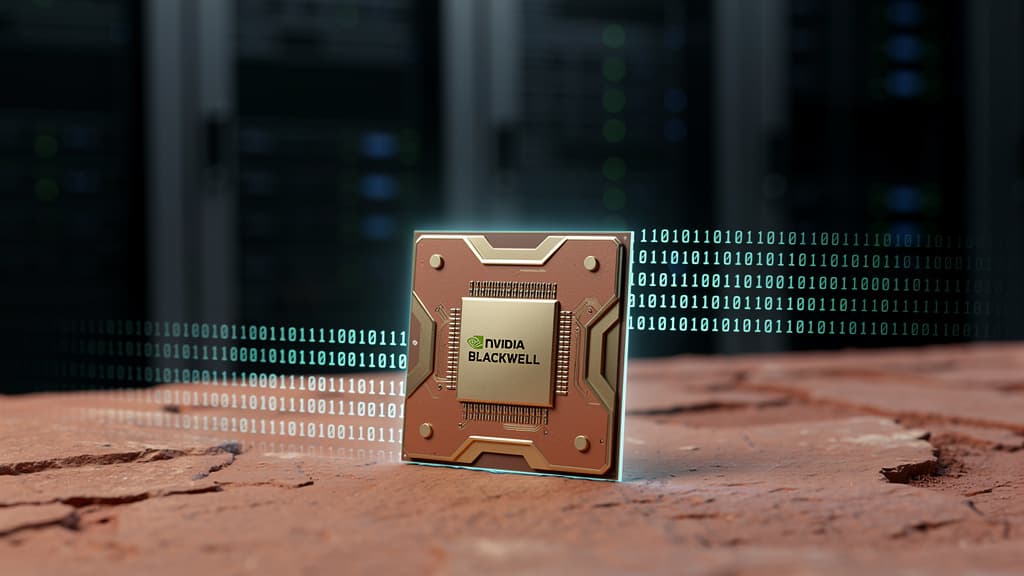
NVFP4 is explicitly designed for NVIDIA's Blackwell architecture, which introduced native FP4 tensor core support. This creates a meaningful architectural fork in enterprise hardware planning:
- Organizations on Hopper-generation hardware (H100/H200) will not see the full benefit of NVFP4 — they can approximate it with FP8 workflows but lack native 4-bit acceleration.
- Organizations evaluating Blackwell (B100/B200/GB200) deployments now have a concrete technical justification beyond raw FLOP counts: NVFP4 is a first-class training methodology that requires the hardware to deliver its promised efficiency gains.
This is not a subtle distinction for enterprise procurement teams. It reframes the Blackwell upgrade cycle from "more performance" to "qualitatively different training capabilities" — a stronger business case for capital expenditure.
Private Model Development at Scale
Perhaps the most strategically significant implication is for enterprises pursuing domain-specific foundation model development. The conventional wisdom has been that only hyperscalers (Meta, Google, Microsoft, Amazon) can afford to pretrain models from scratch. Continued pretraining and domain adaptation on top of open-weight models has been the pragmatic enterprise alternative.
NVFP4 shifts this calculus. If a 12B model can be trained on 10 trillion tokens with 4-bit efficiency, the compute cost of full pretraining on a curated enterprise corpus — legal documents, financial filings, scientific literature, manufacturing specifications — becomes meaningfully more accessible. The gap between "what hyperscalers do" and "what well-resourced enterprise AI teams can do" narrows.
What the Mamba-Transformer Hybrid Reveals
The choice of a hybrid Mamba-Transformer architecture as the validation platform deserves attention beyond its role as a test bed.
Mamba-style state space models (SSMs) handle long-context sequences with linear rather than quadratic complexity, making them attractive for enterprise use cases involving long documents, extended codebases, or time-series data. Transformers retain their advantage on tasks requiring dense attention over shorter contexts. Hybrid architectures attempt to capture both properties.
The fact that NVFP4 was validated specifically on this hybrid design — rather than a standard decoder-only transformer — suggests NVIDIA is anticipating that enterprise AI architectures will increasingly move toward hybrid designs. It also demonstrates that the quantization methodology is robust across fundamentally different computational motifs, not just tuned for vanilla attention blocks.
For enterprise architects, this is a signal: when evaluating next-generation model architectures for internal deployment, hybrid Mamba-Transformer designs are sufficiently mature to be used in production-scale pretraining research at NVIDIA, and they are compatible with the efficiency techniques that will define the next generation of training infrastructure.
Remaining Constraints and Open Questions
NVFP4 is a significant advance, but it does not eliminate all constraints in enterprise AI solution architecture.
Toolchain maturity: NVFP4 requires specific framework support — the selective layer identification, RHT implementation, and stochastic rounding must be integrated into training pipelines. As of mid-2026, this toolchain is not yet as broadly available as BF16 or FP8 workflows in standard frameworks like PyTorch or JAX. Enterprise teams should anticipate an adoption lag before NVFP4 is a drop-in option.
Hardware dependency: The methodology's full efficiency gains are tied to Blackwell's native FP4 support. Organizations with multi-year hardware refresh cycles may not see the benefits until their next procurement cycle.
Scaling law uncertainty: The 12B parameter scale, while meaningful, is not at the frontier of model size. Whether NVFP4's stability properties hold at 70B, 200B, or beyond remains an open research question. Enterprises planning very large private pretraining runs should monitor follow-on research before committing to 4-bit training at extreme scales.
Architectural specificity: The hybrid Mamba-Transformer is not the architecture every enterprise team is building on. Validation on dense transformer architectures at comparable scale would strengthen the generalizability case.
The Broader Trajectory
NVFP4 is best understood not as an endpoint but as a proof of concept for a broader trend: precision is becoming a first-class architectural variable in AI system design, not a fixed constraint imposed by numerical stability requirements.
The progression from FP32 → BF16 → FP8 → FP4 in training has followed a consistent pattern: each step was considered impractical until the right combination of hardware support, algorithmic stabilization, and engineering rigor made it viable. NVFP4 establishes that FP4 pretraining at production scale is no longer theoretical.
For enterprise AI solution architects, the strategic implication is clear: solution designs that treat compute as a fixed, scarce resource are becoming outdated. The more relevant constraint is now algorithmic sophistication — the ability to implement and maintain precision-aware training pipelines, select appropriate architectures for quantization-friendly training, and align hardware procurement with the specific numerical formats that deliver efficiency at scale.
Compute scarcity is not over. But its character is changing. The bottleneck is shifting from raw FLOP availability toward the engineering capability to use those FLOPs at maximum efficiency — and NVFP4 raises the efficiency ceiling substantially.
Sources:
- NVIDIA Introduces a 4-Bit Pretraining Methodology Using NVFP4 — MarkTechPost
- NVIDIA Blackwell Architecture Technical Brief — developer.nvidia.com
- Megatron-LM FP8 Training Documentation — github.com/NVIDIA/Megatron-LM
- "LLM.int8() and Emergent Features" — Dettmers et al., 2022
- Mamba: Linear-Time Sequence Modeling with Selective State Spaces — Gu & Dao, 2023
Last reviewed: May 19, 2026