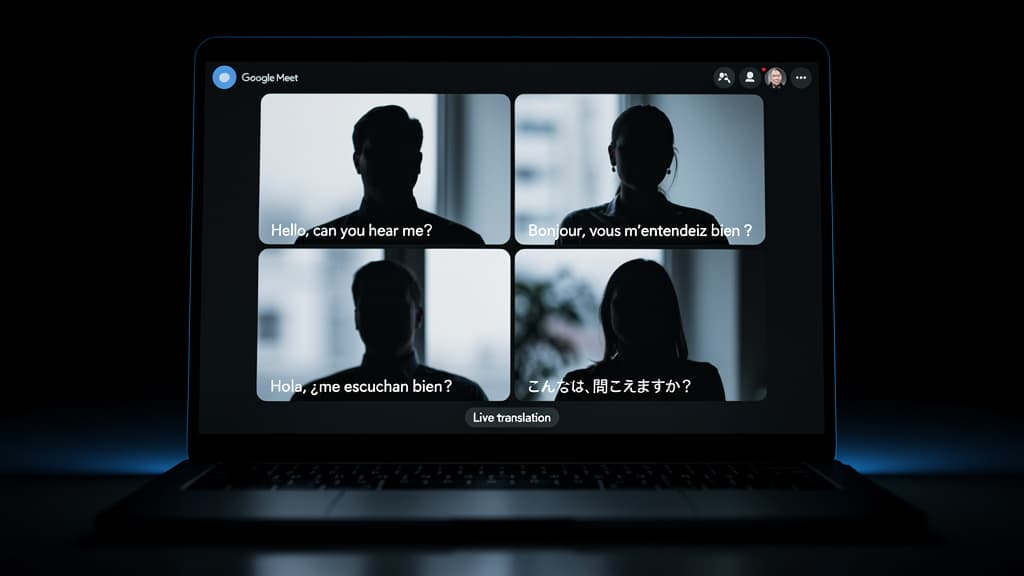
Google's Gemini 3.5 Live Translate is transforming multinational meetings by offering real-time voice translation in over 70 languages, directly within Google Meet.
Google's latest audio model is quietly rewriting the rules for multinational meetings. Gemini 3.5 Live Translate, released in June 2026, delivers real-time voice translation across more than 70 languages directly inside Google Meet — expanding the platform's previous language support from just five languages to over 70 in a single release. For enterprises running cross-border operations on Google Workspace, the implications are immediate and significant.
What Changed — and Why It Matters
The jump from five to 70+ supported languages isn't just a number upgrade. It represents a fundamental shift in how Google Meet can serve multinational teams. Previously, only a handful of major language pairs — English, Spanish, French, German, and Mandarin among them — were covered by live translation. The vast majority of the world's business languages, from Indonesian to Polish to Swahili, were left out entirely.
With Gemini 3.5 Live Translate, Google has closed that gap at scale. The model operates on a multimodal audio architecture that processes spoken input in near real-time, generating translated audio output rather than just subtitles or transcripts. This distinction matters enormously in practice: participants hear a translated voice, not a wall of text they must read while simultaneously trying to engage in conversation.
Google Meet's language support expands from five to over 70 languages with Gemini 3.5 Live Translate — a 14x increase in a single model release.
3 Ways This Disrupts Global Collaboration
1. Voice Preservation Changes the Dynamics of Trust
One of the most technically notable aspects of Gemini 3.5 Live Translate is its ability to preserve speaker tone, pace, and pitch during translation. Prior machine translation systems — even sophisticated ones — produced a flattened, robotic output voice that stripped away the emotional and interpersonal signals embedded in speech.
In a business context, those signals carry weight. A measured, confident delivery from a Tokyo-based CFO briefing a London investment committee shouldn't arrive sounding rushed or monotone. A customer success manager in São Paulo conveying urgency to a Berlin engineering team needs that urgency to land intact. By maintaining prosodic features — the rhythm, stress, and intonation of the original speaker — Gemini 3.5 Live Translate keeps the human layer of communication intact across language boundaries.
This is a meaningful trust-building mechanism for google gemini for business workspace deployments, where relationship quality directly affects deal velocity, project alignment, and organizational culture across geographies.
2. Reducing Operational Friction for Multinational Enterprises
Before this release, enterprises operating across language barriers typically relied on one of three workarounds: hiring professional interpreters for high-stakes calls, scheduling meetings at awkward hours to accommodate bilingual team members who could relay information, or accepting degraded communication quality through static subtitle tools.
All three approaches carry real costs — in budget, in scheduling overhead, and in the cognitive load placed on multilingual employees who are effectively doing two jobs at once. Gemini 3.5 Live Translate removes the need for these workarounds in the context of Google Meet, enabling direct, real-time spoken exchange between participants who share no common language.
For companies with operations in regions where English proficiency varies — Southeast Asia, Latin America, parts of Eastern Europe and Africa — this dramatically lowers the barrier to including local teams in global strategy conversations rather than receiving summarized readouts after the fact.
3. Accelerating the Multimodal AI Roadmap Inside Workspace
The release signals something larger about Google's product direction. Gemini 3.5 Live Translate is built on the same multimodal audio model infrastructure underpinning Google's broader Gemini 2.5 and 3.5 architecture — a system designed to process, reason about, and generate across text, audio, image, and video modalities simultaneously.
Deploying that capability inside a widely-used enterprise collaboration tool like Google Meet is a strategic move: it normalizes AI-mediated communication at the infrastructure level, rather than as an add-on feature users must opt into. As Google continues to integrate Gemini capabilities across Workspace — Docs, Sheets, Gmail, Drive — Live Translate positions audio intelligence as a first-class citizen in the enterprise AI stack.
For product managers and IT decision-makers evaluating google gemini for business workspace, this release is evidence that the platform's AI layer is maturing from productivity assistance toward ambient intelligence embedded in the communication fabric itself.
What to Watch Next
Several questions remain open as enterprises begin deploying this capability. First, latency: real-time voice translation at this scale is computationally intensive, and performance on lower-bandwidth connections — common in emerging markets where the language coverage expansion is most relevant — will determine practical utility. Second, accuracy at domain-specific vocabulary: legal, medical, and financial terminology often breaks general-purpose translation models, and enterprise customers will need confidence that Gemini 3.5 handles technical jargon reliably before deploying it in high-stakes contexts.
Google has not yet detailed the compliance and data residency framework governing translated audio streams — a critical consideration for regulated industries operating under GDPR, HIPAA, or sector-specific data sovereignty requirements.
The pace of the language expansion itself — 14x in a single release — also raises a question about quality distribution across the 70+ supported languages. Coverage breadth and translation quality are not the same thing, and independent benchmarking across language pairs will be essential before enterprises commit to it as a primary communication infrastructure.
For now, Gemini 3.5 Live Translate represents the most significant upgrade to Google Meet's language capabilities since the platform launched live captions in 2019. For multinationals already invested in the Google Workspace ecosystem, it's a development worth evaluating closely.
Sources:
- Google's Gemini 3.5 Live Translate delivers real-time voice translation across 70+ languages — The Decoder
Last reviewed: June 10, 2026