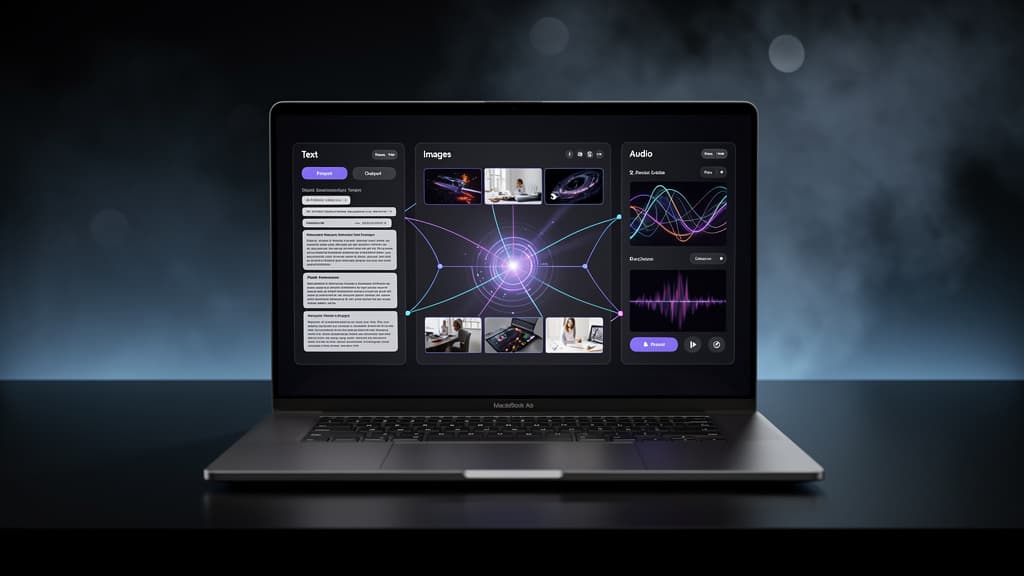
Google DeepMind's Gemma 4 12B shatters the tradeoff between capability and hardware, enabling powerful multimodal AI on standard 16GB laptops for the first time.
5 Reasons Why Gemma 4 12B Changes the Edge AI Landscape
Large language model (LLM) deployment has long been constrained by a brutal tradeoff: capability versus hardware accessibility. The most powerful models demand data center-grade GPUs, while models small enough to run on consumer hardware typically sacrifice too much performance to be genuinely useful. Google DeepMind's Gemma 4 12B breaks that tradeoff in a way that demands serious attention from anyone thinking about edge AI deployment strategy.
Released in mid-2026, Gemma 4 12B is an open-source, natively multimodal model — processing text, images, and audio — that runs on standard laptops equipped with just 16 GB of RAM. More striking still, benchmarks show it matching or exceeding the performance of models nearly twice its size, including 26B model variants. For practitioners, product teams, and enterprise architects evaluating where and how to deploy AI inference, this is a meaningful inflection point.
Here are five specific, technically grounded reasons why Gemma 4 12B reshapes the edge deployment calculus.
1. Multimodal Natively — Not Bolted On
Most compact models that claim multimodal capability achieve it through adapter layers or pipeline stitching — a vision encoder feeds embeddings into a text-only backbone. The seams show in latency, in context-switching artifacts, and in the architectural complexity that practitioners have to manage at deployment time.
Gemma 4 12B processes text, images, and audio within a unified architecture. This matters for edge LLM deployment in several concrete ways:
- Reduced inference overhead: A single model load replaces what would otherwise be two or three separate model processes competing for the same 16 GB of RAM.
- Simpler serving infrastructure: Edge deployments — on-device, in a browser runtime, or on an embedded industrial system — benefit enormously from reducing the number of runtime dependencies.
- Coherent cross-modal reasoning: When image context and text instructions are processed through shared attention layers rather than separate pipelines, the model can reason about relationships between modalities rather than just translating between them.
For teams building applications like document understanding (PDF + text queries), real-time video annotation, or voice-driven interfaces that also need to interpret visual context, native multimodality at 12B parameters is a qualitative leap over what was previously achievable on consumer hardware.
2. The 16 GB Threshold Is the Entire Consumer Laptop Market
This is the deployment statistic that should stop every infrastructure architect in their tracks. 16 GB of RAM is not a niche specification — it is the baseline configuration for the overwhelming majority of laptops sold to professionals today. Apple's M-series MacBooks, Dell XPS configurations, Lenovo ThinkPad tiers, and Microsoft Surface Pro lines all ship at 16 GB as a standard or entry-level professional SKU.
Running a natively multimodal model that matches 26B-scale performance on a standard 16 GB laptop means the deployment target is essentially every professional device already in the field.
The implications for enterprise LLM deployment strategy are significant:
- Zero new hardware procurement: Organizations can deploy Gemma 4 12B to existing endpoint fleets without a refresh cycle.
- Air-gapped and offline use cases unlock: Legal, defense, healthcare, and financial services environments with strict data egress restrictions can now run capable multimodal inference entirely on-device.
- Developer iteration accelerates: Engineers can run the full production model locally during development, eliminating the latency and cost of round-tripping to a cloud inference endpoint during prototyping.
Previous generations of capable open models — LLaMA 3 70B, Mistral Large, Qwen 2.5 72B — required either quantization-induced quality degradation or hardware well above the 16 GB baseline to run at useful speeds. Gemma 4 12B changes that baseline assumption.
3. Matching 26B Performance at 12B Parameters: What the Architecture Is Actually Doing
The claim that a 12B model matches a 26B model is the kind of marketing language that practitioners rightly treat with skepticism. But in Gemma 4 12B's case, the performance parity appears to stem from specific, verifiable architectural choices rather than benchmark cherry-picking.
Several design decisions contribute to the efficiency:
Distillation from Gemini-class models: Gemma 4 12B was trained with knowledge distillation from Google DeepMind's larger Gemini models, meaning the 12B parameter budget encodes a higher-density representation of capability than a model trained from scratch at that scale.
Interleaved attention mechanisms: Google DeepMind's Gemma lineage has progressively refined how attention is structured across layers, reducing redundancy in parameter usage while maintaining reasoning depth. Gemma 4 continues this trajectory.
Multimodal token efficiency: Rather than padding context windows with high-dimensional image embeddings that overwhelm a small model's attention budget, Gemma 4's architecture appears to compress visual tokens more aggressively, preserving the model's effective reasoning capacity for the actual task.
For practitioners benchmarking models for deployment decisions, the relevant comparison is not raw parameter count but performance per watt and performance per GB of RAM at the target hardware tier. On both of those metrics, Gemma 4 12B's positioning against 26B alternatives is the story.
4. Apache 2.0 License Removes the Commercial Deployment Barrier
Licensing is not a footnote for enterprise large language model deployment — it is frequently the deciding factor. Meta's LLaMA models carry usage restrictions that complicate commercial deployment above certain user thresholds. Mistral's licensing has varied by model version. Many capable open models ship with research-only or non-commercial clauses that create legal exposure for production deployments.
Gemma 4 12B ships under the Apache 2.0 license.
Apache 2.0 means unrestricted commercial use, modification, and redistribution — with no royalty obligations and no user-count caps.
For organizations evaluating build-versus-buy decisions on AI capabilities, this matters in at least three ways:
- Fine-tuning and redistribution: Teams can fine-tune Gemma 4 12B on proprietary data and redistribute the resulting model — embedded in a product, shipped to a customer, or deployed across a fleet — without licensing negotiations.
- Vendor independence: Apache 2.0 deployments are not subject to upstream provider policy changes, model deprecations, or pricing adjustments. The model you deploy today remains yours to operate indefinitely.
- Compliance clarity: Legal and procurement teams in regulated industries have well-established frameworks for evaluating Apache 2.0 software. The absence of novel AI-specific licensing clauses simplifies the compliance review significantly.
This licensing posture, combined with the hardware accessibility story, positions Gemma 4 12B as a serious contender for production edge deployments in ways that more restrictively licensed models cannot match regardless of their technical performance.
5. The Paradigm Shift: From Cloud-First to Edge-First LLM Architecture
The four reasons above are individually significant. Together, they point toward something larger: a genuine architectural shift in how organizations should think about LLM deployment topology.
The dominant deployment pattern of 2023–2025 was cloud-first by necessity. Capable models required infrastructure that only hyperscalers could provide, so the architecture defaulted to: device → API call → cloud inference → response. Edge AI was a category reserved for tiny, narrow models — keyword spotters, image classifiers, anomaly detectors — not general-purpose reasoning systems.
Gemma 4 12B, alongside a handful of other models in the 7B–14B range that have emerged from the efficiency research wave, makes a different architecture viable:
Edge-primary, cloud-fallback: Route the majority of inference to on-device models. Reserve cloud API calls for tasks that genuinely require frontier-scale capability (complex multi-step reasoning, very long context, specialized domains). This pattern dramatically reduces API costs, eliminates latency for the common case, and maintains privacy by default.
Federated fine-tuning at the edge: With a capable base model running locally, organizations can explore fine-tuning workflows that keep sensitive training data on-device, syncing only model weight updates — not raw data — to a central coordinator.
Resilient offline operation: Applications built on cloud inference fail when connectivity fails. Edge-primary architectures built on models like Gemma 4 12B can degrade gracefully, maintaining core AI functionality in disconnected or intermittently connected environments.
This is the deployment paradigm that enterprise architects, embedded systems engineers, and product teams building for real-world reliability constraints have been waiting for. The hardware was always there — 16 GB laptops have existed for years. What was missing was a model capable enough to make the architecture worth building.
What to Watch Next
Gemma 4 12B's release is a data point in a trend, not an isolated event. The efficiency research driving models like Gemma 4 — distillation, architectural refinement, multimodal token compression — is accelerating. The practical question for teams making deployment decisions now is not whether edge-capable multimodal models will become the norm, but how quickly the ecosystem of tooling, fine-tuning infrastructure, and deployment frameworks catches up to the hardware reality.
Key developments to track:
- Quantization support: INT4 and INT8 quantized versions of Gemma 4 12B would push the RAM floor below 16 GB, opening deployment to an even broader hardware base.
- Framework integration: Native support in llama.cpp, Ollama, and Hugging Face Transformers determines how quickly the developer community can build on the model.
- Fine-tuning toolchain maturity: LoRA and QLoRA fine-tuning workflows specifically validated for Gemma 4's multimodal architecture will determine how quickly organizations can adapt the base model to domain-specific use cases.
For practitioners evaluating their large language model deployment strategy today, Gemma 4 12B is the clearest signal yet that the edge AI inflection point has arrived — not as a future roadmap item, but as a deployable reality on hardware already sitting on your engineers' desks.
Sources
- Google DeepMind's Gemma 4 12B Squeezes Multimodal AI onto a Laptop with Just 16 GB of RAM — The Decoder
- Gemma Model Card and License — Google AI for Developers
- Apache License 2.0 — Apache Software Foundation
Last reviewed: June 04, 2026