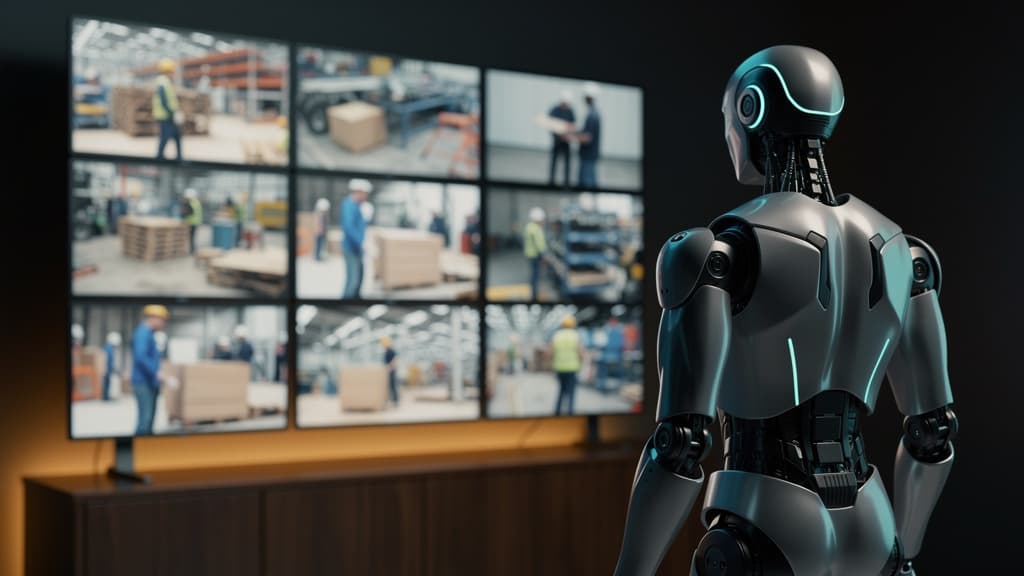
General Intuition is betting $2 billion that the future of physical AI lies in massive video datasets rather than simulation. Is this the end of the sim-to-real gap?
Are General Intuition's World Models the Future of Physical AI?
The robotics industry has spent decades building simulated environments to train machines how to move, grasp, and navigate. But a $300 million funding round at a $2 billion valuation is now making a pointed argument: the future of physical AI isn't built in simulation — it's built from watching humans live their lives on video.
General Intuition, a company developing embodied AI and world models, is reportedly in talks to raise that $300M, according to TechCrunch. The company's core thesis rests on a partnership with Medal, a gaming and activity capture platform with 10 million monthly active users generating roughly 2 billion videos per year. That's not a dataset. That's a firehose of grounded, real-world physical behavior — and investors are betting it changes everything about how robots learn.
This is a genuine inflection point, and it deserves more than a funding announcement. It deserves a hard look at whether video-grounded world models are actually the right foundation for physical AI — and what it means if they are.
The Simulation Problem Nobody Likes to Talk About
Simulation-based training has been the dominant paradigm in robotics AI for good reason. Simulators are cheap, scalable, and safe. You can run a robot through millions of manipulation trials overnight without breaking a single gripper. Companies like DeepMind, Boston Dynamics, and dozens of well-funded startups have built impressive capabilities this way.
But simulation carries a fundamental liability: the sim-to-real gap. Physics engines approximate reality. Lighting is idealized. Object textures are procedural. Contact dynamics — the subtle way a hand feels resistance when picking up a wet glass versus a dry one — are notoriously difficult to model faithfully. Robots trained exclusively in simulation often fail in ways that feel embarrassing when deployed in physical environments, because the world doesn't behave like the simulator said it would.
The field has known about this for years. The honest answer has always been: you eventually need real-world data. The question was always where to get it at scale.
General Intuition's answer is Medal's 2 billion annual videos.
Why Video Is a Surprisingly Good Teacher for Robots
At first glance, gaming footage seems like an odd foundation for physical AI. Medal's users are primarily capturing gameplay highlights — not folding laundry or assembling furniture. But this misses what world models actually need.
A world model isn't a task-specific training set. It's a learned representation of how the physical world behaves: how objects move, how forces interact, how scenes evolve over time in response to actions. Gaming footage, especially from first-person and physics-rich games, contains enormous amounts of this kind of temporal structure. Players navigate 3D spaces, interact with objects, respond to dynamic environments — all captured at scale with consistent metadata.
More importantly, Medal's dataset represents human-generated behavioral priors. These aren't synthetic trajectories sampled from a physics engine. They are decisions made by 10 million real people, in real time, under real cognitive load. For an embodied AI system trying to learn generalizable physical intuition — not just task completion, but the kind of flexible, context-sensitive reasoning humans apply effortlessly — that signal is qualitatively different from anything a simulator produces.
This is the core of General Intuition's bet: that video-grounded world models can bootstrap a kind of physical common sense that simulation simply cannot.
The Valuation Tells You Something Real
A $2 billion valuation for a company in the world models space is not a fluke. It reflects a broader conviction — now backed by significant capital — that the next competitive moat in AI isn't model architecture. It's data provenance.
OpenAI, Google DeepMind, and Anthropic have largely exhausted the publicly available text corpus. The frontier has shifted to multimodal, embodied, and temporally grounded data. Video is the richest such source. And video at the scale Medal provides — 2 billion clips annually, with behavioral metadata attached — is genuinely scarce.
Consider what General Intuition is actually acquiring with this raise: not just compute, not just talent, but a defensible data flywheel. As Medal's user base grows, the dataset grows. As the dataset grows, the world model improves. As the world model improves, General Intuition's embodied AI systems become more capable. That's a compounding advantage that's very hard to replicate from scratch.
This is why the valuation makes sense even before a single robot ships at scale. The asset being valued isn't current revenue — it's the structural position in a data-scarce environment.
The Counterargument: Is Gaming Data Actually General Enough?
Fairness demands engaging with the skeptical case. Gaming footage, however rich, is not the same as real-world physical interaction data. First-person shooters don't teach a robot how to pour coffee. Racing simulators don't encode the haptic feedback of tightening a bolt.
There's also a question of distribution shift. If General Intuition's world model is primarily trained on gaming behavior, does it generalize to the messy, unstructured environments where embodied AI actually needs to operate — hospital corridors, construction sites, home kitchens? The sim-to-real gap doesn't disappear just because you've replaced a physics engine with a video corpus. You've traded one distribution problem for another.
The strongest version of this critique is that Medal's data is a proxy for physical reality, not physical reality itself. A robot learning from gaming footage is still learning from a mediated representation of the world — one filtered through game engine physics, rendering pipelines, and human play patterns that may not reflect real physical task demands.
General Intuition would presumably counter that world models aren't meant to be task-specific training sets — they're meant to learn structure, not procedures. And structure, the argument goes, is transferable even across mediated domains. Whether that holds empirically is the central technical question the company's research will have to answer.
What This Means for the Broader Embodied AI Landscape
General Intuition's raise is a signal, not just a company story. It suggests several things about where physical AI is heading:
Data partnerships will become strategic assets. The race for embodied AI capability will increasingly be won or lost at the data layer. Expect more deals between AI labs and platforms that generate behavioral video at scale — sports broadcasting, surveillance infrastructure, consumer electronics with cameras, industrial IoT.
World models are becoming a distinct product category. Rather than training task-specific robotic policies from scratch, the emerging paradigm is to first build a general world model, then fine-tune on specific physical tasks. General Intuition appears to be positioning itself as a world model foundation provider — the embodied equivalent of a large language model API.
The simulation era isn't over, but it's being subordinated. Simulation will remain valuable for safety-critical testing and edge-case exploration. But as a primary training modality, it's losing ground to real-world video grounding. The next generation of robotics AI will likely use simulation for validation, not formation.
The Honest Bottom Line
Is General Intuition's approach the future of physical AI? Probably — with caveats.
The directional bet is almost certainly right. Video-grounded world models trained on behavioral data at scale represent a more principled path to physical AI generalization than simulation-only approaches. The Medal partnership is a genuinely clever solution to the data scarcity problem. And the $2 billion valuation reflects a rational market assessment of what defensible data assets are worth in the current AI landscape.
But the execution risks are real. Generalizing from gaming footage to physical task competence is not a solved problem. The company will need to demonstrate empirical transfer — not just theoretical plausibility — to justify what comes after this raise.
What's not in doubt is that the question General Intuition is asking is the right one: Where does physical intuition actually come from, and how do we give it to machines? The answer they're pursuing — 2 billion videos of human behavior, processed into a world model that grounds robotic learning in reality rather than approximation — is more compelling than anything simulation has produced so far.
That's worth $2 billion of attention, at minimum.
Sources: TechCrunch — General Intuition funding report
Last reviewed: June 19, 2026