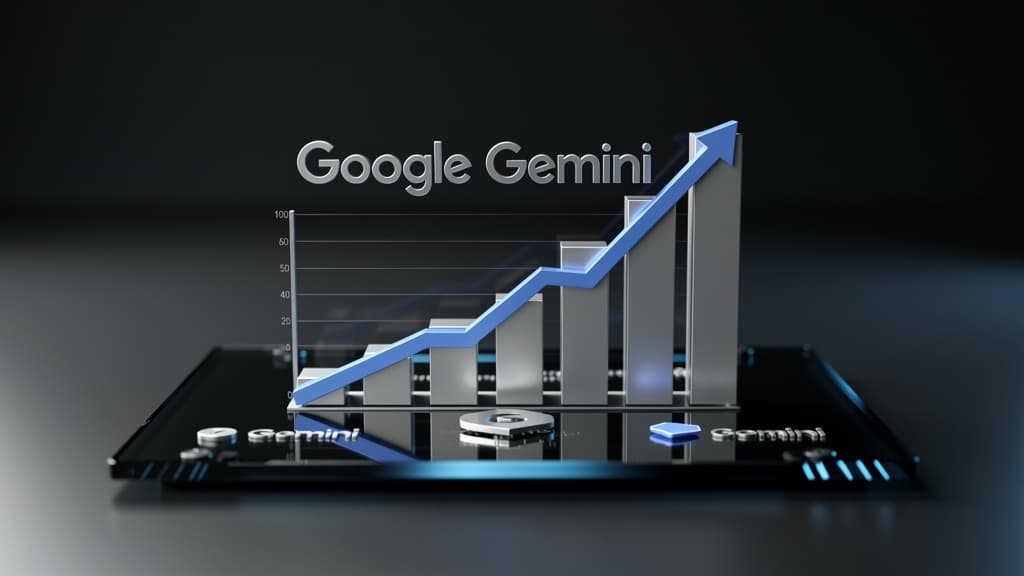
Google Gemini has tripled its market share in just one year, challenging ChatGPT's dominance. Explore the five key drivers behind this massive shift in enterprise AI adoption and workflow integration.
Google Gemini's Market Share Tripled in One Year — Here's Why It Matters for Business
Google Gemini for business workspace adoption has surged dramatically, and the traffic numbers now back it up. According to Similarweb data, Google Gemini grew its share of the generative AI chatbot market from 7.3% to 26.7% in just twelve months — a more than threefold increase. Over the same period, ChatGPT's web traffic dominance fell sharply, dropping from 77.6% to 53.7%. The data, reported by The Decoder, marks one of the most significant competitive shifts in consumer-facing AI since the category emerged.
For enterprise technology leaders, this isn't just a traffic story. It's a signal about where organizational AI workflows are heading — and which platforms are positioning to own them.
1. Deep Google Workspace Integration Drives Sticky Adoption
Gemini's most durable competitive advantage isn't its model performance — it's distribution. Google embedded Gemini directly into the tools hundreds of millions of professionals already use daily: Gmail, Google Docs, Sheets, Slides, and Meet. For business users, that means AI assistance without switching context or managing a separate subscription.
This integration flywheel is hard to replicate. When a user drafts an email in Gmail, summarizes a meeting in Meet, or generates a formula in Sheets — all powered by Gemini — they're building habitual usage that compounds over time. ChatGPT, despite its API reach and consumer mindshare, requires users to leave their workflow and enter a separate interface. That friction matters at enterprise scale.
Google's decision to bundle Gemini into Google Workspace plans — rather than gate it behind a premium tier — accelerated adoption among business users who might otherwise have defaulted to ChatGPT out of familiarity.
2. The ChatGPT Ceiling Was Always a Web Traffic Story
It's worth being precise about what the Similarweb data actually measures: web traffic share among generative AI chatbot platforms. This excludes API usage, mobile app activity, and enterprise deployments — areas where OpenAI remains formidable.
ChatGPT's website traffic share dropped from 77.6% to 53.7% in one year, while Google Gemini jumped from 7.3% to 26.7%, according to Similarweb.
That caveat matters, but it doesn't diminish the signal. Web traffic is a reliable proxy for casual and professional consumer use — the segment that forms the top of the adoption funnel. When users explore, experiment, and build habits with AI tools, they do it through browsers. Gemini's gains in this channel suggest it's winning the consideration phase, not just benefiting from forced bundling.
For OpenAI, the erosion of web dominance is strategically significant even if API revenue holds. Consumer mindshare is where the next generation of enterprise buyers forms their preferences.
3. Google's Brand Trust Gave Enterprise Buyers Permission to Switch
One underappreciated factor in Gemini's rise is institutional trust. Many IT departments and procurement teams that hesitated to approve ChatGPT — citing data privacy concerns, vendor risk, or the novelty of a startup managing sensitive business data — had no such hesitation with Google.
Google's existing enterprise relationships, compliance certifications, and data governance frameworks gave Gemini a credibility shortcut that OpenAI has spent years trying to build. For regulated industries in particular — finance, healthcare, legal — the ability to deploy an AI assistant within a trusted, auditable cloud environment is a meaningful differentiator.
This dynamic helps explain why Gemini's growth appears to be structural rather than cyclical. It's not driven by a single viral feature or a news cycle. It's driven by procurement decisions that tend to be sticky.
4. Multimodal Capabilities Expanded the Use Case Surface
Gemini's architecture was designed from the ground up as a multimodal model — capable of processing text, images, audio, video, and code within a unified system. For business users, this translates into a broader set of practical applications than text-only workflows support.
The ability to analyze a chart from a PDF, generate a presentation from a written brief, or query a spreadsheet in natural language within the same tool expands Gemini's footprint across job functions. Marketing teams, analysts, developers, and operations managers can all find relevant use cases — which drives cross-functional adoption within organizations that might have initially licensed Gemini for a single team.
As enterprises move from AI experimentation to AI integration, platforms that cover more of the workflow surface area gain a compounding advantage. Gemini's multimodal foundation positions it well for that transition.
5. Competitive Pricing Pressure Reshaped the Market
Google's pricing strategy deserves direct credit for the traffic shift. By including Gemini access within existing Google Workspace subscription tiers and offering generous free-tier access through gemini.google.com, Google effectively lowered the switching cost to near zero for millions of users already paying for Workspace.
This put OpenAI in an uncomfortable position: competing on features and model quality against a platform that many target users were already paying for as part of a bundle. The economics of bundled distribution are difficult to fight with a standalone subscription model, particularly as the perceived quality gap between frontier models has narrowed.
For businesses evaluating AI tools in 2026, the calculus increasingly favors platforms embedded in existing infrastructure — and Google has more existing infrastructure than almost any competitor.
What This Means for the Competitive Landscape
The Similarweb data shouldn't be read as a prediction that ChatGPT is finished. OpenAI's API business, enterprise agreements, and developer ecosystem remain substantial. But the web traffic trend confirms that the generative AI market is no longer a one-platform story.
For technology decision-makers, the practical implication is clear: Google Gemini for business workspace is now a serious default option, not a secondary consideration. Organizations that evaluated Gemini a year ago and passed should reassess — the product, the integration depth, and the market validation have all changed materially.
For the broader industry, Gemini's rise signals that distribution and ecosystem integration may ultimately matter more than model benchmarks in determining which AI platforms achieve enterprise scale. That's a dynamic that favors incumbents with deep workflow presence — and puts pressure on pure-play AI companies to find defensible distribution of their own.
Sources:
- The Decoder: ChatGPT's web traffic share dropped from 78% to 54% in one year as Gemini quietly tripled its reach
- Similarweb generative AI chatbot market data (via The Decoder, May 2026)
Last reviewed: May 15, 2026