OpenAI's GPT-Realtime-2.1 introduces critical latency reductions that change the economics of voice AI. We analyze how this impacts enterprise chatbot ROI.
Are Voice Agents Ready for Prime Time with GPT-Realtime-2.1?
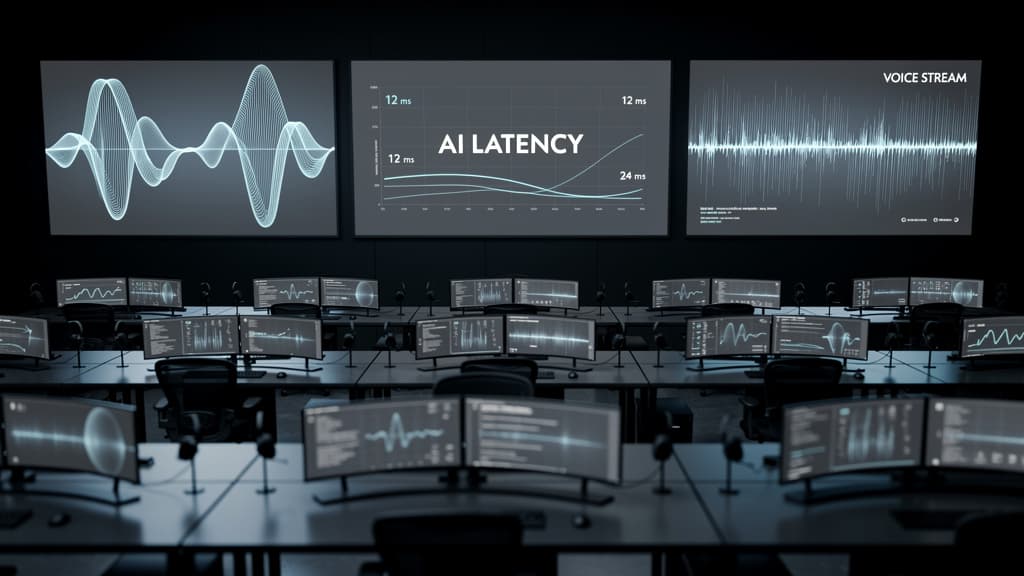
For enterprise customer service leaders, the calculus on voice AI deployment has always come down to a single friction point: latency. A conversational agent that pauses for two seconds before responding doesn't feel like a conversation — it feels like a broken phone tree. OpenAI's release of GPT-Realtime-2.1 and GPT-Realtime-2.1-mini on July 6, 2026 directly targets that friction, delivering a 25% reduction in p95 latency through improved caching and WebRTC transport optimization. The question for enterprise architects and CX decision-makers isn't whether this is technically impressive — it is — but whether it finally crosses the threshold that makes real-time voice agents viable at scale in high-stakes customer support environments.
This deep dive examines the architecture behind the latency improvements, maps those gains against real-world enterprise deployment requirements, and evaluates what the enterprise chatbot ROI for customer service equation looks like now that the performance ceiling has shifted.
The Latency Problem in Enterprise Voice AI
Human conversation operates within a narrow tolerance band. Cognitive science research consistently places the threshold for "natural" conversational response at under 300 milliseconds for turn-taking cues, with perceived awkwardness setting in around 700–800ms. Enterprise telephony systems — already burdened with codec conversion, SIP stack overhead, and CRM API lookups — routinely push total response latency well past that mark when AI inference is added to the chain.
Prior generations of real-time voice APIs addressed this through aggressive audio chunking and streaming, but the p95 latency metric — the latency experienced by the 95th percentile of requests, representing near-worst-case production conditions — remained stubbornly high. P95 is the number that matters in enterprise SLA conversations, not median latency. A contact center handling 50,000 calls per day means thousands of customers per day hitting that tail-end latency. That's not a statistical abstraction; it's churn.
OpenAI's previous GPT-Realtime generation showed the architectural direction was right, but enterprise pilots frequently reported p95 figures that made deployment in tier-1 support flows — billing disputes, account recovery, fraud escalation — difficult to justify against a skilled human agent baseline.
What Changed: Caching Architecture and WebRTC Transport
The GPT-Realtime-2.1 release targets latency reduction through two distinct mechanisms that compound in production environments.
Improved Caching
The primary driver of the 25% p95 latency reduction is improved caching at the inference layer. In voice agent deployments, a significant portion of computational overhead comes from re-processing context that hasn't meaningfully changed between turns — system prompts, tool definitions, conversation history preambles, and static knowledge retrieval. By expanding the scope and efficiency of what the model can cache across turns within a session, GPT-Realtime-2.1 reduces the effective compute burden per response, directly compressing the time-to-first-audio-token.
This matters disproportionately in enterprise deployments because enterprise voice agents are almost always context-heavy by design. A customer service agent for a telecommunications provider might carry a system prompt defining escalation policies, a tool schema for 12 different CRM integrations, and a retrieved customer account summary — all of which would previously be partially re-evaluated on each turn. Caching improvements make that overhead a one-time cost rather than a per-turn tax.
WebRTC Transport Optimization
WebRTC as the transport layer for the Realtime API isn't new, but GPT-Realtime-2.1's optimizations around it are significant for enterprise deployments specifically. WebRTC's peer-to-peer architecture, adaptive bitrate control, and built-in packet loss concealment make it architecturally superior to WebSocket-based streaming for voice in variable network conditions — the real-world condition of customers calling from mobile devices, home broadband, or enterprise VoIP systems with inconsistent QoS.
The practical implication: latency improvements aren't just measured in controlled benchmark environments. They hold under the degraded network conditions that represent a substantial fraction of real customer interactions. For enterprise architects, this means the p95 latency improvement is likely to be observable in production telemetry, not just vendor benchmarks.
25% reduction in p95 latency — the metric that governs worst-case production performance and enterprise SLA commitments — represents a meaningful shift in what's achievable for real-time voice agents in customer service.
Mapping Technical Gains to Enterprise Deployment Tiers
Not all customer service interactions carry equal stakes or equal latency sensitivity. A useful framework for evaluating GPT-Realtime-2.1's enterprise viability maps deployment scenarios across two axes: interaction complexity and customer emotional state.
Tier 1: High-Volume, Low-Complexity Routing and FAQ
These interactions — order status, store hours, basic account inquiries — were already viable with prior Realtime API generations. The latency improvements here translate primarily into cost optimization: higher throughput per API connection, reduced infrastructure overhead, and better user satisfaction scores that reduce escalation rates. ROI in this tier is well-established and the 25% p95 improvement compounds existing gains.
Tier 2: Transactional Support with CRM Integration
Password resets, address changes, subscription modifications — interactions that require real-time tool calls to backend systems. This is where the caching improvements have the most direct impact. The model's ability to cache tool schemas and session context means that the latency cost of each CRM API call isn't amplified by inference overhead. Enterprises that previously saw acceptable median latency but problematic p95 figures in this tier will find GPT-Realtime-2.1 meaningfully changes the deployment calculus.
Tier 3: High-Stakes Emotional Interactions
Billing disputes, service outage complaints, fraud reporting, retention conversations. This tier has historically been the hardest case for voice AI deployment — not purely because of latency, but because latency compounds the perceived lack of empathy. A 600ms pause before a response about an unexpected charge feels dismissive in a way that the same pause during an order status check does not.
GPT-Realtime-2.1's p95 improvements push more interactions below the perceptual awkwardness threshold. Combined with improved model capabilities for emotional calibration in the 2.1 generation, this tier is now genuinely in scope for augmented deployment — not full automation, but AI handling the first two to three turns of an interaction before a human agent joins with full context already populated.
The ROI Equation: What the Numbers Look Like Now
Enterprise chatbot ROI for customer service is typically modeled across three value streams: cost deflection (calls handled without human agent involvement), handle time reduction (AI-assisted human agents resolving faster), and CSAT/NPS improvement (better experiences driving retention).
The latency improvements in GPT-Realtime-2.1 affect all three, but the mechanism differs.
Cost deflection improves because higher-tier interactions become automatable. If a contact center previously automated 40% of inbound volume with prior Realtime API generations, and GPT-Realtime-2.1's latency improvements enable Tier 2 transactional flows to be automated reliably, a conservative estimate of 8–12 percentage points of additional deflection is plausible — representing millions of dollars annually at scale for large contact centers.
Handle time reduction benefits from the caching architecture in a different way: AI-assisted agents using real-time transcription and suggestion tools built on the same API see faster suggestion generation, meaning agents spend less time waiting for AI context before responding to customers.
CSAT improvement is the hardest to model but potentially the most durable. Research from contact center analytics firms consistently shows that perceived responsiveness — how quickly an agent (human or AI) responds — is among the top three drivers of post-interaction satisfaction scores. A 25% p95 latency reduction that keeps more interactions below the perceptual awkwardness threshold has a direct, if difficult to isolate, effect on CSAT.
Industry benchmarks suggest that a 1-point improvement in CSAT score correlates with a 1–2% reduction in customer churn for subscription-based businesses. For an enterprise with $500M in annual recurring revenue, that's $5–10M in retained revenue per CSAT point.
GPT-Realtime-2.1 vs. GPT-Realtime-2.1-mini: The Deployment Decision
The release includes two model variants with meaningfully different enterprise deployment profiles.
GPT-Realtime-2.1 is the full-capability model, suited for complex interactions requiring nuanced reasoning, multi-step tool orchestration, and handling ambiguous or emotionally charged customer inputs. The latency improvements apply here, but this remains the higher-cost option appropriate for Tier 2 and Tier 3 deployments.
GPT-Realtime-2.1-mini maintains pricing parity with the earlier gpt-realtime-mini while delivering the same architectural latency improvements. For high-volume Tier 1 deployments — where the primary value driver is deflection volume rather than interaction complexity — the mini variant represents a compelling cost-performance profile. Enterprise architects can deploy mini for routing, FAQ, and simple transactional flows while reserving the full model for escalated or complex interactions, with seamless handoff between them.
This tiered model deployment pattern — routing interactions to the appropriate model based on detected complexity — is likely to become a standard enterprise architecture pattern as the cost-performance tradeoffs between model variants become more predictable.
What Remains Unsolved
The 25% p95 latency improvement is significant, but intellectual honesty requires acknowledging what it doesn't fix.
Regulatory and compliance constraints in financial services, healthcare, and telecommunications create deployment friction that latency improvements don't address. Call recording consent, PCI-DSS scope for payment discussions, and HIPAA considerations around health-related inquiries require architectural solutions — data residency, audit logging, real-time redaction — that exist independent of model performance.
Hallucination risk in high-stakes contexts remains a genuine concern. A voice agent that confidently provides incorrect information about a billing dispute or insurance claim creates liability exposure that no latency improvement mitigates. Enterprises deploying in Tier 3 contexts will need robust grounding strategies — retrieval-augmented generation with verified knowledge bases, confidence thresholding, and graceful escalation paths — regardless of model generation.
Integration complexity with legacy telephony infrastructure — particularly on-premise PBX systems and older IVR platforms — remains a significant deployment barrier for enterprises that haven't modernized their contact center stack. WebRTC optimization is valuable, but it requires the telephony layer to support modern transport protocols, which is not universal in enterprise environments.
The Verdict: Prime Time, With Caveats
GPT-Realtime-2.1 represents a genuine inflection point for enterprise voice AI deployment. The combination of 25% p95 latency reduction through improved caching and WebRTC optimization, paired with the pricing accessibility of the mini variant, moves real-time conversational agents from "promising pilot technology" to "defensible production deployment" for a meaningful expansion of customer service use cases.
For enterprises that have been waiting for the performance floor to rise before committing to voice AI at scale, this release provides a credible technical foundation. The ROI case for customer service automation — already strong in Tier 1 contexts — now extends credibly into Tier 2 transactional flows and, with appropriate guardrails, into augmented Tier 3 interactions.
The caveats are real: compliance complexity, hallucination risk in high-stakes contexts, and legacy infrastructure integration remain unsolved problems that no model release resolves. But the latency barrier — the most fundamental UX objection to voice AI in customer service — has materially weakened.
Voice agents aren't ready for every prime-time customer service scenario. But for a significantly larger portion of enterprise contact center volume than was true twelve months ago, they are.
Sources:
- OpenAI GPT-Realtime-2.1 and Mini — MarkTechPost
- OpenAI API Documentation — Realtime API Reference
- Cognitive science research on conversational turn-taking latency thresholds
- Contact center analytics industry benchmarks on CSAT and churn correlation
Last reviewed: July 07, 2026