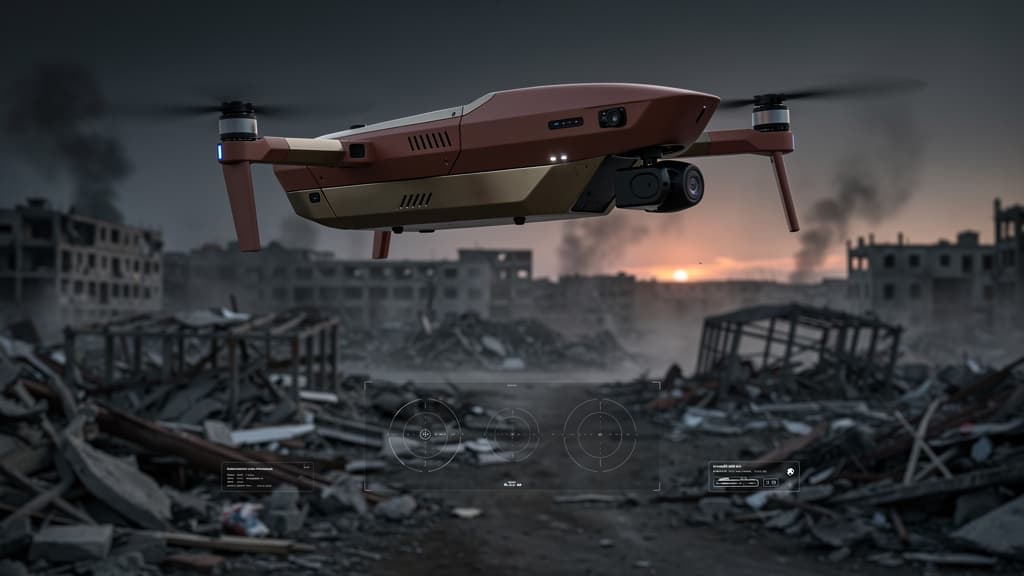
With the first confirmed lethal strike by an autonomous drone, the stakes for AI governance have shifted. Discover the critical lessons for deploying autonomous agents in high-consequence environments.
Autonomous drones made lethal decisions without human intervention in a real conflict zone — and the world is only now reckoning with what that means. A senior Ukrainian defense industry official has confirmed to New Scientist that fully autonomous drones conducted a lethal test approximately two years ago, destroying targets in a designated area with confirmed human casualties. The disclosure marks the first documented instance of an autonomous weapons system independently selecting and engaging human targets in an active war.
The implications stretch far beyond the battlefield. For AI practitioners, defense technologists, and policymakers, this moment forces an urgent question: what does responsible ai agent deployment best practices look like when the agent can kill?
What Happened in Ukraine
According to the New Scientist report, the Ukrainian operation involved fully autonomous drones operating in a geofenced area with a pre-authorized kill zone. Human operators defined the operational parameters before launch — the target area, the engagement rules, the mission window — but once deployed, the drones made targeting and strike decisions independently, without a human in the loop at the moment of lethal action.
The official's confirmation is notable for its specificity: this was not a near-miss or an ambiguous engagement. Targets were destroyed. Human soldiers died. And no human pulled the trigger.
Ukraine has been a proving ground for drone warfare since Russia's full-scale invasion in 2022, with both sides rapidly iterating on first-person-view (FPV) drones, loitering munitions, and AI-assisted targeting. But the shift from AI-assisted to AI-autonomous lethal action represents a categorical line that defense ethicists have long warned about — and it has now been crossed.
The Architecture of Autonomous Lethality
Understanding why this matters technically requires unpacking what "fully autonomous" means in this context. A human-in-the-loop system requires operator confirmation before each strike. A human-on-the-loop system allows a human to abort an action but proceeds automatically if no intervention occurs. A fully autonomous system — what the Ukrainian case appears to describe — requires no human action at any stage of target selection or engagement after initial deployment.
The drones in question likely used a combination of computer vision models for target classification, onboard inference hardware for real-time decision-making, and GPS or visual odometry for navigation within the designated zone. The geofencing element is significant: it represents the primary human constraint on the system, effectively pre-authorizing lethal action against anything matching target criteria within a defined space and time window.
This architecture is not exotic. Variants of it exist in commercial drone platforms today. The barrier to lethal autonomy, it turns out, was less technical than political.
Why This Is a Threshold Moment
International humanitarian law has long operated on the assumption that a human being bears legal and moral responsibility for each lethal act in warfare. The laws of armed conflict — including principles of distinction, proportionality, and precaution — assume a human decision-maker who can exercise judgment in context.
Fully autonomous systems break that chain of accountability. If a drone misidentifies a civilian as a combatant and kills them, who is responsible? The operator who defined the geofence? The engineer who trained the classification model? The commander who authorized the mission? No existing legal framework cleanly answers this question.
The UN Group of Governmental Experts on Lethal Autonomous Weapons Systems (LAWS) has been deliberating since 2014 without producing a binding treaty. The Ukraine disclosure may finally force that conversation to a conclusion.
For the broader AI industry, the parallel is uncomfortable but instructive. The same questions of accountability, explainability, and failure-mode tolerance that apply to autonomous weapons apply — at lower stakes — to every agentic AI system making consequential decisions without human review.
What This Means for AI Agent Deployment
The Ukraine case is an extreme instance of a challenge that AI teams face across industries: deploying autonomous agents into environments where their decisions have real, potentially irreversible consequences. The lessons are transferable.
Pre-authorization is not the same as oversight. The geofenced kill zone gave human commanders the illusion of control while removing meaningful human judgment from the actual decision. In enterprise AI deployments, pre-configured permissions and scope boundaries can create similar false confidence. Defining what an agent can do is not the same as supervising what it does.
Failure modes compound in adversarial environments. Military drones operate in environments specifically designed to confuse sensors — smoke, decoys, electronic jamming, civilian presence. AI agents deployed in high-stakes business contexts face analogous adversarial conditions: edge cases, bad data, prompt injection, and unexpected user behavior. Robust deployment requires stress-testing against adversarial inputs, not just average-case performance.
Reversibility must be a design constraint. The most dangerous autonomous actions are irreversible ones. Lethal drone strikes are the ultimate example, but the principle applies to financial transactions, medical dosing systems, infrastructure controls, and any agentic system with write access to consequential state. Best practice demands that high-stakes actions be staged, logged, and — wherever possible — reversible or at minimum interruptible.
Accountability gaps are deployment risks. If your organization cannot clearly answer "who is responsible when this agent makes a harmful decision," the agent is not ready for production. This is not a philosophical nicety — it is a governance requirement that regulators in the EU, UK, and US are increasingly codifying into law.
What to Watch Next
The New Scientist disclosure is unlikely to remain an isolated data point. Military analysts expect that if Ukraine has crossed this threshold, other actors — state and non-state — have or will shortly. The pressure on NATO allies to respond in kind creates a classic arms-race dynamic that historically has not resolved in favor of restraint.
On the policy side, the UN LAWS negotiations and the International Committee of the Red Cross's ongoing advocacy for a binding prohibition on fully autonomous weapons systems will face renewed urgency. The EU AI Act's provisions on prohibited AI practices and high-risk systems, while not written for military applications, signal the direction of travel for civilian oversight frameworks.
For AI practitioners, the signal is clear: the deployment of autonomous agents in high-stakes environments is no longer a theoretical risk scenario. It is a documented reality. The engineering and governance choices made now — about human oversight, accountability structures, failure-mode tolerance, and reversibility constraints — will define whether autonomous AI systems remain tools that serve human judgment or become actors that replace it.
The first lethal autonomous drone strike happened two years ago. The frameworks to govern the next one do not yet exist.
Sources:
- New Scientist — Fully autonomous drones have killed human soldiers for the first time
- UN Group of Governmental Experts on LAWS
- International Committee of the Red Cross — Autonomous Weapons
- EU AI Act — Official Text
Last reviewed: July 05, 2026