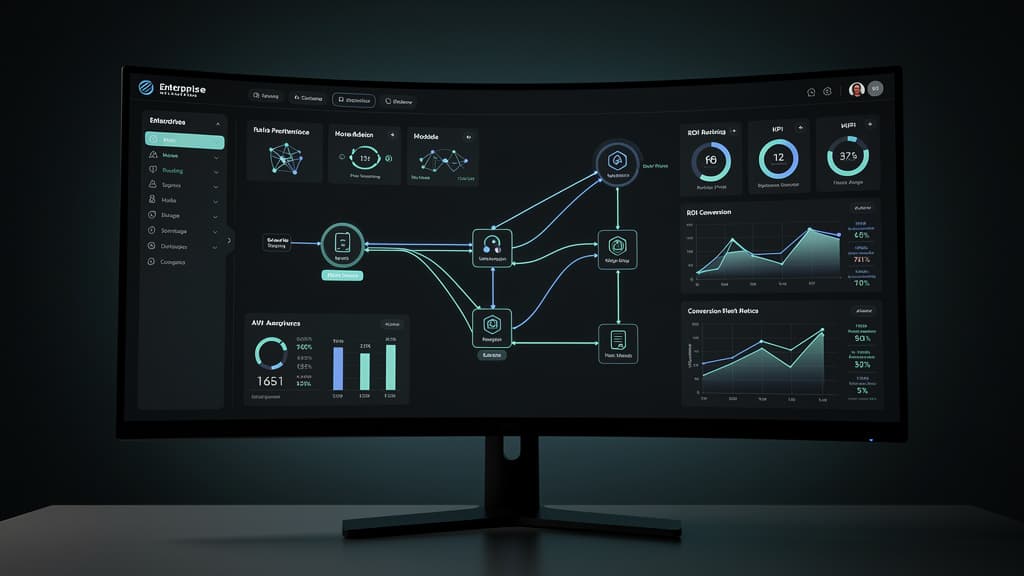
Enterprise AI investment is surging, but traditional metrics are failing. Learn how agentic workflows and new orchestration models are finally providing a path to measurable, verifiable business ROI.
Enterprise AI investment has surged past $200 billion annually, yet a persistent gap between deployment cost and measurable business value continues to frustrate CFOs and technology leaders alike. The question of how to measure AI ROI has never been more urgent — or more poorly answered by conventional metrics. Completion rates, token throughput, and benchmark scores tell you how fast a model runs, not whether it delivered business outcomes.
Two launches in June 2026 are forcing a recalibration of that measurement framework. xAI introduced /goal inside Grok Build, enabling long-running autonomous task execution with built-in verification. Days later, Sakana AI released Sakana Fugu and its more capable sibling Fugu Ultra, an orchestration model that routes tasks across a swappable pool of frontier LLMs. Together, these systems represent something qualitatively different from the AI tools most enterprises have been trying — and failing — to attach ROI numbers to.
This analysis examines what agentic workflows actually change about enterprise AI economics, why legacy measurement frameworks break down when applied to autonomous systems, and how organizations can construct metrics that reflect the value these architectures are genuinely capable of delivering.
The Measurement Problem Legacy AI Created
When enterprises first deployed large language models as assistants — Copilot integrations, customer service chatbots, document summarizers — the ROI calculus was relatively straightforward. You measured time saved per task, multiplied by headcount, and compared against licensing costs. McKinsey's 2024 State of AI report found that organizations measuring AI ROI this way typically reported 10–20% productivity improvements in targeted workflows, but struggled to show impact at the organizational level.
The problem is structural. Single-turn, single-model interactions are discrete and auditable. A human asks a question; the model responds; a human evaluates and acts. The human remains the agent — the entity that takes consequential action in the world. The AI is a tool, and tools are easy to cost-justify.
Agentic AI changes the unit of analysis entirely. When a system autonomously decomposes a goal into subtasks, executes them across multiple steps, verifies its own outputs, and loops back to correct errors — all without human intervention at each step — you are no longer measuring a tool. You are measuring a process.
And process ROI requires process-level instrumentation.
xAI /goal: Verification as a First-Class Primitive
The architectural detail that distinguishes /goal from earlier agentic attempts is its treatment of verification. According to xAI's launch announcement covered by MarkTechPost, /goal is designed specifically for multi-step coding tasks that run over extended time horizons — not the seconds-long inference window of a chat interaction, but genuine long-running execution.
Built-in verification means the system doesn't merely produce an output and hand it off. It checks its own work against defined criteria before proceeding to the next step. This is a meaningful departure from earlier agentic frameworks where verification was either absent or bolted on externally.
From an ROI measurement standpoint, this matters for two reasons:
1. Error propagation cost becomes quantifiable. In multi-step autonomous workflows without verification, a flawed intermediate output compounds. By the time a human reviews the final deliverable, the cost of the error has multiplied across every downstream step that built on it. /goal's built-in verification creates natural checkpoints where failure is caught early — and where that catch can be logged, timestamped, and costed.
2. Confidence intervals replace binary success/failure. Traditional software either works or doesn't. Agentic systems operate probabilistically. A verification layer that emits confidence signals at each step gives organizations the data infrastructure to build reliability curves — essential for any serious ROI model that accounts for rework and exception handling.
For enterprises evaluating Grok Build, the practical implication is this: /goal doesn't just automate coding workflows, it generates the audit trail that makes those workflows measurable. That audit trail is itself an asset.
Sakana Fugu: The Economics of Model Routing
Where /goal addresses execution reliability within a single model context, Sakana Fugu attacks a different dimension of enterprise AI economics: cost-per-task optimization across a heterogeneous model landscape.
According to Sakana AI's Fugu launch, also covered by MarkTechPost, Fugu is an orchestration model — its primary function is deciding which frontier LLM in a swappable pool should handle a given task. Fugu Ultra extends this capability toward more complex routing decisions.
The "swappable pool" framing is architecturally significant. Most enterprise AI deployments today are locked into a single provider relationship: you use GPT-4o, or Claude, or Gemini, and your costs and capabilities are bounded by that choice. Fugu's design assumes a multi-model world where the right model for a task depends on factors like:
- Task type (code generation vs. reasoning vs. document synthesis)
- Latency requirements (real-time vs. batch)
- Cost tolerance (frontier model vs. smaller specialized model)
- Compliance constraints (data residency, model provenance)
For enterprise ROI measurement, this creates a new and powerful metric category: routing efficiency. The question is no longer just "did the AI complete the task?" but "did the orchestration layer select the optimal model for this task given cost and quality constraints?"
A mature Fugu deployment should be able to answer: for every dollar spent on AI inference, what percentage was allocated to the minimum-cost model capable of meeting quality thresholds for that task class? That ratio — call it inference allocation efficiency — is a metric that simply didn't exist in single-model deployments.
Rebuilding the ROI Framework for Agentic Systems
The convergence of /goal-style execution verification and Fugu-style model orchestration points toward a new measurement architecture. Here is how enterprise teams should restructure their AI ROI frameworks:
Layer 1: Task Completion Economics
This is the closest analog to legacy metrics, but it needs to be expanded. Don't just measure whether a task completed — measure:
- Autonomous completion rate: percentage of tasks completed end-to-end without human intervention
- Intervention cost: when humans do intervene, how much time and at what seniority level?
- Verification catch rate: what percentage of errors were caught by built-in verification vs. human review?
Organizations that instrument verification catch rates typically find that 60–80% of agentic workflow errors are caught at intermediate steps — errors that would have reached human review in non-verifying systems, at significantly higher remediation cost.
Layer 2: Orchestration Efficiency
For multi-model deployments like those Fugu enables:
- Inference allocation efficiency: cost of actual model used vs. cost of most expensive available model, per task class
- Quality-adjusted cost per task: normalize completion quality scores against inference spend
- Model substitution rate: how often does the orchestrator route away from default/expensive models without quality degradation?
Layer 3: Workflow-Level Business Outcomes
This is where most enterprise ROI frameworks currently stop — at individual task metrics — rather than ascending to this level. Agentic systems, because they execute multi-step processes, can be instrumented at the workflow level:
- Cycle time reduction: end-to-end time for a defined business process (e.g., code review → test → deployment pipeline)
- Throughput at constant headcount: volume of completed workflows per human FTE over time
- Exception rate: percentage of workflows that require escalation out of the autonomous system
Layer 4: Compounding Value Indicators
The most underappreciated dimension of agentic ROI is compounding. Unlike a chatbot that delivers the same marginal value on the thousandth query as the first, agentic systems can accumulate institutional knowledge, refine routing decisions based on historical performance, and reduce exception rates over time.
Measuring this requires longitudinal instrumentation:
- Exception rate trend: is the system escalating fewer tasks to humans month-over-month?
- Routing accuracy drift: is orchestration improving its model selection over time?
- Verification precision: are built-in checks becoming more accurate, reducing false positives that block valid outputs?
Why Conventional Benchmarks Mislead Enterprise Buyers
A critical failure mode in enterprise AI procurement is over-reliance on academic benchmarks — MMLU, HumanEval, MATH — as proxies for business value. These benchmarks measure model capability on standardized tasks under controlled conditions. They say nothing about how a model performs inside a multi-step agentic workflow under real enterprise constraints.
The specific failure modes that benchmarks miss:
Instruction drift: In long-running tasks like those /goal is designed for, models can drift from original instructions over many steps. A model that scores 90% on HumanEval may degrade significantly on step 15 of a 20-step autonomous coding workflow. No standard benchmark measures this.
Orchestration compatibility: A model that performs well in isolation may perform poorly when receiving inputs from an orchestration layer like Fugu — inputs that are structured differently than human prompts. Benchmark scores don't capture this.
Verification false positive rate: A verification system that flags too many valid outputs creates its own cost — human reviewers spending time on false alarms. This is entirely absent from standard evaluation frameworks.
Enterprise teams should construct shadow deployment periods — running agentic systems in parallel with existing processes for 60–90 days — before committing to ROI projections. The data generated in shadow deployment is far more predictive than any vendor-provided benchmark.
The Competitive Stakes
The timing of /goal and Sakana Fugu is not coincidental. Both launches reflect a maturing recognition across the AI industry that enterprise adoption is stalling not because models aren't capable, but because enterprises cannot justify continued investment without credible ROI evidence.
xAI's bet with /goal is that verification infrastructure — making autonomous execution auditable and reliable — is the unlock for enterprise trust. Sakana AI's bet with Fugu is that orchestration intelligence — routing tasks to optimal models dynamically — is the unlock for enterprise economics.
Both bets are likely correct, and they are complementary rather than competing. The enterprise AI stack that wins the next three years will probably look like: a goal-oriented execution layer with built-in verification (the /goal model) sitting atop an intelligent orchestration layer that manages cost and capability across a frontier LLM pool (the Fugu model).
Organizations that build their ROI measurement frameworks now — before these architectures are widely deployed — will be positioned to capture and demonstrate value that their competitors are still trying to explain to skeptical CFOs.
What to Instrument Starting Now
For technology leaders who need to act before their measurement frameworks are fully mature, here is a prioritized instrumentation roadmap:
Immediate (0–30 days): Establish baseline cycle times and human intervention rates for the top three workflows you plan to automate. You cannot measure improvement without a baseline.
Short-term (30–90 days): Deploy shadow agentic workflows alongside existing processes. Log every step, every verification event, every human escalation. Don't optimize yet — just collect.
Medium-term (90–180 days): Build the four-layer ROI dashboard described above. Begin tracking routing efficiency if you're operating in a multi-model environment. Establish quality scoring rubrics for task outputs that are consistent enough to track over time.
Ongoing: Monitor exception rate trends and verification precision as leading indicators of system maturity. These metrics predict future ROI before it shows up in business outcome data.
The enterprises that will report credible AI ROI numbers in 2027 are the ones building this instrumentation infrastructure today — not waiting for the industry to hand them a standard framework that may never come.
Sources
- xAI Launches /goal in Grok Build — MarkTechPost, June 22, 2026
- Sakana AI Launches Sakana Fugu — MarkTechPost, June 22, 2026
- McKinsey & Company, The State of AI 2024, https://www.mckinsey.com/capabilities/quantumblack/our-insights/the-state-of-ai
Last reviewed: June 23, 2026