As companies shift from unrestricted token usage to strict rationing, they are finally building the infrastructure needed to accurately measure AI ROI and justify enterprise-scale model deployment.
The Tokenmaxxing Hangover Is Real — and It's Reshaping How Companies Measure AI Value
Token rationing — the deliberate practice of capping, monitoring, and optimizing the number of tokens consumed per AI interaction — is emerging as the dominant cost-control framework for enterprise AI in 2026. It represents a fundamental reversal of the "more is more" mentality that characterized early generative AI adoption, when organizations encouraged unrestricted usage to maximize employee experimentation.
The shift has a surprisingly mundane catalyst: employees converting PDFs into PowerPoint slides.
According to reporting from 404 Media and TechCrunch, leaked audio from inside Accenture revealed that one of the firm's primary AI cost drivers wasn't sophisticated agentic workflows or complex code generation — it was the routine, high-volume task of converting PDF documents into presentation slides. Repeated thousands of times across a large workforce, this single use case was consuming token budgets at a scale that alarmed finance teams.
That revelation has become something of a Rorschach test for the enterprise AI industry. For some, it's an embarrassing indictment of ROI discipline. For others, it's the inflection point that finally forced organizations to build the measurement infrastructure they should have had from the start. Either way, it's accelerating a structural shift in how to measure AI ROI — and three distinct forces are driving it.
Reason 1: The "Tokenmaxxing" Era Generated Waste at Industrial Scale
Tokenmaxxing — the practice of submitting maximally verbose prompts, uploading entire document libraries as context, and running multi-step chains without optimization — was, for a period, rational behavior. When AI budgets were treated as R&D experiments rather than operational line items, the incentive structure rewarded exploration over efficiency. Employees had no visibility into their consumption, no feedback loops, and no reason to self-regulate.
The results were predictable in retrospect. A single employee converting a 40-page PDF into a slide deck via a frontier model might consume 50,000–150,000 tokens per conversion, depending on prompt construction and model selection. Multiply that by hundreds of employees doing it daily, and the monthly token burn for a single low-value use case can reach tens of millions of tokens — translating to thousands of dollars per month on tasks that a template and a junior analyst could accomplish in comparable time.
The Accenture case is notable not because it's unusual, but because the audio leaked. Industry observers widely believe similar dynamics exist at most large enterprises that gave employees broad API access without usage governance.
"Companies are scrambling to stop employees from maxing out AI budgets with small tasks." — TechCrunch, June 2026
The core problem is architectural: most organizations instrumented their AI deployments for capability, not cost accountability. They tracked whether the model produced a usable output. They did not track the token cost per output, the cost-per-task relative to non-AI alternatives, or the distribution of consumption across employees and use cases.
Without that data, measuring AI ROI was effectively impossible. You could point to anecdotal productivity wins. You could not tell your CFO which use cases were generating positive returns and which were burning budget on reformatting tasks.
Reason 2: Token Budgets Are Forcing the Construction of Real ROI Metrics
The imposition of token budgets — hard caps on API consumption per employee, per team, or per use case — is doing something counterintuitive: it's making AI ROI measurable for the first time.
When consumption is unconstrained, there's no unit economics. When consumption is capped and tracked, every token becomes a cost input that can be set against a value output. This is the foundational requirement for any legitimate ROI calculation.
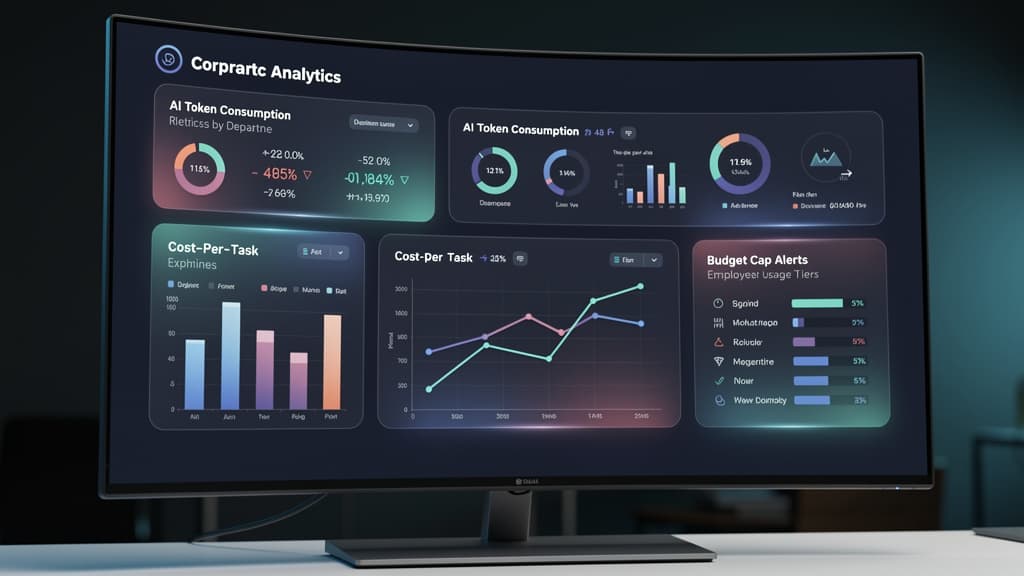
Organizations that have moved to token rationing are now building measurement frameworks around several key metrics:
Cost Per Completed Task (CPCT)
The most direct metric: total token cost (input + output tokens × model price per million tokens) divided by the number of completed, accepted outputs. For the PDF-to-slides use case, CPCT might be $0.80–$2.50 per deck depending on model and prompt efficiency. The question organizations are now asking is whether that cost is justified relative to the time saved and the quality of output — a calculation that was never being made during the tokenmaxxing era.
Token Efficiency Ratio (TER)
Some engineering teams are tracking the ratio of output tokens to input tokens as a proxy for prompt efficiency. Bloated system prompts, unnecessary context injection, and poorly structured few-shot examples all inflate input token counts without improving output quality. A TER analysis can identify which internal prompt templates are wasteful and which are optimized.
Use Case ROI Classification
Perhaps the most strategically important development: organizations are now classifying AI use cases into tiers based on token cost relative to measurable business value. A tier-one use case (e.g., automated contract review that reduces legal review time by 60%) justifies high token expenditure. A tier-three use case (e.g., reformatting a PDF into slides that will be used once) does not.
This classification work is nascent and inconsistent across organizations, but the Accenture situation has given it urgency. The question "is this use case worth the tokens it costs" is now a legitimate procurement and governance question, not just an engineering optimization.
Per-Employee Consumption Benchmarks
Several enterprises are now tracking AI token consumption at the individual level, similar to how SaaS seat utilization is monitored. The goal isn't punitive — it's to identify both the power users generating disproportionate value and the high-consumption users generating questionable outputs. This data feeds into license allocation, training prioritization, and use case governance.
Reason 3: Model Diversity Is Making Cost Optimization Structurally Necessary
The third force driving token rationing isn't behavioral — it's architectural. The enterprise AI stack in 2026 looks nothing like it did in 2023. Organizations now have access to a tiered ecosystem of models ranging from sub-cent-per-million-token open-weight models running on internal infrastructure, to mid-tier API models at $1–5 per million tokens, to frontier reasoning models that can cost $15–60 per million tokens for complex tasks.
In a single-model environment, cost optimization was limited. You could optimize prompts, but you couldn't route tasks to cheaper models because there were no cheaper models that met enterprise quality thresholds.
That constraint no longer exists. The PDF-to-slides conversion that Accenture employees were running on a frontier model could, in most cases, be handled adequately by a model costing one-tenth as much. The failure to implement intelligent model routing — automatically directing tasks to the least expensive model capable of completing them acceptably — is now recognized as a significant source of AI budget waste.
Token rationing frameworks are increasingly incorporating model routing logic. Rather than simply capping consumption, sophisticated implementations assign use case categories to model tiers and enforce those assignments at the API gateway level. A request to convert a PDF to slides gets routed to a mid-tier model. A request to analyze legal contract risk gets routed to a frontier model. The routing decision is based on a combination of task classification, quality requirements, and cost thresholds.
This creates a new dimension of ROI measurement: model selection efficiency. Organizations can now calculate how much they would have spent if all tasks had been routed to frontier models versus their actual mixed-model spend — and attribute the delta as measurable cost avoidance.
What a Token Rationing Framework Actually Looks Like
For organizations building their first token governance infrastructure, the Accenture case suggests a practical starting point: audit before you cap.
The audit phase involves pulling API logs and answering three questions:
- What are the top 10 use cases by token volume? (Not by number of requests — by total tokens consumed, which surfaces high-cost tasks that may occur infrequently.)
- What is the CPCT for each use case? (This requires mapping token costs to completed outputs, which may require instrumentation work.)
- Which use cases have a measurable business value output, and which are convenience tasks? (This is the qualitative judgment that finance and business unit leaders need to make, not just engineering.)
The audit typically produces a Pareto-style finding: a small number of use cases account for a disproportionate share of token spend. In many organizations, two or three use cases — often including document transformation tasks similar to the Accenture example — represent 40–60% of total token consumption.
From there, the rationing framework has three levers:
- Hard caps: Maximum token budgets per employee per month, enforced at the API gateway
- Soft alerts: Notifications when an employee or team approaches a threshold, prompting review without blocking access
- Use case restrictions: Blocking or deprioritizing specific categories of requests (e.g., document reformatting during peak cost periods) via prompt classification at the gateway
The Measurement Infrastructure Gap
The deeper issue exposed by the token rationing shift is that most organizations lack the observability infrastructure to measure AI ROI rigorously. They have billing data from their API providers. They do not have a clean mapping between API calls and business outcomes.
Building that mapping requires connecting three systems that are typically siloed:
- API usage logs (token counts, model versions, timestamps, user identifiers)
- Task completion data (what output was produced, whether it was accepted or rejected, how it was used downstream)
- Business value proxies (time saved, error rates reduced, revenue influenced, cost avoided)
The organizations that are ahead on AI ROI measurement have invested in building this connective tissue — typically through a combination of custom instrumentation, AI observability platforms, and structured output tagging that allows outputs to be traced to business processes.
This is not a trivial engineering investment. But the alternative — continuing to run AI spend as an unaccountable R&D line item — is increasingly untenable as AI becomes a material cost in operating budgets.
The shift from tokenmaxxing to token rationing is ultimately a maturity signal: organizations are moving from "can AI do this?" to "is it worth it for AI to do this?"
The Broader Implication for AI Strategy
The token rationing movement will likely produce a counterintuitive outcome: it will make AI more valuable, not less. By forcing organizations to identify which use cases justify the cost, it directs AI investment toward high-ROI applications and away from convenience tasks that could be handled more cheaply.
The Accenture PDF-to-slides case will be remembered not as a story about waste, but as the moment enterprise AI crossed from the adoption phase into the accountability phase. In that phase, the question "how to measure AI ROI" stops being a theoretical exercise and becomes a prerequisite for continued investment.
Organizations that build token governance infrastructure now — audit pipelines, CPCT tracking, model routing logic, per-employee benchmarks — will have a structural advantage as AI costs continue to scale with usage. Those that don't will face the same conversation Accenture's leadership apparently had when the audio leaked: explaining to stakeholders why millions in AI spend went to reformatting documents.
Sources:
- 404 Media: The Tokenpocalypse Is Here: Companies Are Scrambling to Stop Spending So Much on AI
- TechCrunch: Companies Are Scrambling to Stop Employees from Maxing Out AI Budgets with Small Tasks
Last reviewed: June 25, 2026