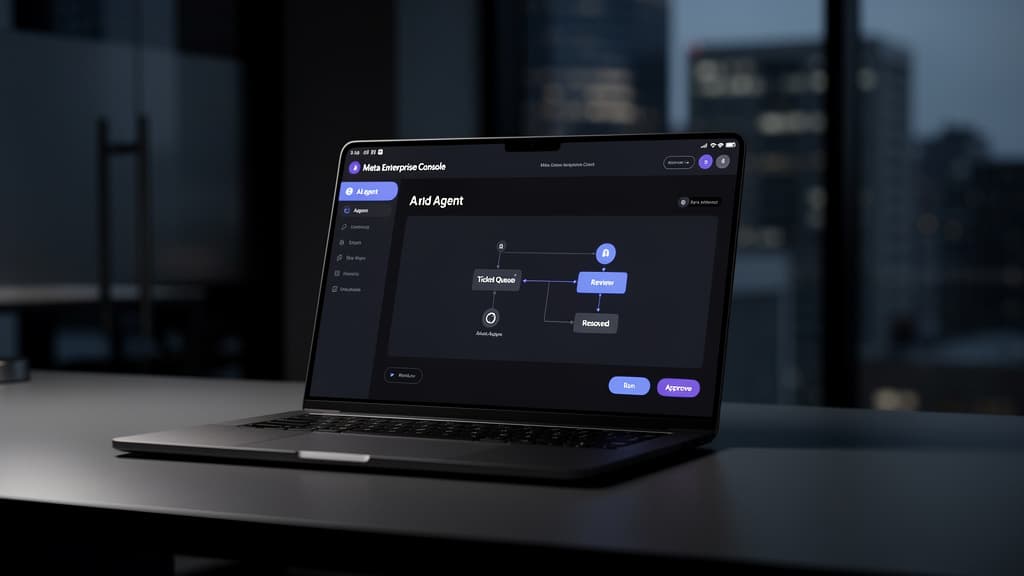
Meta is launching Hatch, a $200-per-month autonomous AI agent designed to handle complex workflows. This strategic move signals a major shift toward enterprise productivity software.
Meta is preparing to launch Hatch, a premium AI agent priced at up to $200 per month, marking the company's first foray into paid AI products. The move signals a significant strategic pivot for a company that has historically monetized through advertising — and it positions Meta squarely in the enterprise productivity market at a moment when AI tools for enterprise productivity are becoming a serious budget line item for organizations worldwide.
What Hatch Actually Does
Hatch is not simply a chatbot. According to reporting from The Decoder, Hatch is designed to function as a capable autonomous agent — one that can build tools, schedule appointments, and send emails based on natural-language requests from users. The distinction matters: this is agentic AI, not conversational AI. Rather than answering questions, Hatch is being built to take action on behalf of users inside real workflows.
That positions Hatch alongside competitors like Microsoft Copilot, Google's Gemini for Workspace, and Salesforce's Agentforce — all of which are racing to capture enterprise budgets by embedding AI agents directly into daily work processes.
Zuckerberg's Monetization Play
Mark Zuckerberg has been explicit that Meta's AI investments — which have run into the tens of billions of dollars — need to generate returns beyond the core advertising business. Meta's capital expenditure guidance for 2025 alone reached as high as $65 billion, much of it directed toward AI infrastructure including data centers and custom silicon.
Hatch represents the clearest signal yet that Zuckerberg intends to build a second revenue pillar. A $200/month price point is not a consumer product — it is an enterprise and prosumer offering, comparable to what companies already pay for tools like Notion AI, GitHub Copilot, or Salesforce Einstein. If Meta captures even a fraction of the enterprise productivity software market, which research firm Gartner has projected will exceed $1 trillion in total addressable value by 2027, the revenue implications are substantial.
Meta's AI infrastructure investment requires new monetization pathways. Hatch is the first concrete answer to how the company plans to generate direct revenue from AI beyond advertising.
Why the $200 Price Point Is Deliberate
Pricing an AI agent at $200 per month is not arbitrary. It places Hatch in a bracket that enterprise buyers recognize and that procurement teams can justify — roughly equivalent to a mid-tier SaaS seat license. It is high enough to signal premium capability and low enough to avoid the extended procurement cycles that come with six-figure software contracts.
For comparison:
- Microsoft Copilot for Microsoft 365 runs $30/user/month at the standard tier, with higher-tier agent capabilities priced separately
- Salesforce Agentforce is consumption-based, with enterprise deals typically running into thousands per month
- OpenAI's ChatGPT Enterprise starts at roughly $30/user/month with volume pricing
At $200/month, Hatch is betting that the depth of its agentic capabilities — particularly around task execution rather than just generation — justifies a premium over conversational AI subscriptions.
The Enterprise Productivity Angle
The specific capabilities attributed to Hatch — scheduling, email, and tool-building from natural language — map directly onto the highest-friction parts of knowledge worker workflows. These are not glamorous tasks, but they are time-consuming ones. McKinsey research has consistently found that knowledge workers spend between 20% and 30% of their working hours on coordination activities: scheduling meetings, composing routine communications, and managing information across tools.
An AI agent that reliably handles these tasks autonomously — not just suggesting drafts but actually executing — would represent a meaningful productivity multiplier. The key word is reliably. Enterprise buyers have grown skeptical of AI productivity claims after early Copilot deployments showed uneven results. Meta will need to demonstrate that Hatch can execute tasks accurately and consistently before enterprise IT departments commit to deployment at scale.
Meta's Structural Advantages — and Its Challenges
Meta enters the enterprise AI market with some genuine structural advantages. Its AI research division has produced foundational models — most notably the Llama series — that are widely deployed and respected within the technical community. The company's infrastructure scale means it can run inference at a cost basis that smaller AI companies cannot match.
But Meta also faces real headwinds in the enterprise space. The company has no established enterprise sales motion, no significant footprint in corporate IT environments, and a brand that is more closely associated with consumer social media than with business software. Selling to CIOs and procurement teams requires a different playbook than selling to consumers or developers.
There is also the question of data trust. Enterprise buyers are acutely sensitive about which AI providers can access their internal communications, calendars, and workflows. Meta's history with data privacy — including ongoing regulatory scrutiny in the EU and elsewhere — may give some enterprise IT and legal teams pause before granting Hatch the kind of deep system access that agentic AI requires to function effectively.
What to Watch Next
Several questions will determine whether Hatch becomes a serious enterprise productivity platform or a high-profile experiment:
Integration depth: Will Hatch connect natively with Microsoft 365, Google Workspace, Slack, and Salesforce — the tools where enterprise work actually happens? Without deep integrations, a $200/month agent has limited utility for most organizations.
Data governance controls: Enterprise buyers will want to know where data is processed, how it is retained, and what audit trails exist. Meta's answers to these questions will shape adoption among regulated industries.
Go-to-market strategy: Does Meta build a direct enterprise sales team, partner with system integrators, or distribute Hatch through existing channels like WhatsApp Business? The distribution model will significantly affect how quickly Hatch scales.
Performance benchmarks: How does Hatch perform on real-world agentic tasks compared to established competitors? Independent benchmarks — not just Meta's own claims — will matter to enterprise evaluators.
Meta has not announced a firm launch date for Hatch as of this reporting. But the product's existence and pricing structure confirm that the company is serious about competing for enterprise AI budgets — and that the AI tools for enterprise productivity market is about to get considerably more crowded.
Last reviewed: June 07, 2026