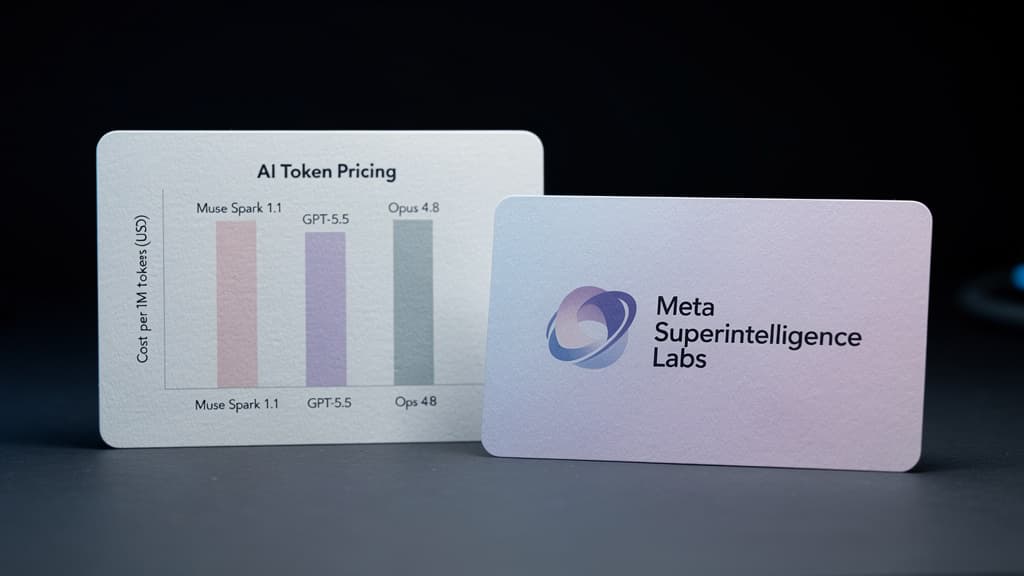
Meta's release of Muse Spark 1.1 at $4.25 per million tokens is challenging the dominance of OpenAI and Anthropic, forcing enterprises to re-evaluate their AI agent cost reduction strategies.
Meta's Muse Spark 1.1 Challenges Enterprise AI Pricing
Meta Superintelligence Labs dropped a significant pricing challenge on the enterprise AI market on July 9, 2026, releasing Muse Spark 1.1 — a multimodal reasoning model built for agentic workflows — at $4.25 per million output tokens through the Meta Model API. The move directly undercuts both OpenAI's GPT-5.5 and Anthropic's Opus 4.8, forcing enterprise AI buyers to reconsider the cost assumptions baked into their current AI ROI models.
For organizations running high-volume AI agent pipelines, the pricing gap isn't academic. It's a line item that could reshape procurement decisions across industries.
What Muse Spark 1.1 Actually Delivers
Muse Spark 1.1 arrives with two capabilities that matter most to enterprise agentic deployments: a 1,000,000-token context window and zero-shot tool generalization. The context window alone positions it for long-horizon tasks — think multi-step code review across large codebases, extended document analysis, or persistent agent sessions that would otherwise require expensive context management workarounds.
Zero-shot tool generalization means agents built on Muse Spark 1.1 can interact with new APIs and tools without task-specific fine-tuning. For enterprises deploying agents across heterogeneous internal systems, this reduces both setup time and the ongoing cost of maintaining specialized model variants.
The combination targets a specific pain point: enterprise AI agents that fail not because the model is weak, but because context limits force fragmentation and tool integration requires constant retraining.
The Pricing Math That's Forcing a Rethink
The $4.25 per million output tokens figure becomes meaningful when placed against real agentic workload volumes. Enterprise AI agent deployments — particularly in customer support automation, software development assistance, and internal knowledge retrieval — routinely generate hundreds of millions of output tokens per month at scale.
At $4.25 per million output tokens, Meta's pricing on Muse Spark 1.1 represents a direct challenge to the cost structures enterprises have built around GPT-5.5 and Opus 4.8 deployments.
The competitive pressure here is structural. OpenAI and Anthropic have both benefited from enterprise lock-in built during periods when frontier model access was scarce. That scarcity premium is eroding. Meta's open-ecosystem positioning — the Meta Model API is designed for straightforward integration — removes friction that previously made switching costs prohibitive.
For AI cost reduction case studies now being built inside enterprise finance and IT organizations, Muse Spark 1.1's pricing creates a credible benchmark. Teams that previously justified GPT-5.5 or Opus 4.8 on capability grounds alone now need to demonstrate that the performance premium justifies the token cost differential at their specific usage volumes.
Where the Competitive Pressure Lands
The timing is deliberate. Meta Superintelligence Labs is entering the agentic AI race at the moment enterprises are moving from pilot programs to production deployments. The AI coding assistant space — where TechCrunch noted Meta's entry with Muse Spark 1.1 — is particularly exposed, as token volumes in coding workflows are high and the ROI calculation is relatively transparent.
For OpenAI and Anthropic, the challenge isn't losing a single enterprise deal. It's the downstream effect on pricing negotiations across their entire enterprise customer base. Every procurement team now has a concrete alternative to cite.
The-Decoder's analysis of the pricing dynamics frames this accurately: Meta's API pricing is designed to squeeze competitors' margins at the enterprise tier, not just attract cost-sensitive startups. The 1M-token context window and zero-shot tool capabilities are the technical justification for enterprise consideration; the $4.25 price point is the commercial lever.
What Enterprises Should Evaluate Now
For technology decision-makers, Muse Spark 1.1's release creates a concrete evaluation checklist:
Context window utilization: If current agent deployments are hitting context limits and implementing costly chunking workarounds, the 1M-token window may deliver efficiency gains beyond raw token cost savings.
Tool integration overhead: Organizations maintaining fine-tuned model variants for internal tool access should assess whether zero-shot tool generalization reduces that maintenance burden enough to offset any migration costs.
Volume thresholds: The pricing advantage compounds at scale. Teams running below a few million tokens per month may find switching costs outweigh savings; teams running at hundreds of millions of tokens per month face a materially different calculation.
Benchmark parity: Pricing only matters if capability is sufficient. Independent benchmarks on Muse Spark 1.1's reasoning performance on domain-specific tasks — not just general leaderboard scores — will be the critical data point for enterprise evaluations over the coming weeks.
The Broader AI Price War Context
Muse Spark 1.1 doesn't exist in isolation. It arrives as the AI infrastructure cost curve continues to compress, driven by hardware efficiency gains, model optimization research, and intensifying competition among frontier labs. The price war that The-Decoder identified in its coverage of Meta's API strategy is accelerating a dynamic that ultimately benefits enterprise buyers — but only those with the technical sophistication to evaluate and migrate between providers.
For the AI agent cost reduction case studies that enterprise teams are actively building, July 2026 may mark an inflection point: the moment when frontier model pricing became competitive enough that cost efficiency, not just capability, became a first-order decision variable in AI infrastructure planning.
What to watch next: independent performance benchmarks comparing Muse Spark 1.1 against GPT-5.5 and Opus 4.8 on agentic task suites, and whether OpenAI or Anthropic respond with pricing adjustments before enterprise procurement cycles close in Q3 2026.
Sources: Meta Superintelligence Labs Releases Muse Spark 1.1 — MarkTechPost; Meta's Muse Spark 1.1 API Pricing Squeezes OpenAI and Anthropic — The Decoder; Meta Enters the Crowded AI Coding Battle with Muse Spark 1.1 — TechCrunch
Last reviewed: July 10, 2026