A new open-source stack from Trajectory and UC Berkeley enables concurrent multi-LoRA training, achieving a 2.81× throughput gain for large language model deployment by optimizing GPU utilization.
2.81× Throughput: The New Benchmark for Multi-LoRA Training
Scaling reinforcement learning experiments for large language model (LLM) deployment has long been constrained by a fundamental infrastructure bottleneck: each RL experiment typically monopolizes a dedicated model instance, forcing teams to queue experiments sequentially and watch GPU utilization crater between runs. A new open-source stack from Trajectory, UC Berkeley Sky Lab, and Anyscale is challenging that orthodoxy with a concurrent multi-LoRA training architecture that reports a 2.81× end-to-end experiment-throughput improvement over single-tenant baselines — with zero reward regression.
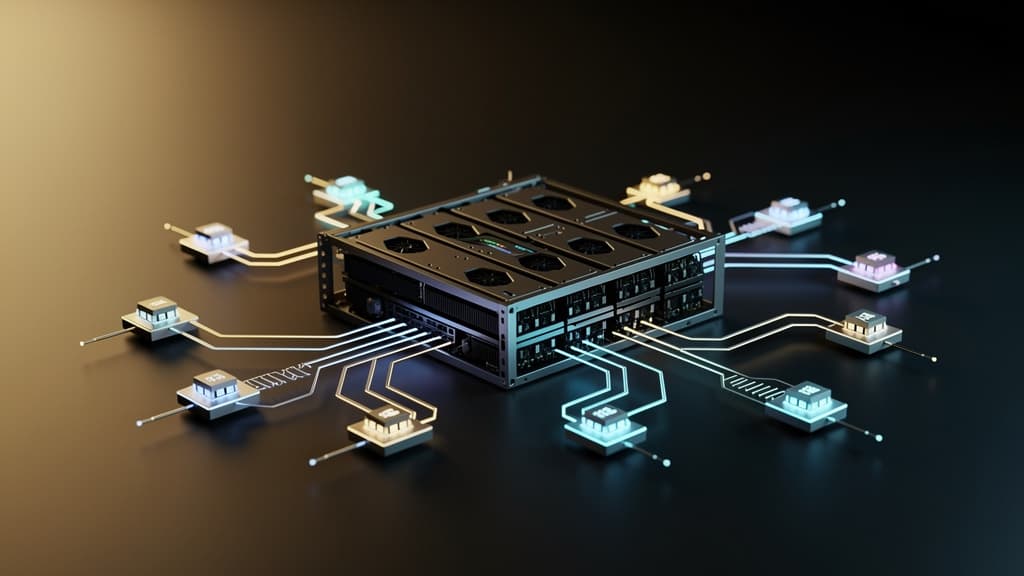
The system, open-sourced under NovaSky-AI/SkyRL, maps each RL experiment to a dedicated LoRA adapter rather than a full model replica, allowing multiple experiments to share a single base model in memory while training concurrently. The implications for enterprise RL infrastructure are significant: teams running continuous learning pipelines can now parallelize hypothesis testing at a fraction of the compute cost.
The Problem: Sequential RL Experiments Are Killing GPU Utilization
Reinforcement learning from human feedback (RLHF) and related RL-from-verifiable-rewards (RLVR) pipelines are iterative by nature. A research team running hyperparameter sweeps, reward shaping experiments, or domain adaptation studies might queue dozens of runs. In a conventional single-tenant setup, each run spins up a full model replica — consuming tens to hundreds of gigabytes of GPU memory — trains to completion, then tears down before the next run begins.
This creates two compounding inefficiencies:
- Memory waste during rollout phases. During trajectory sampling, the policy model is largely idle on the training nodes while rollout workers generate completions. Full model replicas sit allocated but underutilized.
- Serialized experiment queues. Because each experiment owns its model instance, teams cannot parallelize exploratory runs. A 48-hour experiment blocks all subsequent work behind it.
For organizations serious about LLM deployment at scale — where continuous fine-tuning, domain adaptation, and reward model iteration are ongoing operational concerns — this serialization tax compounds into weeks of lost iteration velocity per quarter.
The SkyRL Architecture: One Base, Many Adapters
The core insight behind the SkyRL stack is that LoRA adapters are orders of magnitude smaller than the base models they modify. A 7B-parameter base model might consume 14 GB of GPU memory in bfloat16; a rank-16 LoRA adapter for that same model occupies roughly 20–80 MB depending on target modules. This asymmetry creates an opportunity: load the base model once, hot-swap or concurrently serve multiple LoRA adapters, and route each RL experiment's gradient updates to its own adapter.
Concurrent Adapter Execution
Rather than time-multiplexing adapters (loading one, training, unloading, loading the next), the SkyRL stack maintains multiple LoRA adapters simultaneously resident in GPU memory alongside the shared base model. Each adapter corresponds to an independent RL experiment with its own:
- Reward function (verifiable reward, learned reward model, or composite)
- Training trajectory buffer
- Optimizer state (Adam moments, gradient accumulators)
- Hyperparameter configuration (learning rate, KL penalty coefficient, clip range)
The shared base model's weights are frozen during LoRA training — a standard constraint — which means gradient computation for adapter A does not interfere with adapter B. This isolation property is what enables true concurrency rather than just rapid sequential switching.
Trajectory Sampling and Batching
One of the more technically interesting aspects of the design is how rollout batches are constructed. In a naive implementation, concurrent experiments would each generate their own rollout batches independently, leading to fragmented GPU utilization during the forward passes needed for trajectory sampling.
The SkyRL system instead batches rollout requests across experiments, running a single forward pass through the base model with per-sample adapter selection. This is architecturally similar to how multi-LoRA inference servers (such as S-LoRA or vLLM's LoRA serving) handle concurrent inference requests — but extended into the training loop where gradient isolation must be maintained.
The 2.81× throughput gain is reported as end-to-end experiment throughput — meaning wall-clock time to complete a fixed set of RL experiments — not raw token throughput. This distinction matters: the improvement reflects reduced queuing latency and better GPU utilization across the full experiment lifecycle, not just faster individual training steps.
Memory Footprint Analysis
The memory economics depend heavily on the number of concurrent experiments and the LoRA rank. For a Qwen2.5-7B or similar base model:
- Base model (bfloat16): ~14 GB
- Per-adapter overhead (rank 16, all attention + MLP): ~40–80 MB
- Optimizer state per adapter (Adam): ~80–160 MB
- Trajectory buffer per experiment: variable, typically 1–4 GB depending on sequence length and batch size
This means a system running 8 concurrent RL experiments adds roughly 1–4 GB of adapter + optimizer overhead on top of the base model footprint — compared to 8× the base model memory (112+ GB) required for 8 independent full-model replicas. The memory savings alone justify the architectural shift for teams operating within fixed GPU budgets.
The 2.81× Number: What It Measures and Why It Holds
The headline 2.81× throughput figure deserves scrutiny. According to the MarkTechPost coverage of the release, this is measured as end-to-end experiment throughput — the number of complete RL experiments finished per unit time — against a single-tenant baseline where experiments run sequentially on equivalent hardware.
The gain comes from three compounding sources:
1. Eliminated queue latency. Experiments that previously waited behind a running job now execute concurrently. For a team running 10 experiments with average runtime of 6 hours, the single-tenant wall time is 60 hours; concurrent execution compresses this toward the duration of the longest single experiment (plus scheduling overhead).
2. Improved GPU utilization during rollout phases. When experiment A is in its rollout phase (memory-bound, lower compute intensity), experiment B can be in its gradient update phase (compute-bound). Interleaving these phases across experiments smooths the utilization curve.
3. Shared base model forward passes. Batching rollout requests across experiments amortizes the base model's forward pass cost, reducing per-experiment sampling overhead.
Critically, the team reports no reward regression — the quality of trained adapters, measured by task reward on held-out evaluation sets, is statistically equivalent to single-experiment baselines. This is the result that will matter most to practitioners: a throughput gain that degrades final model quality would be a poor trade for production RL pipelines.
The no-regression result is plausible given the architecture: LoRA adapters for different experiments never share gradient updates, so there is no parameter interference analogous to catastrophic forgetting in continual learning settings where a single model is updated sequentially. Each adapter's training trajectory is fully isolated.
Continual Learning as a First-Class Citizen
Beyond the throughput headline, the SkyRL stack is explicitly designed for continual learning — the operational pattern where a deployed model is continuously updated as new data, new reward signals, or new task requirements emerge.
In conventional LLM deployment pipelines, continual learning is often treated as a periodic retraining event: collect data for N weeks, run a fine-tuning job, evaluate, deploy. This batch cadence introduces latency between capability gaps being identified and patches being deployed.
The multi-LoRA architecture enables a different operational model:
- Experiment-as-adapter: Each hypothesis about how to improve the model (new reward function, new domain data, new RLHF preference set) gets its own adapter, trained concurrently with production-serving adapters.
- Adapter promotion: When an experimental adapter demonstrates sufficient reward improvement on evaluation benchmarks, it can be promoted to production without retraining the base model.
- Rollback safety: Because the base model is never modified, rolling back a failed adapter update is instantaneous — swap the adapter pointer, not the model weights.
This maps cleanly onto how software engineering teams manage feature flags and canary deployments, and represents a meaningful step toward treating LLM capability updates with the same operational rigor applied to traditional software releases.
Positioning Against the Existing Landscape
The SkyRL approach sits at the intersection of two active research areas: parameter-efficient fine-tuning (PEFT) infrastructure and distributed RL training frameworks.
Existing multi-LoRA inference systems like S-LoRA (Stanford, 2023) demonstrated that serving thousands of LoRA adapters concurrently during inference is tractable through unified memory management and adapter batching. SkyRL extends this paradigm into the training loop, where the additional complexity of optimizer state management, gradient isolation, and trajectory buffer bookkeeping must be handled.
On the RL training side, frameworks like OpenRLHF, veRL, and DeepSpeed-Chat have focused on scaling single-experiment training across many GPUs. SkyRL's contribution is orthogonal: rather than making one experiment faster, it makes many experiments cheaper to run simultaneously.
For enterprise teams evaluating LLM deployment infrastructure, the practical positioning looks like this:
| Scenario | Recommended Approach |
|---|---|
| Single large-scale RL run (maximize speed) | OpenRLHF / veRL with full model parallelism |
| Many concurrent RL experiments (maximize throughput) | SkyRL multi-LoRA stack |
| Production inference with many fine-tuned variants | S-LoRA / vLLM LoRA serving |
| Continual learning with rapid iteration | SkyRL (training) → vLLM (inference) |
Open Questions and Limitations
Several practical questions remain open for teams evaluating adoption:
Rank and capacity limits. The 2.81× figure is reported for a specific experimental configuration. Teams running higher-rank adapters (rank 64+) or very long-context experiments will see different memory and throughput profiles. The relationship between concurrent experiment count and throughput gain likely follows a curve with diminishing returns as memory pressure increases.
Reward model sharing. If multiple experiments share the same learned reward model (common in RLHF pipelines), concurrent training introduces questions about reward model staleness — experiment A's policy updates may shift the distribution the reward model was trained on, affecting experiment B's reward signal. The SkyRL documentation does not yet address multi-experiment reward model co-training.
Gradient interference at the base. While LoRA adapters are isolated, the base model's forward pass is shared. In theory, this should not cause issues since base weights are frozen. In practice, numerical precision and memory bandwidth contention during batched forward passes warrant empirical validation at scale.
Distributed training topology. The current open-source release targets single-node or limited multi-node configurations. Extending concurrent multi-LoRA training across large GPU clusters (32+ nodes) will require additional work on adapter state synchronization and rollout worker coordination.
What This Means for Enterprise RL Infrastructure
The SkyRL stack's 2.81× throughput gain, if it holds at production scale, represents a meaningful shift in the economics of RL-based LLM improvement. Teams that currently run 10 RL experiments per week could run 28 with the same hardware budget — or run the same 10 experiments on roughly 35% of the previous GPU allocation.
For organizations building continuous learning pipelines — where reward signal quality, domain coverage, and alignment properties must be iteratively refined post-deployment — this kind of infrastructure efficiency directly translates to faster capability iteration and lower operational cost per improvement cycle.
The open-source release under NovaSky-AI/SkyRL, backed by UC Berkeley Sky Lab and Anyscale's infrastructure expertise, positions this as a serious contender for enterprise adoption rather than a research prototype. Teams evaluating RL training infrastructure for large language model deployment in 2026 should treat concurrent multi-LoRA training as a baseline capability to evaluate, not an experimental curiosity.
Sources:
- Trajectory Releases a Concurrent Multi-LoRA Training Stack for Continual Learning, Reporting a 2.81× Experiment Throughput Gain — MarkTechPost
- NovaSky-AI/SkyRL on GitHub
- S-LoRA: Serving Thousands of Concurrent LoRA Adapters — Stanford CRFM, 2023
- OpenRLHF Framework
- LoRA: Low-Rank Adaptation of Large Language Models — Hu et al., 2021
Last reviewed: May 31, 2026