NVIDIA's ASPIRE framework is redefining robot control through autonomous code generation. Learn how this self-improving loop provides a scalable architectural template for custom GPT development in business.
When Robots Write Their Own Playbook
Robot control has long been bottlenecked by a fundamental problem: every new task requires human engineers to hand-craft instructions, tune parameters, and debug failures — a cycle that doesn't scale. NVIDIA ASPIRE (Autonomous Self-improving Program with Iterative Refinement and Execution) attacks this bottleneck directly, giving robots the ability to write, test, and refine their own control programs without human intervention at each step.
The results are striking. On LIBERO-Pro long-horizon manipulation tasks — one of the field's most demanding benchmarks — ASPIRE achieved 31% zero-shot success, meaning the system solved tasks it had never explicitly seen before. On standard benchmarks, the framework demonstrated gains of up to 77 points, a margin that signals a qualitative shift rather than incremental improvement.
For organizations exploring custom GPT development for business applications that extend beyond text into physical automation, ASPIRE represents a concrete architectural template: an LLM-powered loop that generates, executes, evaluates, and stores reusable code — applied to one of the hardest domains in AI.
What ASPIRE Actually Does: The Three Core Mechanisms
1. Autonomous Code Generation and Iterative Refinement
At its foundation, ASPIRE uses a large language model to write robot control programs expressed as executable code rather than natural language instructions. This is a deliberate architectural choice. Code is unambiguous, testable, and composable in ways that natural language is not — a robot arm can't parse "pick up the red block carefully," but it can execute a function call with defined parameters.
The self-improvement loop works as follows:
- Generate: Given a task description, the LLM writes a candidate control program.
- Execute: The robot runs the program in simulation or on physical hardware.
- Evaluate: The system scores the outcome against success criteria (task completion, collision avoidance, efficiency).
- Refine: Failure modes and execution traces are fed back to the LLM as context, which then rewrites or patches the program.
This closed loop is the mechanism behind the 31% zero-shot figure. The system isn't memorizing solutions — it's reasoning about failure and generating corrected code, which generalizes to novel task configurations.
The 77-point gains on standard benchmarks reflect what happens when this loop runs across a curriculum of tasks: each refinement cycle produces not just a better solution for the current problem, but training signal that improves the code-generation policy more broadly.
2. A Reusable Skill Library That Compounds Over Time
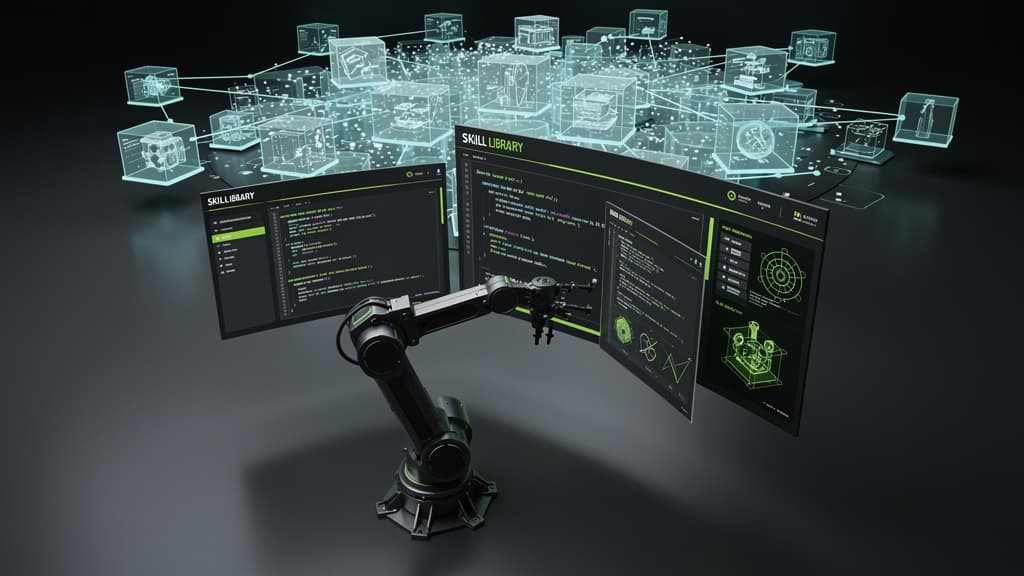
The second transformation ASPIRE introduces is architectural rather than algorithmic: a persistent skill library that stores verified, successful control programs as callable primitives.
This is the compounding mechanism. Once ASPIRE has solved "grasp cylindrical object from cluttered surface" and validated that solution across multiple trials, that program becomes a reusable skill. Future tasks that involve similar sub-problems can invoke the stored skill rather than regenerating it from scratch.
The implications for long-horizon tasks — sequences of 10, 15, or more distinct manipulation steps — are significant. LIBERO-Pro's long-horizon tasks are specifically designed to stress-test this kind of compositional reasoning. A 31% zero-shot success rate on tasks requiring sustained multi-step planning, without any task-specific fine-tuning, suggests the skill library is doing real work: the system is assembling solutions from verified building blocks rather than attempting each long sequence as a monolithic generation problem.
For business applications, this architecture maps directly onto how organizations want AI systems to behave: learn once, reuse everywhere, and improve the shared knowledge base rather than starting cold on every new request.
3. Closing the Sim-to-Real Gap Through Execution Feedback
The third mechanism is perhaps the most practically significant for deployment. ASPIRE's refinement loop is designed to incorporate real execution feedback, not just simulated outcomes.
This matters because simulation fidelity is imperfect. A control program that works in a physics engine may fail on physical hardware due to sensor noise, actuator delays, or surface friction that wasn't modeled accurately. Traditional robot programming approaches treat sim-to-real transfer as a separate engineering problem — ASPIRE treats it as another iteration of the same refinement loop.
When the system executes a program and observes a failure — a gripper that closes too early, a trajectory that clips an obstacle — the execution trace, sensor readings, and failure classification become context for the next code-generation call. The LLM can then write a corrected program that accounts for the specific failure mode observed on real hardware.
This is a meaningful departure from offline learning approaches. Rather than training a policy on millions of simulated trajectories and hoping it transfers, ASPIRE generates targeted code corrections in response to specific real-world failures.
The LIBERO-Pro Benchmark: Why 31% Zero-Shot Is Significant
To appreciate the 31% figure, it helps to understand what LIBERO-Pro is actually measuring. LIBERO-Pro is a long-horizon manipulation benchmark designed to evaluate generalization — not just task performance on seen configurations, but the ability to handle novel object arrangements, lighting conditions, and task sequences.
31% zero-shot success on LIBERO-Pro long-horizon tasks — achieved by NVIDIA ASPIRE without task-specific fine-tuning.
Zero-shot here means no examples of the specific test tasks were provided during the evaluation phase. The system encountered new task configurations and had to compose solutions from its existing skill library and code-generation capabilities alone.
For context, long-horizon manipulation tasks with 10+ steps have historically been extremely difficult for generalist robot systems. Success rates below 10% on novel configurations were common for systems without task-specific training. A 31% zero-shot rate, while not yet production-ready for most industrial applications, represents a meaningful threshold: it demonstrates that the system is doing genuine compositional generalization rather than pattern-matching to memorized solutions.
The 77-point benchmark gains are harder to contextualize without knowing the specific baseline, but gains of that magnitude typically indicate a category-level improvement — the difference between a system that occasionally succeeds and one that reliably does.
What This Architecture Means for Custom AI Development
ASPIRE's design is worth studying closely by anyone building custom AI systems for business, not just robotics engineers. The framework instantiates several principles that apply broadly to custom GPT development for business:
Code as the interface between LLMs and external systems. ASPIRE doesn't ask the LLM to output natural language instructions that a separate system then interprets. It asks the LLM to write executable code that directly controls behavior. This pattern — LLM as code generator, not instruction generator — is increasingly common in production AI systems because it provides testability, debuggability, and composability.
Feedback loops that close on real outcomes. The refinement loop is grounded in actual execution results, not just the LLM's internal confidence. This is the key to avoiding the "hallucination" failure mode in agentic systems: the system's beliefs about what works are constantly tested against reality.
Persistent, verified knowledge bases. The skill library is essentially a curated, verified knowledge base built through autonomous operation. Organizations building custom AI systems often underinvest in this layer — they build systems that generate outputs but don't accumulate verified, reusable solutions. ASPIRE's architecture makes the knowledge base a first-class component.
Failure as training signal. The system doesn't discard failed attempts — it uses them as context for improvement. This is a design principle that applies to any iterative AI system: failed outputs contain information about the gap between model capability and task requirements.
Current Limitations and What Comes Next
A 31% zero-shot success rate on a hard benchmark is impressive as a research result, but it also means the system fails on roughly 70% of novel long-horizon tasks. For deployment in unstructured real-world environments — manufacturing floors, warehouses, service robotics — that failure rate requires significant mitigation strategies.
The most likely path forward involves hybrid approaches: ASPIRE-style self-improvement for expanding the skill library and handling novel configurations, combined with human-in-the-loop verification for high-stakes tasks and traditional motion planning for well-characterized, repetitive operations.
The skill library architecture also raises questions about knowledge management at scale. As the library grows, retrieval and composition become harder — the system needs to identify which stored skills are relevant to a new task, and how to sequence them correctly. This is a known challenge in program synthesis and case-based reasoning systems.
NVIDIA's release of ASPIRE as a research framework suggests the company is positioning it as a foundation for the broader robotics ecosystem — a platform that partners and researchers can extend rather than a finished product. Given NVIDIA's existing position in robotics compute (Isaac Sim, Isaac ROS, the Jetson platform), ASPIRE fits into a larger stack play: own the hardware, the simulation environment, and now the autonomous learning framework.
The Bigger Picture: Robots That Improve Themselves
ASPIRE's most significant contribution may not be the specific benchmark numbers but the architectural demonstration that the self-improvement loop — generate, execute, evaluate, refine — can work in physical robotics at a level of sophistication that produces genuine generalization.
The parallel to how organizations want AI systems to behave is direct: not static tools that require constant human reprogramming, but systems that accumulate verified capabilities, learn from failures, and apply existing knowledge to new problems. Whether the domain is robot arm control or business process automation, the underlying architecture is the same.
For technology decision-makers evaluating where to invest in AI infrastructure, ASPIRE offers a concrete example of what "self-improving AI" looks like in practice — not a marketing claim, but a specific loop with measurable outcomes on hard benchmarks.
Sources:
- NVIDIA AI Introduces ASPIRE: A Self-Improving Robotics Framework Reaching 31% Zero-Shot on LIBERO-Pro Long Tasks — MarkTechPost, July 3, 2026
Last reviewed: July 04, 2026