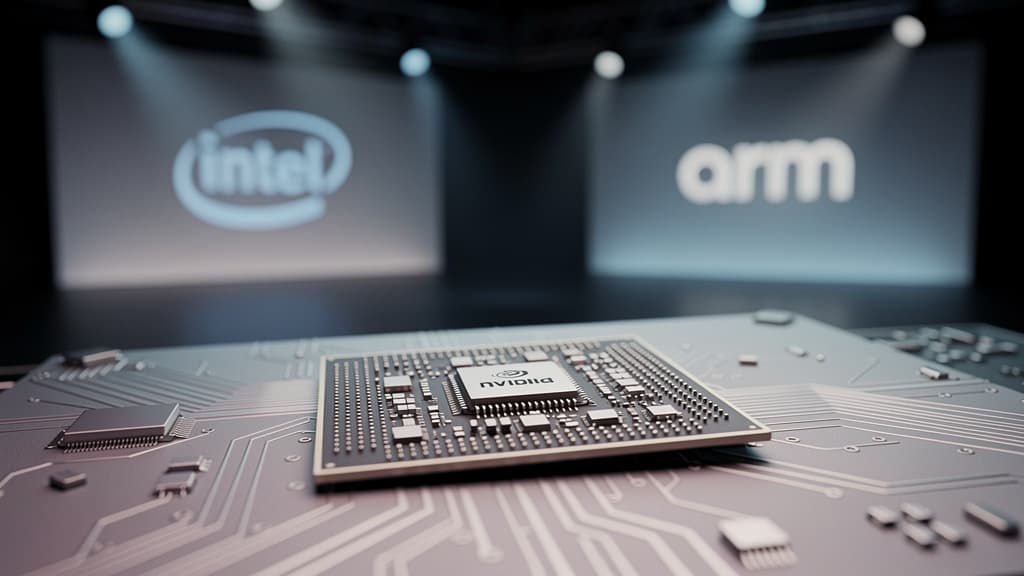
Nvidia’s surprise entry into the consumer CPU market signals a major shift for local AI. Learn how this Arm-based hardware could transform large language model deployment on Windows laptops.
Nvidia is making its most aggressive hardware pivot in years. At Computex 2026, the company revealed its first consumer CPU in over a decade — a move that signals far more than a product launch. Coordinated teasers from Microsoft and Arm ahead of the announcement confirm this is a joint strategic play, one that could fundamentally reshape the compute landscape for everything from Windows laptops to large language model (LLM) deployment at the edge.
What Nvidia Actually Announced
Nvidia's return to the consumer processor market comes after a decade-long absence following the underwhelming Tegra era in PCs. According to reporting from Bloomberg and gHacks, the new chip targets the Windows laptop market directly — putting Nvidia in head-to-head competition with Intel and AMD for the first time in the mainstream PC segment.
The involvement of Microsoft and Arm is not incidental. Microsoft's coordination on the announcement points to deep Windows optimization work, while Arm's participation confirms the chip is built on an Arm-based architecture — consistent with the broader industry shift away from x86 that Apple's M-series chips accelerated and that Qualcomm's Snapdragon X Elite has continued.
Nvidia has not disclosed full specifications, but the architecture decision alone carries major implications: an Arm-based Nvidia CPU paired with Nvidia GPU silicon would create a unified, tightly integrated compute platform unlike anything currently shipping in Windows laptops.
Why This Matters for Local LLM Deployment
For AI practitioners and developers focused on local LLM deployment, Nvidia's CPU entry is potentially more significant than any GPU announcement at Computex.
The core challenge with running large language models on consumer hardware has never been purely about raw GPU performance. It's about memory bandwidth, unified memory architecture, and the overhead cost of shuttling data between a CPU and a discrete GPU. Apple Silicon's dominance in local LLM benchmarks — tools like llama.cpp consistently show M-series chips punching above their weight — is almost entirely attributable to unified memory, not raw compute.
An Nvidia-designed Arm CPU, built to work natively with Nvidia GPU cores, could close that architectural gap on Windows. If Nvidia implements a meaningful unified or near-unified memory subsystem, developers running quantized models like Llama 3, Mistral, or Phi-3 locally on Windows machines would have a credible alternative to Apple's ecosystem for the first time.
The bottleneck for local LLM inference on most Windows laptops isn't the GPU — it's the PCIe bandwidth and memory fragmentation between CPU and GPU subsystems.
The Intel and AMD Response Problem
Intel and AMD face a structural disadvantage in responding to this threat. Both companies have invested heavily in their x86 roadmaps — Intel with Lunar Lake and Panther Lake, AMD with Strix Point and its successors. Pivoting to match an Nvidia-designed Arm chip with deep GPU integration is not a short-cycle engineering problem.
Intel's NPU strategy, embedded in its Core Ultra lineup, was positioned as the answer to on-device AI workloads. But NPUs are optimized for fixed, quantized inference pipelines — not the flexible, memory-intensive workloads that developers actually use for local LLM experimentation. Nvidia's GPU architecture, even in a mobile form factor, is far more programmable and better supported by the existing CUDA and llm.cpp ecosystem.
AMD's integrated Radeon graphics in its Ryzen AI chips have improved substantially, but driver support and software ecosystem maturity for LLM inference on AMD GPUs remain lagging behind Nvidia's CUDA toolchain.
The Microsoft Angle: Windows on Arm Gets Its GPU Story
Microsoft's involvement in the Computex announcement deserves particular attention. The company has been pushing Windows on Arm aggressively since the Qualcomm partnership, but the platform has lacked a compelling GPU story for developers and power users. Qualcomm's Adreno GPU is capable for everyday tasks but is not a serious contender for AI workloads.
An Nvidia-powered Windows on Arm device changes that calculus entirely. Microsoft gains a platform where Copilot+ PC features and local AI inference are backed by the same GPU architecture that powers the world's AI data centers. For enterprise buyers evaluating local LLM deployment for sensitive workloads — legal, healthcare, finance — a Windows device with genuine Nvidia GPU capability and no cloud dependency is a compelling proposition.
What to Watch Next
Several questions will determine how significant this announcement actually is for the AI developer community:
Memory architecture: Does Nvidia implement unified memory between CPU and GPU, or will the chip use a traditional discrete memory model? This single decision will define the device's viability for local LLM inference.
CUDA compatibility: Will full CUDA support extend to the mobile Nvidia CPU platform, or will developers face a fragmented toolchain? Nvidia's incentive is to maintain CUDA as the universal layer, but mobile power constraints may force compromises.
OEM partnerships: Which laptop manufacturers will ship the first devices, and at what price points? Premium ultrabook pricing would limit the addressable market for developers and practitioners.
Timeline to availability: Computex announcements frequently precede shipping hardware by 6–12 months. Actual developer access could be well into 2027.
Nvidia's consumer CPU announcement is not just a competitive move against Intel and AMD — it's a bet that the next frontier for AI compute runs locally, on Windows, and on Nvidia silicon from top to bottom. For the LLM deployment ecosystem, that bet is worth watching closely.
Sources: gHacks — Nvidia set to reveal first consumer CPU in over a decade at Computex 2026 | Bloomberg — Nvidia Enters Windows Laptop Market, Taking On Intel and AMD
Last reviewed: June 01, 2026