NVIDIA's Nemotron-Labs-3-Puzzle-75B-A9B delivers a 2.03x throughput gain for enterprise AI. Learn how iterative compression optimizes your infrastructure.
The Infrastructure Problem Nobody Talks About
Every enterprise AI roadmap eventually hits the same wall: deploying a handful of AI agents in a demo is trivial; deploying hundreds of concurrent agents against long-context tasks at production scale is a different problem entirely. The bottleneck isn't model intelligence — it's inference throughput, memory bandwidth, and the economics of running large models at scale.
This is precisely the infrastructure gap that NVIDIA's Nemotron-Labs-3-Puzzle-75B-A9B is engineered to close. Released in July 2026, this compressed model variant achieves a 2.03x server throughput gain over its predecessor through a technique called iterative Puzzle compression — a hybrid approach that alternates hardware-aware structural compression with knowledge distillation. For enterprise architects evaluating AI solution architecture for enterprise deployments, the numbers here are not incremental. They represent a meaningful shift in what's economically and operationally feasible when scaling agentic workloads.
This deep dive unpacks the three core mechanisms behind Nemotron-Labs-3-Puzzle's throughput gains, examines the architectural decisions that make them possible, and translates those gains into concrete implications for enterprise infrastructure planning.
What Nemotron-Labs-3-Puzzle-75B-A9B Actually Is
Before dissecting the throughput story, the model's architecture deserves precise framing. Nemotron-Labs-3-Puzzle-75B-A9B is a Mixture-of-Experts (MoE) model with 120.7 billion total parameters but only 12.8 billion active parameters per forward pass. A smaller variant sits at 75.3B total / 9.3B active parameters.
The naming convention encodes the compression lineage: "Puzzle" refers to NVIDIA's proprietary iterative compression pipeline. The 75B designation reflects the parameter scale of the base model before compression, while A9B signals the active parameter footprint during inference — the number that actually determines compute cost and latency.
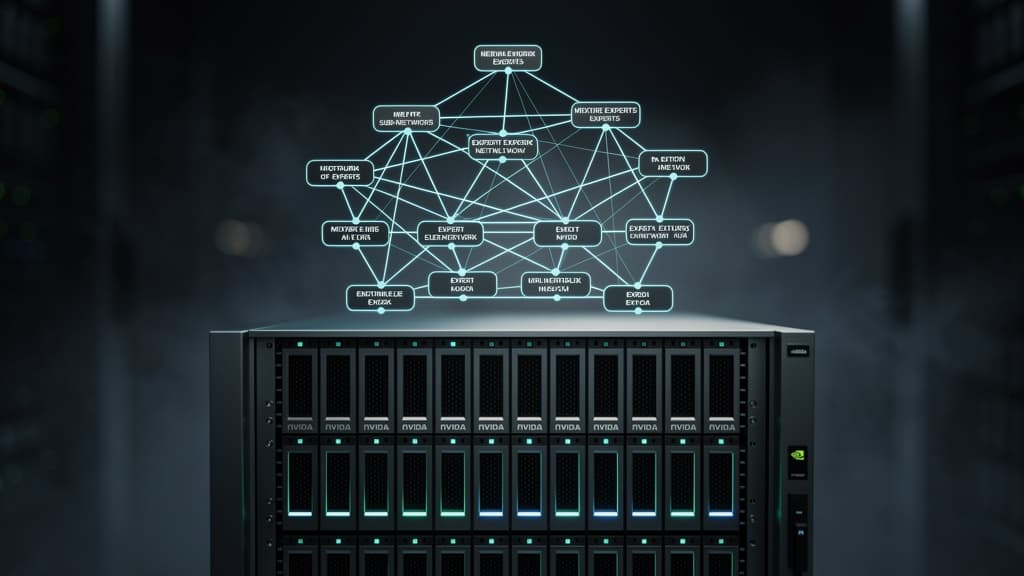
This distinction between total and active parameters is the crux of the MoE efficiency story. Dense models activate every parameter on every token. MoE models route each token through a small subset of specialized "expert" sub-networks. At 9.3B–12.8B active parameters, Nemotron-Labs-3-Puzzle operates at the compute cost of a much smaller model while retaining the representational capacity of a much larger one.
According to reporting by MarkTechPost, the model was developed to address the specific inference constraints enterprises face when deploying agentic AI — where long context windows, high concurrency, and sustained throughput matter far more than peak single-request performance.
Mechanism 1: Hybrid MoE Compression via the Puzzle Pipeline
The 2.03x throughput gain doesn't come from a single optimization — it comes from a structured alternation of two compression techniques that reinforce each other.
Hardware-aware structural compression is the first phase. This step prunes and restructures the model's architecture to align with the specific memory hierarchy and compute characteristics of target hardware — in this case, NVIDIA's H100 and B200 GPUs. Rather than applying generic magnitude-based pruning, Puzzle compression profiles actual hardware bottlenecks: memory bandwidth constraints, tensor core utilization patterns, and KV-cache pressure under concurrent load. The result is a model whose layer structure, attention head count, and expert routing topology are co-designed with the hardware it runs on.
Knowledge distillation follows each structural compression step. This is where the quality recovery happens. After pruning reduces model capacity, distillation transfers behavioral knowledge from the original (teacher) model back into the compressed (student) model, minimizing the accuracy degradation that would otherwise accompany aggressive structural changes.
The critical insight in the Puzzle approach is the alternation of these two phases rather than applying them sequentially once. Each compression step is small enough that distillation can fully recover quality before the next compression round begins. This iterative loop allows the pipeline to achieve compression ratios that would be impossible in a single pass without catastrophic quality loss.
The iterative Puzzle compression pipeline alternates hardware-aware structural compression with knowledge distillation, enabling 2.03x server throughput gains while maintaining model quality at scale.
For enterprise architects, this matters because it means the throughput gains aren't purchased with a hidden quality tax. The distillation phases are specifically designed to preserve the model's performance on the downstream tasks — reasoning, code generation, tool use — that enterprise agentic workflows depend on.
Mechanism 2: The Concurrency Multiplier on H100 Hardware
Server throughput is an aggregate metric. The more revealing number for enterprise planning is what happens to per-request concurrency under real deployment conditions.
On a single H100 GPU, Nemotron-Labs-3-Puzzle's 1M-token concurrency rises from 1 to 8 concurrent requests. That's an 8x increase in the number of simultaneous long-context sessions a single GPU can serve.
This is not a marginal improvement in GPU utilization — it's a fundamental change in the economics of agentic AI deployment. Consider what 1M-token concurrency actually means in an enterprise context: an agent maintaining a full session history, large document corpora in context, multi-turn tool call chains, and cross-agent communication logs. These are not toy workloads. The ability to serve 8 such sessions simultaneously on a single H100, versus 1 previously, changes the cost-per-agent calculation by nearly an order of magnitude.
The mechanism behind this concurrency gain is the reduced KV-cache footprint that comes from the lower active parameter count. KV-cache — the memory structure that stores attention keys and values across a context window — scales with both context length and model size. By reducing active parameters from a dense model's full parameter count down to 9.3B–12.8B, Puzzle compression dramatically reduces the per-request memory reservation, freeing GPU memory to serve additional concurrent sessions.
At the 8xB200 node level (NVIDIA's next-generation Blackwell architecture), these gains compound further. The B200's higher memory bandwidth and larger HBM3e capacity amplify the concurrency benefits of reduced active parameter footprints, making the 8xB200 configuration the natural target for enterprise deployments that need to serve hundreds of concurrent agents.
Mechanism 3: The 100 tok/s Per-User Throughput Floor
The third mechanism is less about architecture and more about what the architecture enables operationally: a 100 tokens per second per user throughput floor under concurrent load.
This number matters because enterprise agentic workflows are latency-sensitive in ways that batch processing pipelines are not. An agent waiting for a model response while holding open tool connections, managing state, and coordinating with other agents can't tolerate the latency degradation that typically accompanies high-concurrency inference. At 100 tok/s per user, even under the 8-concurrent-session load on a single H100, each session receives a response rate that keeps agent workflows moving at human-interactive speeds.
At 100 tokens per second per user across concurrent long-context sessions, Nemotron-Labs-3-Puzzle maintains the latency floor that agentic workflows require — a threshold that previous dense model deployments couldn't sustain at comparable concurrency.
For enterprise architects, 100 tok/s is a meaningful benchmark because it maps directly to agent responsiveness. Tool-calling agents typically generate structured outputs — JSON, code, API calls — in bursts of 50–200 tokens. At 100 tok/s, those outputs complete in under two seconds, keeping the human-in-the-loop experience fluid and preventing agent orchestration frameworks from timing out on model calls.
The ability to sustain this throughput floor while simultaneously serving 8 long-context sessions is what makes Nemotron-Labs-3-Puzzle architecturally significant for enterprise deployment, rather than just academically interesting.
Translating Model Architecture Into Enterprise Infrastructure Design
These three mechanisms — iterative Puzzle compression, the 8x concurrency multiplier, and the 100 tok/s throughput floor — combine to reshape how enterprise architects should think about AI solution architecture for large-scale deployments.
Right-Sizing the Inference Tier
Previous generation dense models forced a painful tradeoff: deploy large models for quality, or smaller models for throughput. MoE architectures with Puzzle compression break this tradeoff. At 9.3B–12.8B active parameters, Nemotron-Labs-3-Puzzle delivers quality competitive with much larger dense models at the inference cost of a much smaller one. This allows enterprises to right-size their inference tier around active parameter count rather than total parameter count — a distinction that can reduce GPU procurement requirements significantly.
Multi-Agent Orchestration at Scale
The 1M-token concurrency improvement from 1 to 8 sessions per H100 has direct implications for multi-agent architectures. Enterprises running orchestrator-agent topologies — where a central orchestrator coordinates dozens of specialized sub-agents — can now serve those sub-agents from a smaller GPU cluster without sacrificing context length or response quality. An 8xB200 node running Nemotron-Labs-3-Puzzle can realistically serve the inference needs of a substantial multi-agent pipeline that would previously have required a much larger hardware footprint.
Cost Modeling for Agentic Workloads
The 2.03x throughput gain translates directly into infrastructure cost reduction for steady-state agentic workloads. If a production deployment previously required 16 H100s to serve a target concurrency level, the same concurrency can now be served with approximately 8 H100s — or the same 16 H100s can serve twice the agent population. For enterprises with predictable agentic workloads, this changes the build-vs-buy calculus for on-premises inference infrastructure versus cloud API spend.
The Broader Signal: Compression as Infrastructure Strategy
Nemotron-Labs-3-Puzzle represents something larger than a single model release. It signals that model compression is becoming a first-class infrastructure strategy for enterprises that need to scale agentic AI beyond pilot deployments.
The Puzzle pipeline's iterative approach — hardware-aware compression alternated with quality-preserving distillation — is a template that NVIDIA is likely to apply across its model portfolio. For enterprise architects, this means the relevant question is no longer just "which model is most capable?" but "which model has been optimized for the specific hardware and concurrency profile of our deployment?"
As agentic AI workloads grow in complexity — longer context windows, more concurrent sessions, tighter latency requirements — the gap between models optimized for inference efficiency and those optimized purely for benchmark performance will widen. Nemotron-Labs-3-Puzzle's 2.03x throughput gain, achieved without sacrificing the quality that enterprise tasks demand, is an early and concrete demonstration of where that gap leads.
For technology decision-makers building AI solution architecture for enterprise scale, the infrastructure lesson is clear: the model you choose is also an infrastructure choice. And in 2026, the infrastructure choice is increasingly about active parameters, KV-cache efficiency, and hardware co-design — not headline parameter counts.
Sources
- Meet Nemotron-Labs-3-Puzzle-75B-A9B — MarkTechPost
- NVIDIA Developer Blog: https://developer.nvidia.com/blog
- NVIDIA Inference Optimization Documentation: https://docs.nvidia.com/nim/
Last reviewed: July 10, 2026