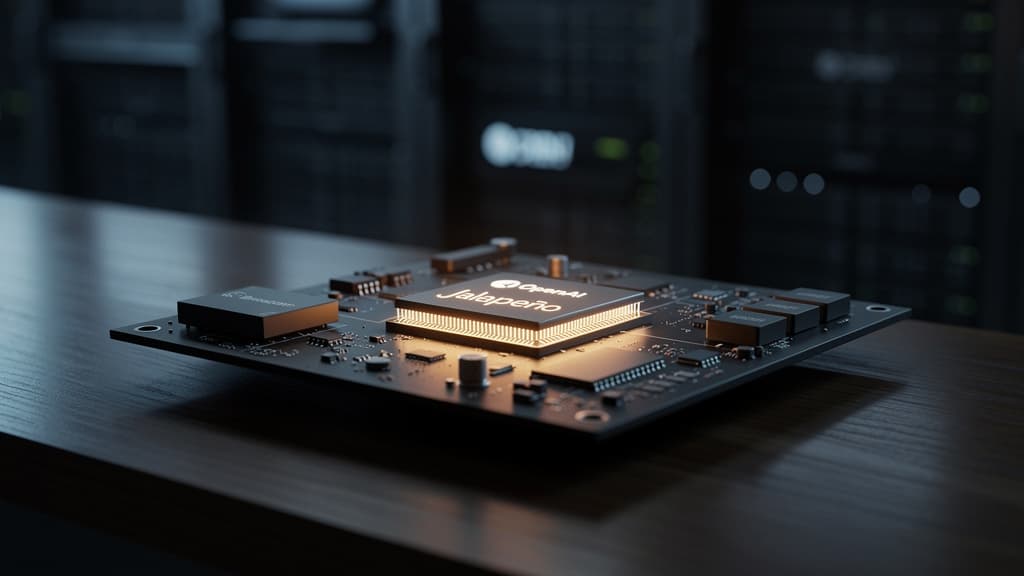
OpenAI and Broadcom have unveiled Jalapeño, a custom inference chip launching in 2026. This strategic shift aims to lower compute costs and reduce reliance on third-party hardware for large-scale AI.
OpenAI has taken a decisive step toward controlling its own hardware destiny. The company and chip design partner Broadcom have jointly unveiled Jalapeño, a custom silicon chip built from the ground up for large language model inference at scale. Deployment is planned for late 2026, and the move marks OpenAI's most significant push yet into vertical integration — a strategy aimed squarely at reducing operational costs with AI and loosening the grip that third-party hardware suppliers currently hold over the company's economics.
Why Jalapeño Exists
Inference — the act of running a trained model to generate responses — is where OpenAI spends the vast majority of its compute budget. Unlike training, which happens in discrete, schedulable bursts, inference runs continuously, at massive scale, every time a user sends a message to ChatGPT or a developer calls the API. The cost structure is relentless.
For years, that cost has been dominated by NVIDIA GPUs, which were designed as general-purpose accelerators and carry premium pricing that reflects their market dominance. OpenAI, like every major AI lab, has had little choice but to pay those prices or queue for supply. Jalapeño is the architectural answer to that constraint.
According to reporting from TechCrunch, the chip is purpose-built for LLM inference workloads — not training, not general compute, but the specific memory-bandwidth-intensive, low-latency operations that serving a language model at scale demands. That specialization is the key to its cost advantage.
The Broadcom Partnership: Why It Makes Sense
OpenAI's choice of Broadcom as the design and manufacturing partner is strategically deliberate. Broadcom has an established track record in custom ASIC development, most visibly through its work on Google's Tensor Processing Units (TPUs) — the chips that power Google's own AI infrastructure and have allowed Alphabet to run inference at costs that give it a structural pricing edge.
That precedent is not lost on OpenAI. Google's TPU program, which began in earnest around 2016, took years to mature but ultimately gave Google the ability to serve models at a cost basis that general-purpose GPU clusters cannot match for sustained inference loads. OpenAI is following the same playbook, roughly a decade later and under considerably more competitive pressure.
The Broadcom relationship also gives OpenAI access to advanced packaging and integration expertise without requiring the company to build a full-stack chip design organization from scratch — a process that takes years and billions of dollars. Custom ASIC development through a partner like Broadcom compresses that timeline while still delivering workload-specific optimization.
Inference Economics: The Real Competitive Battlefield
The business case for Jalapeño is inseparable from the current state of AI pricing competition. Over the past 18 months, token prices across major frontier model providers have fallen dramatically. Anthropic, Google, Meta's open-weight models running on third-party infrastructure, and a wave of Chinese model providers have all compressed margins on API pricing. Competing on token pricing is no longer optional — it is existential.
Inference cost is the new moat. Whoever can serve the most tokens per dollar wins the enterprise and developer market.
For OpenAI, which runs one of the highest-traffic AI services in the world, even marginal improvements in cost-per-token translate into hundreds of millions of dollars annually at scale. A custom inference chip that delivers meaningfully better performance-per-watt and performance-per-dollar than commodity GPU clusters would fundamentally reshape the company's unit economics.
Reporting from The Decoder notes that Jalapeño is specifically optimized for the memory access patterns and matrix operations that dominate transformer-based model inference — the architectural signature of every major LLM currently in production.
Reducing Third-Party Hardware Dependence
Beyond cost, there is a supply chain dimension to this announcement that deserves attention. OpenAI's current infrastructure is heavily dependent on NVIDIA hardware, and that dependency creates both pricing leverage for NVIDIA and potential supply constraints during periods of high demand. The AI chip shortage of 2023–2024 exposed how fragile that dependence can be.
By developing proprietary inference silicon, OpenAI joins a small group of companies — Google, Amazon (with Trainium and Inferentia), and Microsoft (with its Maia chips) — that have concluded the strategic risk of full hardware dependency outweighs the upfront investment in custom silicon. Notably, Microsoft, OpenAI's largest investor and infrastructure partner, has been developing its own AI chips in parallel — a dynamic that makes OpenAI's independent hardware push all the more pointed.
Jalapeño does not eliminate NVIDIA from OpenAI's infrastructure stack, at least not immediately. Training workloads, which require different optimization profiles, will likely continue to run on NVIDIA hardware for the foreseeable future. But carving out inference — the highest-volume, most cost-sensitive workload — is a meaningful first step toward a more diversified and controllable hardware posture.
What to Watch Before Late 2026
The announced deployment timeline of late 2026 leaves several open questions that will determine how transformative Jalapeño actually proves to be:
- Performance benchmarks: How does Jalapeño compare to NVIDIA's H100 and B200 series on tokens-per-second and tokens-per-watt for OpenAI's production model sizes? No public figures have been released.
- Scale of initial deployment: Custom chips typically enter production in limited clusters before full-scale rollout. The size of the initial Jalapeño deployment will signal how confident OpenAI is in yield and reliability.
- Model compatibility: Whether Jalapeño is optimized for a specific model architecture or designed to support OpenAI's full model portfolio will shape how broadly it can reduce costs across the product line.
- Pricing signal to the market: If Jalapeño delivers the cost reductions implied by the announcement, watch for OpenAI to use that headroom to cut API pricing aggressively — a move that would pressure every competitor still running on commodity hardware.
The Jalapeño announcement is not just a hardware story. It is a signal about where OpenAI believes the AI industry's competitive center of gravity is shifting — away from who has the best model and toward who can serve that model most efficiently at scale. In that race, silicon strategy is everything.
Sources: TechCrunch — OpenAI Unveils Its First Custom Chip Built by Broadcom | The Decoder — OpenAI and Broadcom Unveil Jalapeño
Last reviewed: June 25, 2026