Indiscriminate use of frontier AI models is becoming financially unsustainable. Discover how tech giants are shifting toward token management and model routing.
The era of unconstrained AI compute is ending. Two of the most influential companies in enterprise technology — Microsoft and Meta — are now publicly acknowledging what their finance teams have known for months: indiscriminate use of frontier AI models is financially unsustainable, and the industry needs a new discipline around reducing operational costs with AI.
The signal is clear. When Microsoft CEO Satya Nadella admits he's personally guilty of token-maxing — the practice of routing every AI query to the most powerful (and expensive) available model regardless of need — and Meta CTO Andrew Bosworth is rolling out internal governance tools to curb the same behavior, something structural is shifting across the industry.
What Is Token-Maxing, and Why Did It Happen?
Token-maxing refers to the default behavior of developers, product teams, and even executives who reach for frontier models like GPT-4, Claude 3 Opus, or Llama's largest variants for every task — regardless of whether the complexity of the task warrants it. A chatbot answering "what are your business hours?" does not need the same model as one synthesizing a 200-page legal document. But in practice, teams defaulted to the biggest model available because the cost was abstracted away, performance was easier to guarantee, and there was no internal accountability mechanism.
For a period, this made sense. During the initial land-grab phase of enterprise AI adoption, demonstrating capability mattered more than optimizing unit economics. Compute costs were treated as a cost of innovation — a necessary tax on moving fast.
That calculus has changed.
Nadella's Admission and Microsoft's Reckoning
In a candid acknowledgment that reframes Microsoft's internal AI posture, Satya Nadella admitted he too is a token-maxer — and that the behavior is, in his words, "addictive." The admission, reported by The Decoder, is notable not because it reveals a personal quirk but because it exposes a systemic problem at scale.
When the CEO of a company that has committed billions to OpenAI and embedded Copilot across its entire product suite is personally defaulting to the highest-cost model for tasks that don't require it, the behavior is almost certainly replicated thousands of times daily across engineering teams, product managers, and enterprise customers.
Microsoft's response is architectural. The company has been building out what internal teams refer to as an AI Gateway — a routing and governance layer designed to match AI queries to the appropriate model tier based on task complexity, latency requirements, and cost thresholds. Rather than every request hitting a frontier model, the gateway can redirect simpler queries to smaller, cheaper models while reserving top-tier compute for genuinely complex tasks.
This isn't cost-cutting in the traditional sense. It's the introduction of engineering discipline into a domain that previously operated without it.
Meta's Token Budgets and the Billions Problem
At Meta, the situation is more acute. According to The Decoder's reporting, Meta's internal AI costs have reportedly reached billions of dollars, driven in significant part by token-maxing behavior across its engineering and product organizations. The company is now in active pivot mode — shifting from token-maxing to what Bosworth's team is calling token managing.
The practical implementation includes:
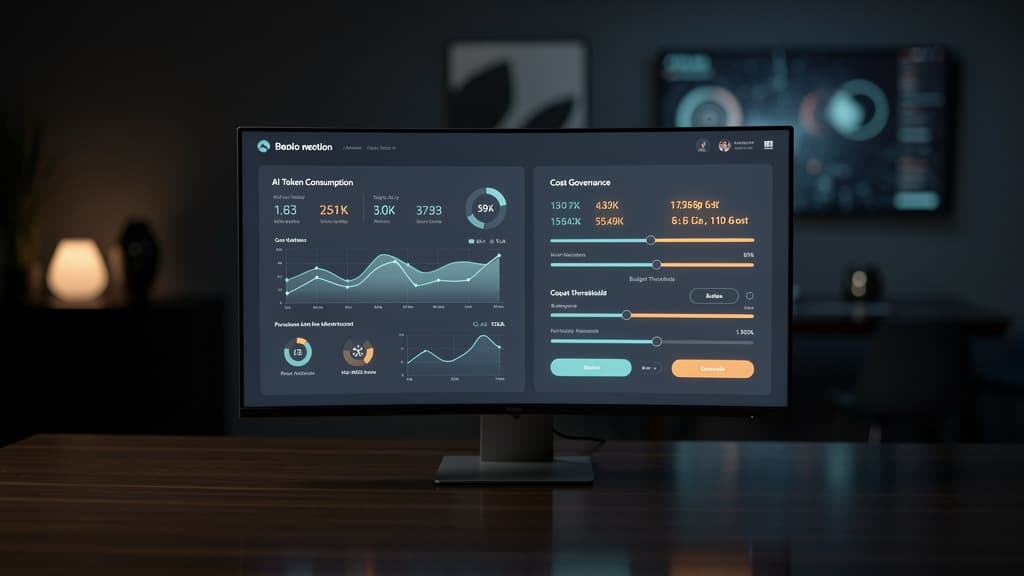
- Internal token budgets assigned to teams and products, creating accountability for AI consumption the way cloud cost dashboards created accountability for infrastructure spend
- Dashboards that surface real-time visibility into which teams are consuming the most tokens, on which models, for which use cases
- Model selection governance that encourages or enforces routing to smaller models for tasks where frontier performance isn't required
The parallel to cloud cost management is deliberate and instructive. A decade ago, the introduction of AWS cost explorer and similar tools transformed how engineering teams thought about infrastructure. Compute was no longer free-feeling — it had a visible price tag attached to every decision. Meta is attempting the same cultural and tooling shift for AI inference costs.
Meta's internal AI costs have reportedly hit billions of dollars, prompting the company to implement token budgets and consumption dashboards across engineering teams.
An Industry-Wide Inflection Point
Meta and Microsoft are not outliers. They are the most visible examples of a broader recalibration happening across enterprise AI. The pattern is consistent: organizations that moved aggressively to embed AI into products and workflows during 2023 and 2024 are now confronting the operational cost reality of doing so at scale.
The economics are straightforward. Frontier model inference is expensive — costs that are manageable at prototype scale become material at production scale, and prohibitive at the scale Meta or Microsoft operate. A single percentage-point reduction in average model tier across millions of daily queries translates to meaningful savings.
This is also reshaping the competitive dynamics of the AI model market. Smaller, faster, cheaper models — including Meta's own Llama family at various sizes, Mistral's offerings, and Google's Gemini Flash variants — are no longer positioned as "good enough" alternatives. They're becoming the default for a growing class of production use cases, with frontier models reserved for tasks that genuinely require their capabilities.
The 2027 horizon matters here. Multiple AI infrastructure teams have indicated that cost governance frameworks being built now are designed to scale through the next two to three years of AI expansion. The governance infrastructure being laid today — routing layers, budget dashboards, model selection frameworks — is intended to be the operational backbone of AI deployment at scale.
What This Means for AI Practitioners and Decision-Makers
For technology leaders evaluating or scaling AI deployments, the Meta and Microsoft pivot offers a practical framework:
Model routing is now a core competency. Building or adopting an AI gateway that intelligently routes queries based on complexity and cost isn't optional infrastructure — it's becoming table stakes for sustainable AI operations.
Token consumption needs a budget owner. Just as cloud spend requires a designated owner and governance process, AI inference costs need the same treatment. Teams operating without visibility into their token consumption are flying blind on a material cost line.
Smaller models deserve serious evaluation. The reflex to default to frontier models is understandable but increasingly unjustifiable. For classification, summarization, simple Q&A, and structured data extraction tasks, smaller models often deliver 90%+ of the performance at a fraction of the cost.
Internal culture matters as much as tooling. Nadella's token-maxing admission underscores that the behavior is partly psychological — the comfort of the most capable model, the avoidance of optimization work. Changing that behavior requires both tooling (dashboards, budgets, routing) and cultural signals from leadership.
The Broader Signal
The end of token-maxing as the default posture isn't a retreat from AI ambition. Meta is still building frontier models. Microsoft is still deeply embedded with OpenAI. But both companies are now insisting that ambition must be paired with operational discipline.
This is, in many ways, the maturation of enterprise AI. The first wave was about proving that AI could work at scale. The second wave — the one we're now entering — is about proving it can work economically. The companies that build the governance infrastructure to answer that question will have a durable advantage over those still treating compute as an unlimited resource.
The token budget has arrived. The question now is which organizations will build the systems to manage it.
Last reviewed: June 14, 2026