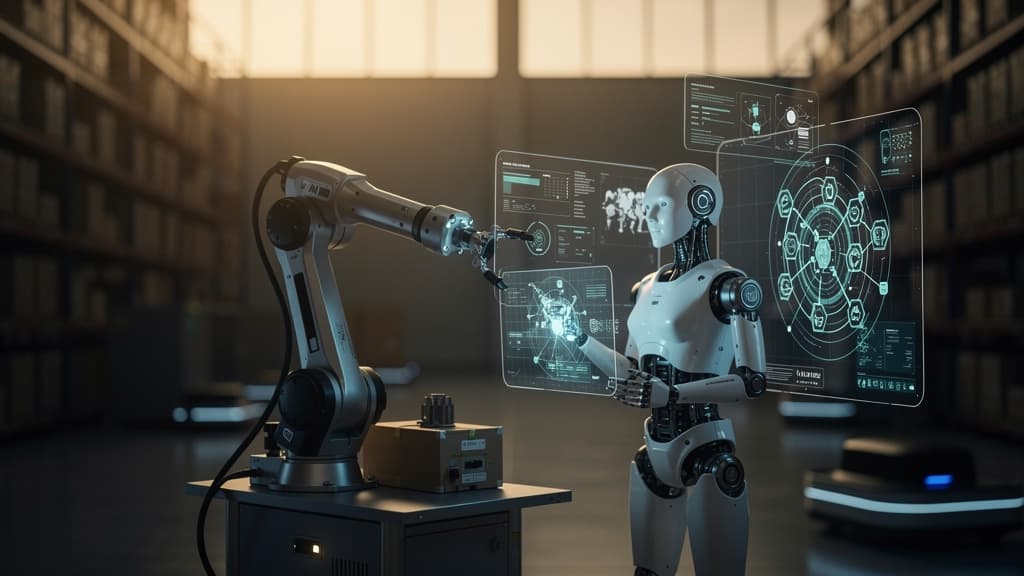
Robotics is shifting from brittle, hand-engineered systems to flexible foundation models. Explore three breakthrough developments that are setting the stage for scalable, general-purpose industrial automation.
Robotics is undergoing a fundamental architectural shift. For decades, industrial automation relied on hand-engineered control systems — brittle, task-specific pipelines that required expert tuning for every new environment or object. Now, foundation models trained on massive multimodal datasets are stepping in, bringing the same generalization capabilities that transformed natural language processing into the physical world.
Three developments this week crystallize how quickly this transition is accelerating. From LingBot-VLA 2.0's cross-embodiment scale to Robostral Navigate's single-camera navigation, and Physical Intelligence's approach to grounding LLM reasoning in robot hardware, these are not incremental upgrades — they are architectural rethinks. Here's what each means for practitioners evaluating AI implementation in industrial and commercial robotics.
1. LingBot-VLA 2.0 — Cross-Embodiment at Scale
Robbyant's LingBot-VLA 2.0 is arguably the most ambitious deployment model in this week's announcements. The system is a 6B parameter vision-language-action (VLA) model trained on a staggering 60,000 hours of robot interaction data across 20 distinct robot configurations.
That last figure deserves emphasis. Most prior VLA research optimized for a single robot morphology — one arm, one gripper type, one sensor suite. Cross-embodiment generalization was a research aspiration, not a shipped product. LingBot-VLA 2.0 treats it as a baseline requirement.
Trained on 60,000 hours of data across 20 robot configurations, LingBot-VLA 2.0 represents one of the most comprehensive cross-embodiment training efforts to reach public release.
For industrial operators, this matters enormously. Manufacturing floors rarely run homogeneous fleets. A single foundation model that can transfer learned manipulation skills across arm types, payload capacities, and end-effector geometries reduces the per-robot integration cost that has historically made AI-driven automation prohibitive for mid-market manufacturers.
The VLA architecture itself — fusing visual perception, natural language instruction following, and low-level action generation into a unified model — mirrors the design philosophy that made large language models so versatile. Rather than a perception module feeding into a separate planner feeding into a separate controller, the entire sensorimotor loop is learned end-to-end.
What to watch: How LingBot-VLA 2.0 performs on out-of-distribution objects and environments not represented in its 60,000-hour training corpus will be the real test of its generalization claims. Cross-embodiment breadth is impressive; real-world deployment robustness is what industrial buyers will scrutinize.
Source: MarkTechPost — LingBot-VLA 2.0
2. Robostral Navigate — Mistral Enters the Physical World
Mistral AI has been one of the most aggressive challengers in the LLM space, consistently punching above its weight class on efficiency benchmarks. Its entrance into robotics via Robostral Navigate follows the same philosophy: do more with less.
Robostral Navigate is an 8B parameter model designed specifically for robot navigation using a single camera as its only sensor input. The benchmark result that anchors its release is a 76.6 percent success rate on the R2R-CE benchmark — the Room-to-Room Continuous Environments task, a standard evaluation for instruction-following navigation in realistic indoor settings.
Robostral Navigate achieves 76.6 percent on the R2R-CE benchmark using only a single camera — no depth sensors, no LiDAR, no structured map.
The single-camera constraint is not a limitation dressed up as a feature. It is a deliberate design choice with direct cost implications. LiDAR units, depth cameras, and multi-sensor fusion stacks add thousands of dollars per unit and introduce calibration complexity that compounds across large deployments. A navigation model that performs competitively with monocular RGB input dramatically lowers the hardware floor for capable autonomous navigation.
For logistics operators, last-mile delivery companies, and facility management services evaluating autonomous mobile robots (AMRs), Robostral Navigate's architecture represents a credible path to deploying capable navigation at commodity hardware costs.
Mistral's move also signals something broader: frontier LLM labs are no longer treating robotics as a separate domain requiring specialized spinouts. The same model compression and efficiency expertise that produced Mistral 7B is now being applied directly to embodied AI — and the R2R-CE score suggests the transfer is working.
What to watch: R2R-CE measures navigation in simulated environments. Sim-to-real transfer remains one of the hardest unsolved problems in robotics. Robostral Navigate's real-world performance in cluttered, dynamic environments will determine whether its benchmark numbers translate to deployable product.
Source: The Decoder — Mistral enters robotics with Robostral Navigate
3. Physical Intelligence — Grounding LLM Reasoning in Robot Hardware
Physical Intelligence (Pi) is taking a different angle on the same fundamental problem. Rather than training purpose-built robotics models from scratch, the company is investigating how the world knowledge encoded in large language models can be leveraged directly for robot reasoning — essentially asking whether a model that understands language deeply enough can also develop useful priors about physical causality.
The thesis is compelling: LLMs trained on internet-scale text have absorbed enormous amounts of implicit physics knowledge — descriptions of how objects behave, how tasks are sequenced, what failure modes look like. If that knowledge can be grounded in sensorimotor experience, it could dramatically reduce the amount of robot-specific demonstration data needed to produce capable manipulation policies.
Physical Intelligence's approach treats LLM world knowledge as a prior for robot reasoning — potentially compressing the data requirements that have historically made robotic manipulation systems expensive to train.
This connects to a broader pattern across all three announcements: the data efficiency problem in robotics is being attacked from multiple directions simultaneously. LingBot-VLA 2.0 solves it through scale and cross-embodiment transfer. Robostral Navigate solves it through hardware simplification. Physical Intelligence is exploring whether it can be partially solved through knowledge transfer from language pretraining.
For enterprise AI teams evaluating robotics vendors, Physical Intelligence's approach is the highest-risk, highest-reward bet in this group — but it is also the one most likely to produce a step-change in what's possible for cross-embodiment robot manipulation if the grounding problem is cracked.
Source: New Scientist — Inside the start-up aiming for a giant leap in robot intelligence
The Pattern Connecting All Three
These three developments are not isolated announcements. They reflect a structural shift in how the robotics industry is approaching the problem of generalization — the same challenge that held back AI for decades before scale and transformer architectures cracked it in language.
The hand-engineered robotics paradigm required domain experts to encode task knowledge explicitly: define the object, define the grasp, define the motion plan. Every new task, every new object, every new environment required a new engineering cycle. It was expensive, slow, and fundamentally unscalable.
Foundation model-driven robotics inverts this. The model learns generalizable representations from data, and task-specific behavior emerges from prompting, fine-tuning, or in-context demonstration. The engineering effort shifts from building task-specific controllers to curating training data and defining evaluation criteria — a workflow that AI practitioners already know.
For technology decision-makers building the business case for AI implementation, these are the successful AI implementation case studies worth tracking in 2026. Not because any of them are finished products ready for unconstrained deployment, but because they mark the moment when the architectural foundations for scalable, general-purpose robotics became real.
The LLM revolution took roughly three years from GPT-3's release to widespread enterprise adoption. If robotics follows a similar trajectory — and the pace of this week's announcements suggests it might — the window for early adopters to build competitive advantage through foundation model-driven automation is narrowing faster than most industrial operators realize.
Last reviewed: July 09, 2026