The $26.5 billion SK Hynix IPO signals a structural shift in the AI hardware market. We analyze the implications for Nvidia AI infrastructure investment.
The largest foreign IPO in US history just happened — and it wasn't a software company, a fintech unicorn, or an AI model startup. It was a memory chip maker.
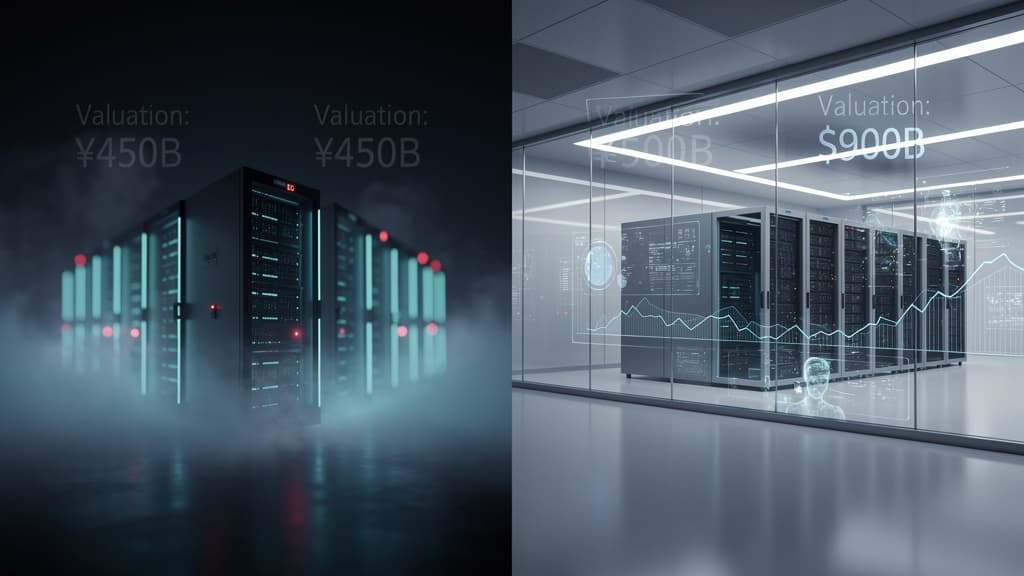
On July 10, 2026, SK Hynix completed a $26.5 billion Nasdaq listing, with shares opening 13% above the $149 offering price. That number alone rewrites the record books. But the more important story isn't the fundraise itself — it's what the market is collectively betting on: that the AI infrastructure buildout is not a cycle. It's a structural shift. And high-bandwidth memory (HBM) is the toll road.
Here are three hard lessons this IPO teaches anyone thinking seriously about Nvidia AI infrastructure investment impact and the capital machinery behind it.
Lesson 1: The Real AI Trade Is Upstream of the GPU
For the past three years, the dominant narrative has been Nvidia. H100s, B200s, GB200 NVL racks — the GPU has become the symbolic unit of AI ambition. But SK Hynix's $26.5 billion debut forces a reckoning with a less glamorous truth: a GPU without HBM is a sports car without an engine.
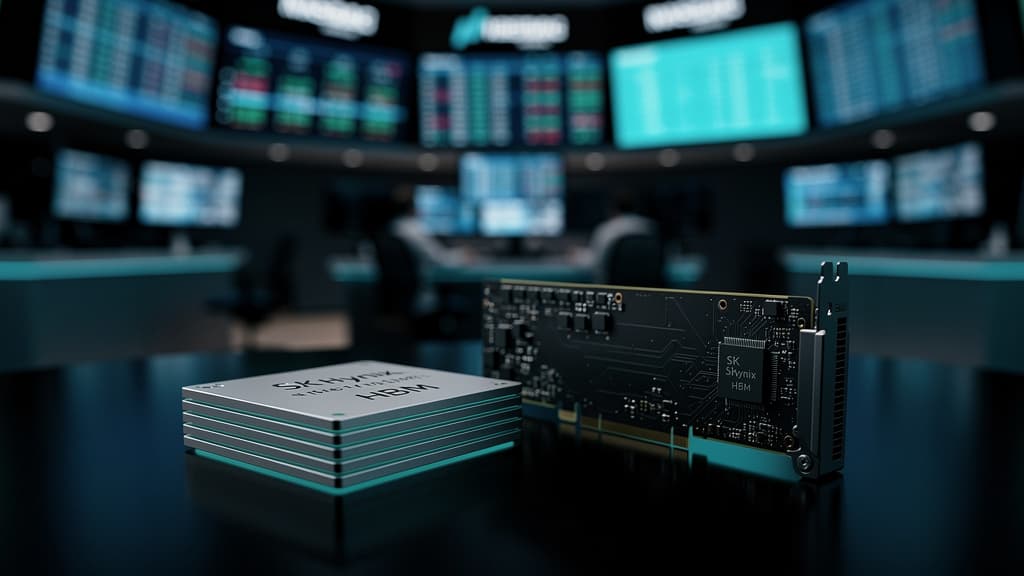
High-bandwidth memory is the critical interface between compute and data. Every Nvidia H100 ships with SK Hynix or Micron HBM3e stacked directly on the package. As models scale — from 70B parameters to 400B to multimodal architectures requiring simultaneous processing of text, image, video, and audio — the memory bandwidth requirement grows faster than raw compute. You can add more CUDA cores; you cannot easily escape the memory wall.
SK Hynix's IPO raising $26.5 billion — the largest foreign listing in US history — signals that institutional investors now view HBM supply as a chokepoint asset, not a commodity.
This is the upstream AI trade. Nvidia captures enormous margin on GPUs, but it sources HBM from a supply chain it does not control. SK Hynix, Samsung, and Micron collectively hold near-total dominance over HBM production. The capital raised in this IPO will fund the next generation of HBM4 and HBM4E capacity — locking in that dominance for the better part of a decade.
The lesson for investors and infrastructure planners alike: the AI supply chain has multiple chokepoints, and memory is one of the most defensible.
Lesson 2: 'Memory as a Service' Is the Business Model Mutation Worth Watching
The most strategically significant detail from the IPO wasn't the valuation — it was the business model signal buried in SK Group Chairman Chey Tae-won's post-listing remarks. According to Bloomberg, Chey announced plans for "much, much bigger" US investments and disclosed that the company is actively exploring "memory as a service" models.
This is not incremental. It is a fundamental rethinking of how memory infrastructure gets monetized.
Today, hyperscalers — Microsoft, Google, Amazon, Meta — purchase HBM-equipped GPUs through hardware procurement cycles. They own the silicon, depreciate it over three to five years, and bear the full capital cost upfront. A memory-as-a-service model would invert this: SK Hynix (or a joint venture partner) retains ownership of the memory layer, charging for bandwidth, capacity, or access on a consumption basis.
The analogy is cloud computing itself. Before AWS, enterprises bought servers. After AWS, they bought compute-hours. If SK Hynix can execute a similar transition for memory infrastructure, the total addressable market expands dramatically — and the revenue becomes recurring rather than lumpy.
The move toward 'memory as a service' mirrors the broader shift in AI infrastructure from capex-heavy hardware ownership to opex-driven consumption models.
This matters for Nvidia's ecosystem too. If memory becomes a service layer, it changes the procurement dynamics for GPU clusters. System integrators, cloud providers, and even sovereign AI programs would need to renegotiate how they architect AI infrastructure. The GPU and the memory are today inseparable at the package level — but at the system level, disaggregation is coming.
Chey's comments suggest SK Hynix is positioning itself not just as a chip supplier, but as an AI infrastructure partner with a stake in how AI compute gets financed and delivered.
Lesson 3: The Market Has Decided AI Capex Is Not a Bubble — Yet
The most contrarian read of this IPO is also the most important one to stress-test.
Chipmaker stocks have been volatile. Nvidia's price-to-earnings ratio has periodically stretched into triple digits. Analysts have debated whether hyperscaler AI capex — which collectively exceeded $300 billion in 2025 across Microsoft, Google, Amazon, and Meta — can be justified by near-term revenue. The bears argue that AI infrastructure investment has outpaced monetization by a wide margin.
And yet: $26.5 billion flowed into a memory chip IPO, with shares immediately trading 13% above offering.
This is not retail speculation. Institutional allocators — pension funds, sovereign wealth funds, hedge funds with multi-year mandates — priced this deal. They modeled SK Hynix's HBM revenue trajectory, stress-tested demand scenarios, and still concluded that the risk-adjusted return justified a record allocation.
The implicit thesis is that AI infrastructure demand has structural, not cyclical, underpinnings. The argument goes: every major economy is now pursuing sovereign AI capacity. Every enterprise software vendor is rebuilding its product around inference. Every hyperscaler has publicly committed to multi-year GPU cluster expansions that require proportional HBM supply. The demand curve doesn't inflect down — it compounds.
That said, the lesson here is not uncritical validation. It is that the market has priced in sustained AI capex through at least the next hardware generation. If that thesis breaks — if AI adoption plateaus, if inference efficiency gains reduce HBM demand faster than expected, or if geopolitical disruption fractures the supply chain — the correction will be severe precisely because the current valuation leaves no margin for disappointment.
The $26.5B SK Hynix IPO is simultaneously the strongest vote of confidence in AI infrastructure and the clearest indicator of how much is now priced in.
The Bigger Picture: Nvidia's Dependency and the Memory Moat
Zoom out and the SK Hynix IPO illuminates something structural about Nvidia's position that often gets overlooked in GPU-centric analysis.
Nvidia designs the world's most powerful AI accelerators, but it does not manufacture them (TSMC does) and it does not produce the HBM that makes them viable at scale (SK Hynix and Micron do). This means Nvidia's infrastructure dominance is real but partially dependent on a supply chain it influences through purchasing power rather than ownership.
SK Hynix's $26.5 billion raise gives it the capital to build out HBM4 capacity ahead of demand — which is strategically rational but also means it is betting that Nvidia (and AMD, and custom silicon from Google and Amazon) will continue to require more HBM per chip per generation. Historical data supports that bet: HBM capacity per GPU roughly doubled from H100 to H200, and the GB200 NVL72 rack unit represents a further step-change in memory bandwidth requirements.
For anyone modeling Nvidia AI infrastructure investment impact, the SK Hynix IPO is a useful forcing function. It confirms that the companies with the deepest insight into AI hardware demand — and the most to lose if that demand softens — are still making massive, long-duration capital commitments. That is not proof the bet is right. But it is evidence that the people closest to the supply chain believe it is.
What to Watch Next
Three indicators will determine whether the SK Hynix IPO thesis holds:
HBM4 yield ramp: SK Hynix's ability to convert its new capital into production-ready HBM4 at competitive yield rates will be the first real test. Yield problems at advanced memory nodes have historically been the primary source of supply shocks.
Hyperscaler capex guidance in Q3 2026 earnings: If Microsoft, Google, or Amazon signals a deceleration in GPU cluster investment, HBM demand projections will need to be revised downward.
Memory-as-a-service pilot announcements: Watch for any disclosed partnerships or pilot programs that give Chey Tae-won's business model ambitions concrete form. The first real MaaS deal will be a significant signal about where AI infrastructure financing is heading.
The SK Hynix IPO is not just a capital markets event. It is a referendum on the durability of the AI infrastructure supercycle — and for now, the market has voted yes.
Sources
- SK Hynix Debut Is a Bet That AI Breaks Boom-and-Bust Chip Cycle — Bloomberg
- SK Chairman Says Company May Offer Memory as a Service — Bloomberg
Last reviewed: July 11, 2026