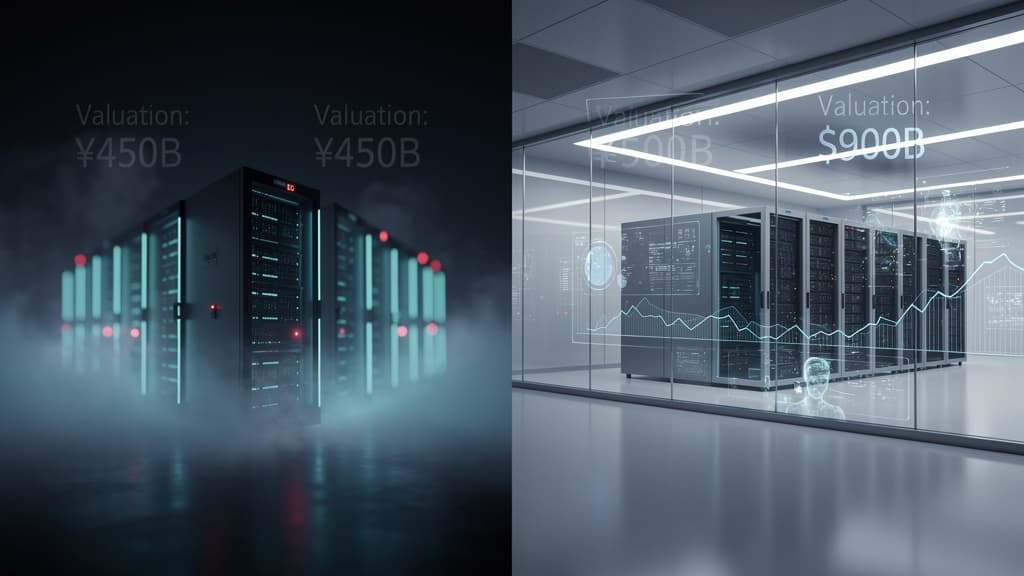
South Korea’s massive $576 billion investment in HBM production is set to reshape the global AI supply chain, challenging Nvidia's dominance by controlling the critical memory bottleneck.
South Korea has launched one of the most consequential industrial bets in modern technology history. The government, alongside Samsung and SK Hynix, has committed between $576 billion and $590 billion to build out next-generation HBM (High Bandwidth Memory) fabs and AI data center infrastructure — a move that directly challenges the Nvidia-centric model that has defined AI hardware supply chains since 2022.
The announcement, reported across AI Business, TechCrunch, and The Decoder, signals that South Korea is moving aggressively to convert its existing memory dominance into systemic leverage over the global AI infrastructure stack.
Why HBM Is the Chokepoint Nobody Talks About
When analysts discuss AI infrastructure bottlenecks, the conversation almost always defaults to GPU compute — Nvidia's H100s, its Blackwell architecture, export controls. But the less-discussed constraint is memory bandwidth. Every Nvidia GPU ships with HBM stacked directly on the package. Without it, the compute is largely unusable for large-scale AI workloads.
Samsung and SK Hynix together control nearly 80% of the global HBM market. That figure alone reframes the geopolitical stakes of this investment. South Korea isn't trying to build a rival to Nvidia — it's tightening its grip on the one component Nvidia cannot manufacture itself.
Memory prices reflect this leverage in real time. HBM pricing is projected to rise 50% per quarter through 2027, driven by surging AI data center demand that is outpacing current fab capacity. The new investment is partly a response to that demand signal — and partly an effort to lock in supply relationships before hyperscalers start negotiating from a position of desperation.
The Scale of the Commitment
To put $576–590 billion in context: it exceeds the entire annual GDP of countries like Thailand or Portugal. It dwarfs the $52 billion allocated under the U.S. CHIPS and Science Act. It is, by most measures, the largest single-country industrial investment in semiconductor history.
The capital will flow into new HBM fabrication facilities, advanced packaging infrastructure, and AI-oriented data center campuses — the full vertical stack that hyperscalers need to build sovereign AI capacity. South Korea is not simply expanding memory production; it is building the physical substrate for AI at national scale.
The government's involvement matters as much as the dollar figure. State backing insulates Samsung and SK Hynix from the demand volatility that has historically plagued memory markets. It also signals that Seoul views chip infrastructure as a strategic asset on par with energy or defense — not a commercial sector to be left to market cycles.
What This Means for Nvidia's Supply Chain Position
Nvidia's current dominance rests on a three-layer stack: its GPU architecture, its CUDA software ecosystem, and its privileged relationships with memory and packaging suppliers. The South Korean investment doesn't threaten the first two layers. But it significantly reshapes the third.
As Samsung and SK Hynix scale HBM production, they gain increased negotiating leverage with every GPU vendor — including Nvidia, but also AMD, Intel, and emerging custom silicon players at Google, Amazon, and Microsoft. A more capacious HBM market could, paradoxically, accelerate the viability of non-Nvidia AI accelerators by removing the memory bottleneck that has historically constrained their performance at scale.
There is also a direct competitive implication for Nvidia's own supply security. The company sources HBM from SK Hynix and Samsung for its flagship data center GPUs. A South Korean government with explicit industrial policy ambitions is now the backstop for that supply. That's a geopolitical dependency Nvidia's customers — and the U.S. government — are unlikely to ignore.
The "Ramageddon" Pressure Behind the Announcement
TechCrunch's framing of the investment as an effort to "ease Ramageddon" — a term circulating in memory industry circles to describe a catastrophic supply crunch — points to the urgency driving this decision. AI model training and inference workloads are scaling faster than existing HBM fabs can accommodate. The gap between demand trajectory and current production capacity is not a rounding error; it is a structural constraint on how quickly the global AI build-out can proceed.
South Korea's investment is, in part, a race against that clock. New fab construction takes three to five years from groundbreaking to volume production. The companies committing capital today are betting that AI infrastructure demand in 2029 and 2030 will justify the expenditure — and given current hyperscaler capex trajectories, that bet looks conservative rather than speculative.
Silicon Sovereignty as Industrial Strategy
The broader context is a global scramble for what analysts are calling silicon sovereignty — the ability to control critical points in the semiconductor supply chain as a matter of national strategy rather than commercial convenience. The U.S. has the CHIPS Act. The EU has its own Chips Act. Taiwan's TSMC has become a geopolitical flashpoint. China is spending hundreds of billions on domestic fab capacity despite export controls.
South Korea's $576B commitment is the latest and largest move in this game. Unlike the U.S. approach, which focuses primarily on advanced logic chips (processors, GPUs), Seoul is doubling down on memory — a segment where it already holds structural dominance and where AI demand is creating a once-in-a-generation pricing and leverage opportunity.
The strategic logic is clear: if every AI data center in the world needs HBM, and South Korea controls 80% of that supply, then South Korea sits at a chokepoint in the global AI economy that is arguably more durable than any single company's software ecosystem.
What to Watch
Several near-term indicators will determine whether this investment reshapes the competitive landscape as intended:
- HBM supply timelines: Whether new fab capacity comes online fast enough to moderate the projected 50% quarterly price increases, or whether the crunch deepens before relief arrives.
- Hyperscaler response: Whether Google, Microsoft, Amazon, and Meta accelerate their own custom silicon programs specifically to reduce HBM dependency — or whether they deepen supply agreements with Samsung and SK Hynix.
- U.S.-Korea trade dynamics: Whether Washington views South Korea's HBM dominance as a strategic asset (allied supply security) or a vulnerability (single-point dependency), and how that shapes semiconductor diplomacy.
- Nvidia's packaging strategy: Whether Nvidia accelerates development of alternative memory architectures or moves to lock in long-term HBM supply contracts before new fab capacity creates a more competitive market.
The $576 billion number will generate headlines. The more important story is structural: South Korea is converting memory market share into geopolitical leverage at the exact moment when memory has become the binding constraint on global AI infrastructure. That is not a coincidence — it is a strategy.
Last reviewed: June 30, 2026