Microsoft Research's Webwright framework marks a shift from brittle click-trace browser automation to robust, inspectable code generation for AI agents.
Webwright, Microsoft Research's newly released terminal-native web agent framework, represents a fundamental architectural departure from how AI systems interact with the browser. Rather than recording and replaying click traces — the dominant paradigm that has kept web automation brittle and benchmark-capped for years — Webwright generates reusable Playwright scripts that can be inspected, modified, and re-executed across sessions. The result: a jump from a base GPT-5.4 score of 33.5% to 60.1% on the long-horizon Odysseys benchmark, and 86.7% on Online-Mind2Web, both new open-sourced baselines for the field.
For practitioners building on an ai agent workflow automation platform, this is not an incremental improvement. It is a rethinking of what browser automation agents should actually produce.
The Core Problem With Click-Trace Automation
Most browser automation agents — from early RPA tools to more recent LLM-powered systems — operate by observing the DOM, deciding on a next action (click, type, scroll), executing it, and repeating. The agent's "memory" of what it did lives in a log of discrete actions. When the workflow needs to be repeated, the agent starts from scratch. When the page layout shifts slightly, the recorded action sequence breaks.
This architecture has a ceiling. On long-horizon benchmarks like Odysseys — which require agents to complete multi-step tasks across real websites, with branching decision points and delayed feedback — the click-trace model accumulates errors. Each step is a fresh inference call with no structural guarantee that the prior step's output is still valid by the time the next one executes.
Base GPT-5.4 scores 33.5% on the Odysseys benchmark. Webwright, using the same underlying model, reaches 60.1% — a 79% relative improvement driven entirely by architectural changes, not model scale.
The brittleness is not a model capability problem. It is a representation problem.
What Webwright Does Differently
Terminal-Native, Script-First Architecture
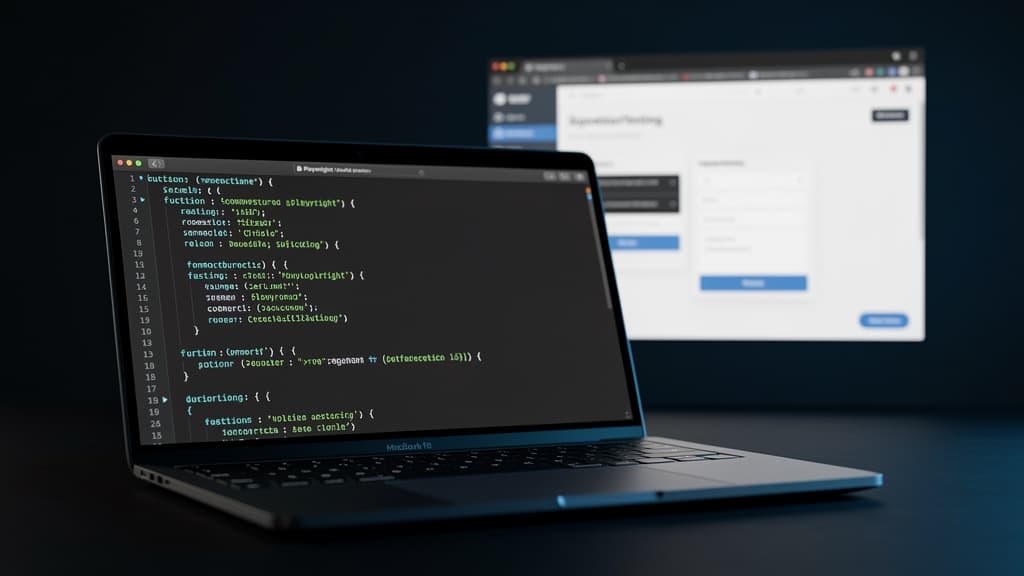
Webwright is built to run in a terminal environment and outputs Playwright scripts as its primary artifact. Instead of emitting a sequence of action tokens that get consumed by a browser controller, the agent writes executable Python (or TypeScript) code using the Playwright API. This means:
- The automation is inspectable. Engineers can read the generated script, understand what it does, and modify it before or after execution.
- The automation is reusable. A script generated for a login-and-search workflow can be parameterized and re-run without re-invoking the LLM.
- The automation is debuggable. When a script fails, the failure surface is a standard code error, not an opaque action-sequence divergence.
The framework itself is deliberately lean — approximately 1,000 lines of code according to Microsoft Research's release. This is a meaningful design signal. Webwright is not a heavyweight orchestration platform; it is a tight loop between an LLM planner, a code-generation layer, and a Playwright execution runtime.
The Planning-Execution Loop
Webwright's architecture separates task planning from script generation. The agent first decomposes a high-level task ("book a flight from Seattle to Tokyo departing June 15") into a structured plan, then generates Playwright code for each sub-task. This two-stage approach has several implications for reliability:
Error localization: When a sub-task script fails, the agent can regenerate just that segment rather than restarting the entire workflow. This is critical for long-horizon tasks where early steps may have already produced side effects (filled forms, navigated to authenticated pages) that would be expensive to redo.
State persistence: Because scripts are code artifacts, intermediate state can be captured explicitly — saved cookies, extracted data, intermediate variables — rather than being inferred from DOM snapshots at each step.
Composability: Sub-task scripts can be combined, reordered, or swapped. A workflow that shares steps with another task can reuse the relevant script segments.
Benchmark Analysis: What the Numbers Actually Mean
Odysseys: The Long-Horizon Test
Odysseys is specifically designed to stress-test agents on tasks that require sustained coherence across many steps and real websites. A 60.1% score is notable not just for its absolute value but for what it reveals about the architecture's scaling behavior.
The 79% relative improvement over base GPT-5.4 (33.5% → 60.1%) occurs without any change to the underlying model. This isolates the contribution of the script-generation paradigm: the model's raw capability is the same, but its ability to complete long-horizon tasks nearly doubles when it is scaffolded to produce structured, executable code rather than action sequences.
The gap between 33.5% and 60.1% is the measurable cost of click-trace architecture on long-horizon web tasks — a cost that Webwright's design eliminates through code generation rather than model scaling.
This has direct implications for teams evaluating AI agent workflow automation platforms. Investing in a better underlying model while keeping a click-trace execution layer may yield diminishing returns compared to architectural changes that improve task coherence.
Online-Mind2Web: Breadth at 86.7%
Online-Mind2Web tests agents across a wider distribution of web tasks, including shorter workflows and more diverse website types. Webwright's 86.7% score here suggests the script-generation approach generalizes well — it does not sacrifice breadth for long-horizon depth.
The Online-Mind2Web benchmark is closer to the distribution of tasks that real enterprise automation workflows encounter: navigating SaaS dashboards, extracting structured data from web tables, submitting forms across multi-page flows. An 86.7% success rate in this setting is operationally relevant.
The Open-Source Angle and What It Signals
Microsoft Research releasing Webwright as an open-sourced baseline is a deliberate move. It establishes a reproducible reference point for the field — teams building web agents can now benchmark against Webwright's architecture rather than proprietary systems whose internals are opaque.
The ~1,000-line codebase is also an invitation. A framework this compact can be forked, extended, and integrated into existing pipelines without the overhead of adopting a full platform. For teams already using Playwright for testing or automation, Webwright's output is natively compatible — the generated scripts drop directly into existing Playwright infrastructure.
This positions Webwright less as a finished product and more as a reference architecture: a proof that the script-generation paradigm works at benchmark scale, implemented minimally enough that practitioners can adapt it to their specific constraints.
Practical Implications for Automation Engineers
When to Consider This Approach
Webwright's architecture is most compelling for:
- Long-horizon enterprise workflows — multi-step processes across authenticated SaaS applications where click-trace agents consistently fail at step 8 of a 12-step task.
- Workflows that repeat with parameter variation — booking, data extraction, form submission pipelines where the script structure is stable but inputs change. Generated Playwright scripts can be parameterized and re-run cheaply.
- Teams with existing Playwright infrastructure — the output format is immediately compatible with existing test suites, CI/CD pipelines, and monitoring tooling.
Where Friction Remains
Script generation is not a universal solution. Dynamic, heavily JavaScript-rendered pages can produce Playwright selectors that are fragile in ways that differ from click-trace fragility — instead of action sequences breaking, selectors break. Webwright's approach shifts the failure mode rather than eliminating it entirely.
Long-horizon tasks that require genuine real-time adaptation — responding to CAPTCHA challenges, handling unexpected modal dialogs, navigating sites that A/B test their UI aggressively — still require fallback mechanisms that go beyond static script execution.
The 60.1% Odysseys score, while a significant improvement, also means that roughly 40% of long-horizon tasks still fail. The benchmark ceiling for this class of problem remains well below production-grade reliability thresholds for many enterprise use cases.
The Broader Shift in Web Agent Design
Webwright is part of a broader convergence in AI agent design toward code-as-action paradigms. Systems like OpenAI's Operator, Anthropic's Computer Use, and various open-source browser agents have experimented with different points on the spectrum between pure action-token generation and full code synthesis. Webwright's contribution is demonstrating that committing fully to the code-synthesis end of that spectrum — with a minimal, auditable implementation — produces measurable benchmark gains.
The terminal-native framing is also significant. By positioning Webwright as a CLI tool rather than a GUI-first product, Microsoft Research signals that the primary user is an engineer integrating web automation into a larger pipeline, not an end user clicking through a no-code interface. This is the right abstraction layer for the practitioners who will actually deploy these systems at scale.
For teams evaluating their ai agent workflow automation platform strategy in 2026, Webwright's architecture offers a concrete data point: the representation of browser actions matters as much as the model generating them. The path to reliable long-horizon web automation runs through code generation, not click traces.
Source: Microsoft Research Releases Webwright, a Terminal-Native Web Agent Framework That Scores 60.1% on Odysseys — MarkTechPost, May 24, 2026
Last reviewed: May 25, 2026