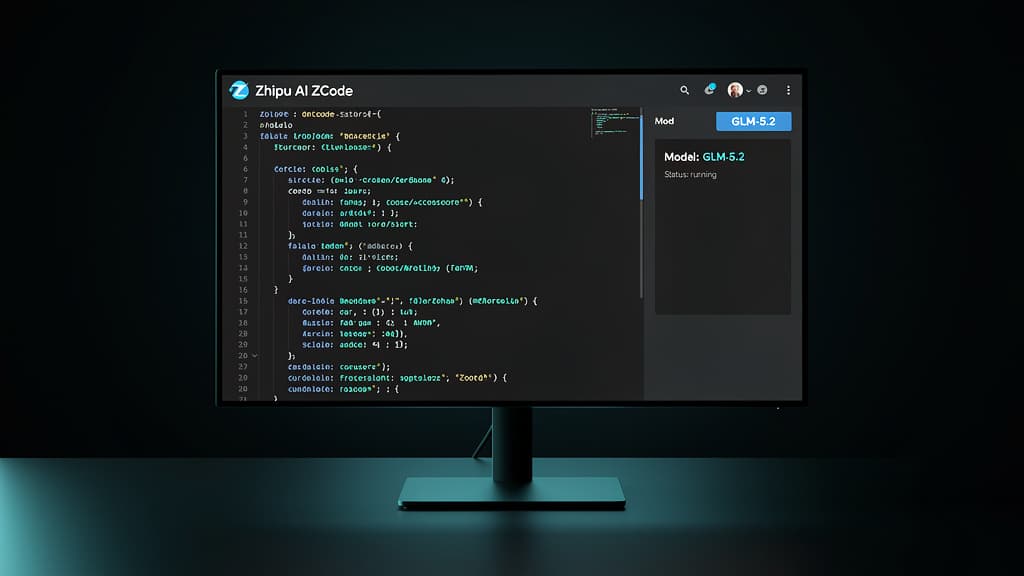
Zhipu AI has launched ZCode, a new development environment powered by GLM-5.2, directly challenging Claude Code and OpenAI Codex with superior pricing and massive token quotas for enterprise teams.
Chinese AI lab Zhipu AI has launched ZCode, a new AI-assisted development environment powered by its latest GLM-5.2 long-context coding model, positioning the offering as a direct challenger to Claude Code and OpenAI Codex — at a fraction of the price. The move is sending ripples through the enterprise developer tooling market, where pricing pressure and token economics have become as decisive as raw model performance.
Here are the three reasons ZCode is forcing established players to take notice.
1. Pricing That Undercuts the Competition
Zhipu AI's most aggressive weapon is cost. According to reporting from The Decoder, ZCode is being offered at a fraction of what enterprises currently pay for comparable coding assistants from Anthropic and OpenAI. For ai tools for enterprise productivity, budget constraints are a recurring friction point — particularly for mid-market companies running large development teams at scale.
Claude Code and OpenAI Codex both carry premium pricing tiers that can become significant line items as usage scales. Zhipu AI's decision to undercut those rates meaningfully isn't a marginal discount — it's a structural pricing challenge designed to make switching economics compelling for cost-conscious engineering organizations.
This mirrors a broader pattern emerging from Chinese AI labs in 2025 and 2026: compete on capability parity first, then weaponize price to accelerate adoption. DeepSeek executed a version of this playbook earlier; Zhipu AI appears to be applying the same logic specifically to the developer tooling vertical.
2. A 5-Million-Token Daily Quota That Changes the Math for Enterprise Teams
Beyond sticker price, Zhipu AI is competing on token economics. New customers receive five-day free trials with up to 5 million tokens per day — a quota that dramatically lowers the barrier to evaluating GLM-5.2 on real enterprise workloads.
For context, 5 million tokens per day is enough to process and reason over very large codebases, multi-file refactoring tasks, or extended agentic coding sessions without hitting hard limits mid-workflow. Token caps are a persistent pain point in enterprise deployments of coding assistants; running out of context mid-task forces developers to restart sessions, re-inject context, and absorb productivity losses that compound across teams.
New customers receive five-day free trials with up to 5 million tokens per day, with subscribers receiving a 1.5x token quota boost through July 2026.
That 1.5x token quota multiplier for subscribers — active through July 2026 — is a calculated move to accelerate paid conversion during the trial window. It creates a direct incentive: teams that find value during the free trial can immediately unlock 50% more capacity by subscribing, reducing the friction between evaluation and commitment.
For enterprise procurement teams evaluating ai tools for enterprise productivity, generous token quotas during trials allow realistic load testing rather than synthetic benchmarks — a meaningful advantage in the sales cycle.
3. ZCode as an Integrated Development Environment, Not Just a Model API
Perhaps the most strategically significant aspect of the launch is that Zhipu AI isn't just releasing GLM-5.2 as a model endpoint. ZCode is a purpose-built development environment, positioning Zhipu AI to compete at the product layer rather than just the infrastructure layer.
This matters because Claude Code and OpenAI Codex have both moved in the direction of integrated, agentic coding experiences — not raw API access. By launching ZCode as an environment, Zhipu AI is signaling that it intends to compete for developer mindshare at the workflow level, where stickiness is highest and switching costs accumulate.
GLM-5.2's long-context capabilities are central to this positioning. Long-context coding models can hold more of a codebase in working memory simultaneously, enabling more coherent multi-file edits, better dependency awareness, and more reliable agentic task execution. These are precisely the capabilities enterprise development teams need when deploying AI assistants on production-grade repositories rather than toy projects.
What This Means for the Market
Zhipu AI's ZCode launch is the latest evidence that the AI developer tooling market is entering a phase of aggressive commoditization. The combination of steep discounts, high token quotas, and a full-stack environment offering creates a credible alternative for enterprises that have been evaluating but not yet committing to Claude Code or OpenAI Codex.
Established players will likely respond on one or more fronts: further pricing adjustments, expanded free tiers, or accelerated feature development to widen the capability gap. For enterprise buyers, the near-term effect is increased negotiating leverage and more options worth evaluating seriously.
The longer-term question is whether GLM-5.2's coding performance holds up under enterprise workloads at scale — benchmarks and controlled demos are one thing, but production reliability across diverse codebases is where developer trust is actually built or lost. That verdict will take months of real-world deployment to emerge.
For now, Zhipu AI has done enough to ensure it's on the shortlist.
Sources:
- The Decoder: Zhipu AI launches ZCode to challenge Claude Code and OpenAI Codex at a fraction of the cost
Last reviewed: July 07, 2026